What Is Horse Racing Called?
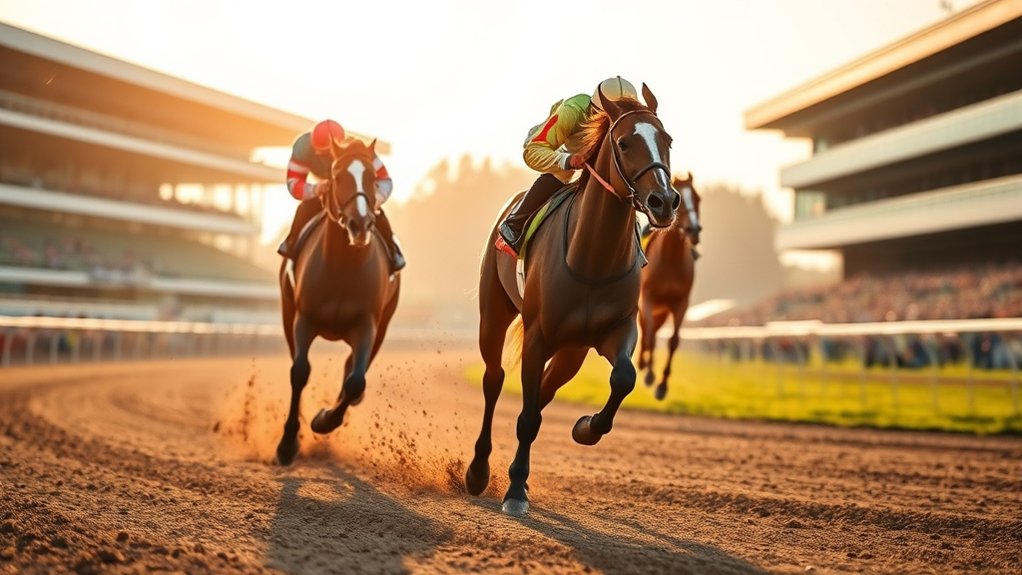
You call it horse racing, but depending on where you are, it might also be known as the “Sport of Kings” in the UK, “course hippique” in France, or “Keiba” in Japan. The names often reflect local traditions and the breeds involved, like Thoroughbred, Quarter Horse sprints, or National Hunt jump races.
Each title captures unique aspects of this thrilling sport, and exploring these terms shows just how rich and varied horse racing really is.
What Is Horse Racing And Why Is It Called That?
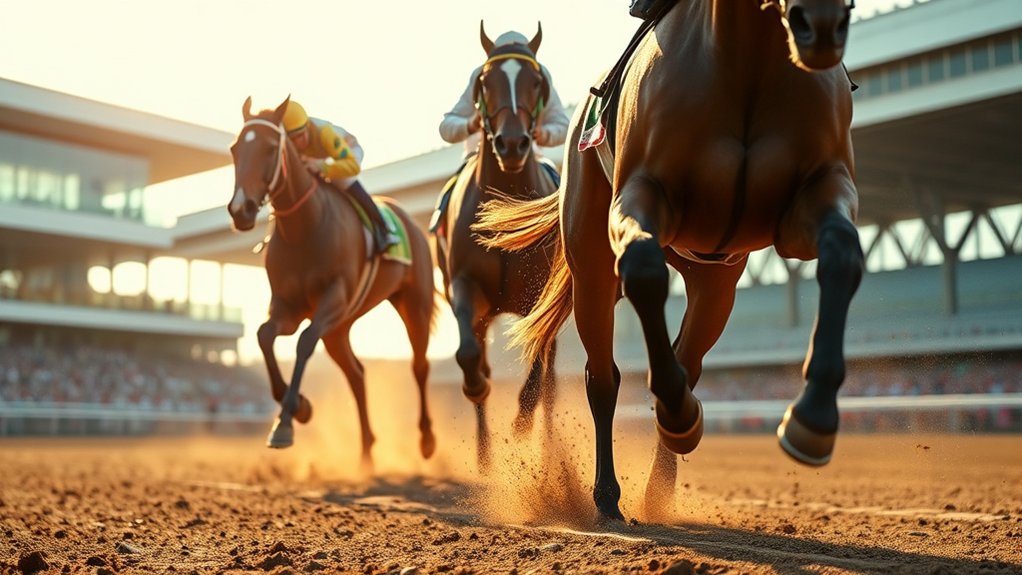
Although horse racing has evolved over centuries, the essence remains the same: horses competing in speed and stamina across a set course.
Horse racing endures as a timeless contest of speed and stamina across a defined course.
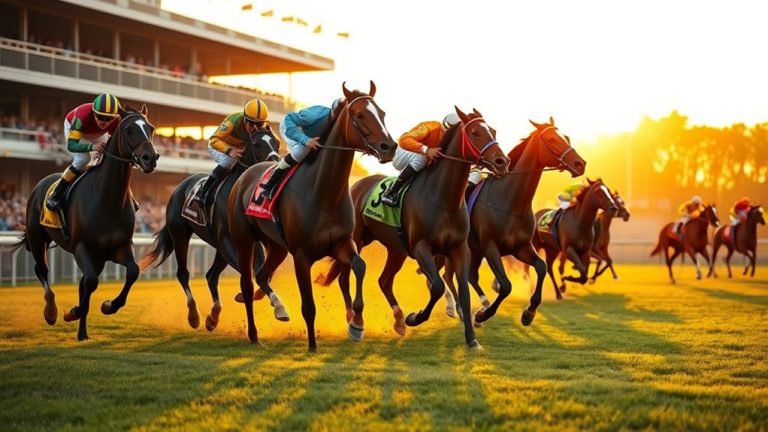
When you watch horse racing, you’re witnessing the “Sport of Kings,” a title earned through its deep ties to royalty and aristocracy.
This sport centers on racing horses on a track, testing their agility and endurance in fierce competition.
Betting adds excitement, making every race a thrilling gamble on raw athleticism.
The term “horse racing” perfectly describes this pursuit.
Horses battle head-to-head to cover distance fastest.
Rooted in ancient civilizations like Greece and Rome, the sport’s name highlights what truly matters: the incredible speed and stamina horses display as they race to victory, a timeless spectacle you can still enjoy today.
What Are The Different Names For Horse Racing Worldwide?
You’ll notice horse racing goes by many different names depending on where you’re and what breed is racing. For example, in the UK, it’s often called the “Sport of Kings.”
Over in France, they refer to it as “course hippique.” Each term really reflects rich traditions and regional pride.
Regional Race Terminology
When you explore horse racing around the world, you’ll find that the sport takes on unique names reflecting local traditions and racing styles. Regional terminology varies widely, with flat racing and National Hunt racing distinguishing race types in the UK and Ireland.
In France, harness racing is called Le Trot, featuring Standardbreds pulling sulkies at specific gaits.
Across the globe, the term Derby often highlights prestigious Thoroughbred racing events, especially in the UK and Australia.
In Japan, horse racing is known as Keiba, covering both flat and jump disciplines.
Meanwhile, North America broadly uses horse racing but specifies Thoroughbred racing and harness racing to differentiate formats.
Understanding these regional terms enriches your appreciation of the sport’s global diversity and heritage.
Breed-Specific Race Names
How do different horse breeds shape the names of racing events worldwide? Breed-specific race names directly reflect the unique qualities of race breeds and race types.
When you hear “Thoroughbred racing,” you know it involves sleek, fast horses competing primarily in the US and UK.
Harness racing features Standardbreds pulling sulkies at a trot or pace, common in North America and Scandinavia.
Jump racing, or National Hunt, challenges horses to clear fences and hurdles. It’s popular in the UK, Ireland, and France.
Arabian racing highlights the endurance and speed of Arabian horses, especially in Middle Eastern countries.
In the US, Quarter Horse racing focuses on short, explosive sprints.
Understanding these breed-specific race names helps you grasp the diversity and regional terminology that define the thrilling world of horse racing.
Traditional and Cultural Titles
Across the globe, horse racing carries a variety of traditional and cultural titles that reveal its deep-rooted significance in different societies. In Britain, you’ll hear it called the “Sport of Kings,” reflecting its royal and aristocratic heritage.
France embraces the term “Courses hippiques,” emphasizing its rich equestrian tradition. When you explore the United States, “horse racing” is common, but iconic events are known as “Derbies” or “Classic Races.”
In Ireland and the UK, the sport divides into “flat racing” and “jump racing,” the latter also known as “National Hunt.”
Globally, “thoroughbred racing” highlights the breed central to the sport.
These cultural titles and horse racing traditions show how the sport resonates uniquely across regions, honoring both heritage and competitive spirit.
How Horse Breeds Shape Different Types Of Racing
Although horse racing might seem uniform at first glance, the breed of the horse plays a crucial role in shaping the type of race it excels in. Different racing breeds have distinct breed characteristics that suit specific racing styles:
- Thoroughbreds dominate flat racing with their blend of speed and stamina. They’re bred for middle to long distances.
- Quarter Horses specialize in sprint races thanks to powerful hind limbs and fast-twitch muscle fibers.
- Arabians thrive in endurance racing. They excel over long distances due to exceptional stamina and efficient muscle composition.
- Standardbreds are tailored for harness racing, combining speed and endurance with unique pacing or trotting gaits.
Understanding these breed differences helps you appreciate how horse genetics shape the thrilling variety within horse racing.
What Is Thoroughbred Racing And How Is It Different?
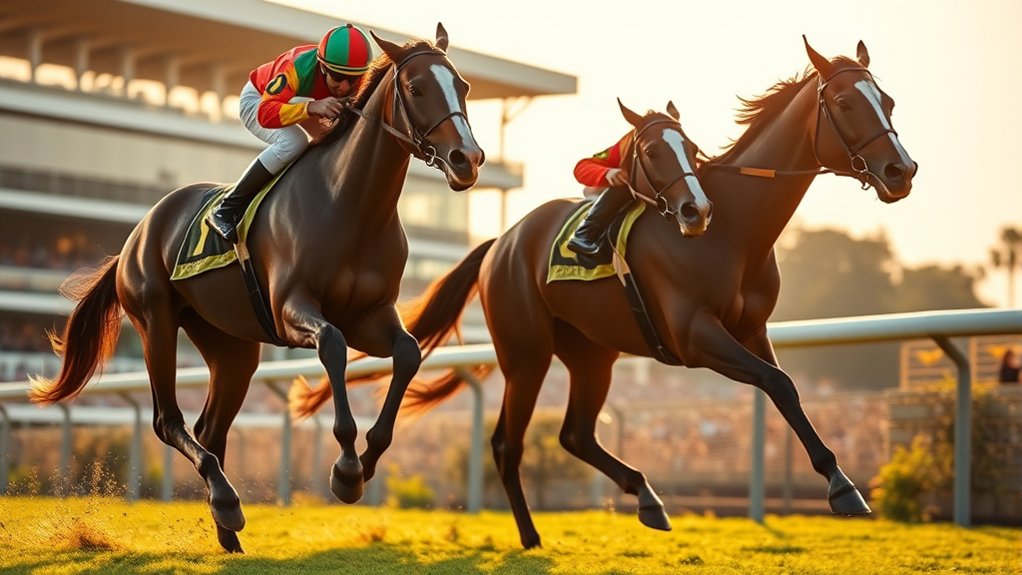
You’ll find that Thoroughbred racing focuses on a specific breed known for its speed, stamina, and agility. These horses mainly compete in flat races that range from 5 furlongs to 2 miles.
The races follow strict formats and rules, all regulated by organizations that ensure pedigree and performance standards are met.
Once you get the hang of these basics, you’ll see how Thoroughbred racing really stands out in the world of horse racing.
Thoroughbred Racing Basics
When you watch a Thoroughbred race, you’re witnessing a unique blend of speed, strategy, and heritage that sets this sport apart from other forms of horse racing. Thoroughbred racing is a type of flat racing held on oval race tracks, featuring specially bred horses renowned for their pedigree and stamina. Here’s what makes it distinct:
- Racing distances vary, typically from 5 furlongs up to 2 miles, demanding both speed and endurance.
- Jockeys play a vital role, balancing pace and position to navigate the race track effectively.
- Breeding standards focus on lineage, aiming to produce elite athletes for iconic races like the Kentucky Derby.
- This sport honors a rich history, with Thoroughbreds tracing back to three foundational Arabian stallions.
Understanding these basics deepens your appreciation of this thrilling horse racing tradition.
Breed Characteristics
Since Thoroughbred racing centers exclusively on the Thoroughbred breed, understanding their unique characteristics is key to appreciating this sport’s distinction. This breed combines impressive speed and stamina, thanks to a physical build optimized for racing.
Their long legs, lean bodies, and high withers enable rapid acceleration. This is supported by a high proportion of fast-twitch muscle fibers. Pedigree matters deeply in Thoroughbred racing; their lineage traces back to three foundation sires, ensuring purity and elite performance.
| Characteristic | Description | Impact on Racing |
|---|---|---|
| Physical Build | Long legs, lean, high withers | Enhances speed and stride |
| Muscle Fibers | Mostly fast-twitch fibers | Enables quick bursts |
| Pedigree | Traced to foundational sires | Ensures breed purity |
| Lineage | Meticulously recorded | Maintains racing standards |
Race Formats and Rules
Although Thoroughbred racing shares the excitement of other equestrian sports, it stands apart through its unique race formats and strict rules. You’ll find Thoroughbred races focus on flat races, where jockeys ride horses at a gallop without obstacles. Here’s what sets it apart:
- Race distances vary from 5 furlongs to 1 1/2 miles, demanding speed and stamina.
- Race courses are strictly regulated, with detailed race rules ensuring fairness.
- Race types include sprints and longer routes, each testing different abilities.
- Race results rely on who crosses the finish line first, often requiring a photo finish for ties.
Race regulations also cover weight allowances, starting procedures, and drug testing, making Thoroughbred racing a precise, thrilling sport you can truly appreciate.
How Did Quarter-Horse Racing Get Its Name?
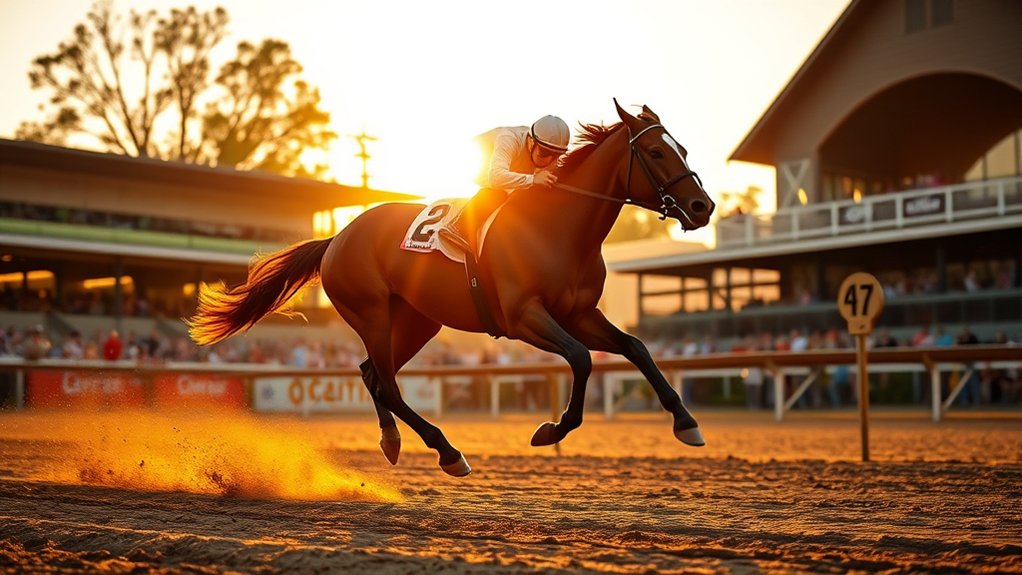
Because of their unmatched speed over short distances, Quarter Horses earned their name from the quarter-mile races in which they excelled. This breed’s explosive speed made it the star of American races, especially in the Southern states during the 19th century.
The racing development focused on these short-distance sprints, solidifying the Quarter Horse’s reputation. By 1940, the breed recognition formalized the name, linking it forever to the thrilling quarter-mile race.
| Feature | Description | Significance |
|---|---|---|
| Breed | Quarter Horse | Known for explosive speed |
| Race Distance | Quarter-mile race | Short-distance specialty |
| Origin | Southern states, USA | Birthplace of racing style |
| Recognition Year | 1940 | Official breed acknowledgment |
What Makes Harness Racing Unique In Name And Style?
When you watch harness racing, you’ll notice it stands apart from other horse races by the unique way horses pull a lightweight two-wheeled cart called a sulky. The horses are guided by a driver rather than ridden by a jockey.
Harness racing features horses pulling lightweight sulkies, guided by drivers instead of jockeys—a truly unique racing style.
This racing style uses Standardbred horses, known for excelling at maintaining specific gaits.
What makes harness racing unique?
- Horses must trot or pace consistently without breaking gait.
- Drivers skillfully control pace and strategy from the sulky.
- Disqualification occurs instantly if a horse breaks its gait.
- The focus is on precision, timing, and maintaining speed while pulling the sulky.
Harness racing demands a blend of athleticism and driver expertise, creating a thrilling and distinct sport unlike any other horse racing style.
Why Is Jump Racing Also Called National Hunt Racing?
Harness racing showcases a unique style where horses pull a sulky, but jump racing takes you into a different world of equestrian challenge.
Jump racing is also called National Hunt racing because it originated in Ireland and the UK, where “Hunt” links directly to fox hunting traditions.
This racing discipline involves horses leaping over obstacles like fences and hurdles, distinguishing it clearly from flat racing.
The term “National Hunt” reflects the sport’s rural roots and its historical ties to amateur hunting clubs in the 18th and 19th centuries, who organized races over natural terrain.
Today, when you hear National Hunt in the UK or Ireland, you’re tapping into a rich legacy, blending the thrill of jump racing with centuries of outdoor pursuit and cultural heritage.
What Is Saddle Trot Racing? Popular Regions Explained
Although it shares similarities with traditional harness racing, saddle trot racing stands out by having horses ridden under saddle rather than pulling a sulky. This unique format demands exceptional rider skill and horse stamina, as the Standardbred trotters must maintain the trot gait throughout the race on flat tracks.
You’ll find saddle trot racing especially popular in Europe and New Zealand, where it’s celebrated as a traditional equestrian sport.
Here’s what you should know about saddle trot racing:
- It features trotters bred for the trot gait, with disqualification if the gait breaks.
- Races take place on flat, oval tracks similar to harness racing.
- The rider’s ability to control the horse under saddle is indispensable.
- Horse stamina plays an essential role in race endurance and success.
How Does Endurance Racing Fit Into The Horse Racing Family?
Since endurance racing challenges horses to cover distances from 25 to over 100 miles across rugged terrain, it holds a unique but essential place in the horse racing family. You’ll see that endurance racing tests stamina and resilience like no other. It requires horses to handle intense physical exertion over long-distance routes on natural terrain.
This discipline demands specialized training and often unfolds as multi-day events, evaluating both performance and recovery.
| Aspect | Focus | Example |
|---|---|---|
| Distance | Long-distance | 25 to 100+ miles |
| Terrain | Natural terrain | Mountains, deserts |
| Training | Specialized training | Conditioning, rest |
| Event Type | Multi-day events | Tevis Cup, Mongol Derby |
Endurance racing truly embodies the spirit of horse racing’s endurance and durability.
How Do Race Types Influence What Horse Racing Is Called?
When you explore different horse racing disciplines, you’ll notice the race type shapes what the sport is called. Each race type highlights unique features that define the experience and terminology:
- Flat racing occurs on level surfaces without obstacles, focusing on speed over short distances.
- Jump racing involves clearing fences and hurdles, emphasizing skill in navigating obstacles.
- Harness racing features horses pulling sulkies at specific gaits like trot or pace, showcasing controlled movement.
- Endurance racing tests stamina and survival across long distances on natural terrain.
Understanding these race types helps you appreciate why horse racing has varied names. The presence of obstacles, the gait of the horse, and the race’s length all influence whether you call it flat, jump, harness, or endurance racing.
Frequently Asked Questions
How Are Horse Racing Events Typically Timed and Scored?
You rely on precise electronic timers and photo finish cameras to time and score horse races accurately, considering race distances and track conditions.
Jockey roles and horse breeds influence race strategies, impacting your betting odds and prize money outcomes.
Understanding training techniques and historical origins helps you appreciate how these elements shape each race’s timing and results, ensuring fair scoring and thrilling competition every time you watch or bet.
What Safety Measures Are in Place for Horses and Jockeys?
You’ll be surprised to know that over 95% of racing injuries are preventable thanks to strict safety measures. Equine welfare is prioritized with thorough veterinary checks and horse hydration protocols.
Jockey safety is guaranteed through equipment standards and training regulations. Race track conditions undergo constant monitoring, plus emergency protocols are always ready.
Breeding practices also focus on durability. These combined efforts protect both horses and jockeys every race day.
How Do Betting Systems Work in Horse Racing?
Betting systems in horse racing use betting odds to reflect each horse’s chance of winning. You’ll find wager types like win, place, show, and exotic bets in diverse betting markets.
Pari-mutuel betting pools all wagers and calculates payouts after fees.
Betting exchanges let you bet against others with dynamic odds calculation.
Smart betting strategies help you navigate payout structures and betting regulations, maximizing your chances while managing risk.
What Are the Common Injuries in Horse Racing?
You’ll often see horse injury from fractures, tendon tears, and joint inflammation caused by intense track conditions and race accidents.
Jockey safety is critical, as concussion risks rise during falls.
Injury prevention relies on vigilant veterinary care and strict recovery protocols to protect equine health.
How Is Horse Racing Regulated Internationally?
When you watch the Dubai World Cup, you see international regulations in action. Racing authorities from various countries collaborate under global standards set by regulatory bodies like the IFHA.
They enforce licensing procedures, anti-doping policies, and breeding regulations to guarantee fairness and equine welfare. Certification processes verify compliance, keeping the sport safe and credible.
Conclusion
Now that you’ve galloped through the vibrant world of horse racing, you see it’s more than just a race. It’s a dance of breeds, traditions, and thrilling challenges.
From the sleek Thoroughbred’s swift ballet to the rugged jumpers’ daring leaps, each name carries a story and a rhythm.
So, next time you hear “National Hunt” or “Quarter-Horse,” you’re stepping into a grand tapestry where passion meets purpose and history rides alongside the future.