What Is Ring Bone In A Horse – Simple Breakdown
Ringbone in a horse is abnormal bone growth around the pastern or coffin joints. It’s caused by inflammation and joint stress. This condition develops when your horse’s body tries to stabilize injured or overloaded joints.
This process leads to stiffness, pain, and reduced mobility. Risks include poor hoof conformation, repetitive activities, and trauma. Early signs are subtle lameness and swelling.
Accurate diagnosis and management are key to keeping your horse comfortable. You’ll find detailed insights on causes, types, treatment, and prevention ahead.
What Is Ringbone And How Does It Develop In Horses?
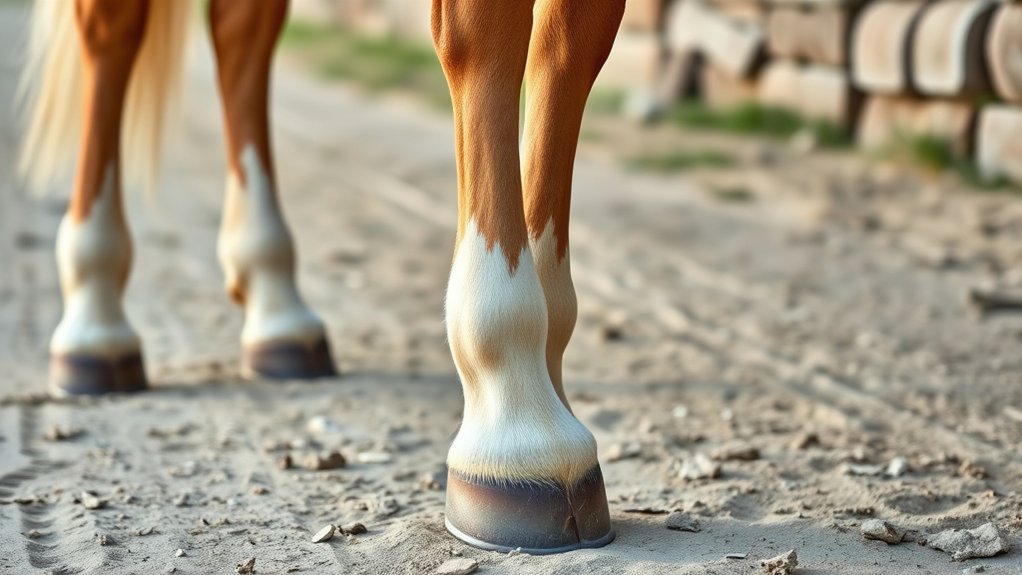
Although you mightn’t notice it immediately, ringbone begins as a bony growth around the pastern or coffin joints caused by inflammation and joint degeneration. Your horse’s body responds to joint stress or injury by depositing extra bone to stabilize the affected joint.
Ringbone starts as extra bone growth around joints, a response to inflammation and stress in your horse’s pastern or coffin bones.
Activities involving repetitive stress, such as jumping or racing, accelerate ringbone development.
Additionally, poor conformation, like upright pasterns or a toed-in stance, raises the risk by increasing joint strain.
Early signs include subtle lameness and localized swelling, which you might overlook initially.
Definitive diagnosis depends on radiographs that reveal new bone formation around the joint margins.
Understanding these mechanisms helps you recognize how mechanical stress and anatomical factors combine to initiate ringbone. This way, you can enable timely intervention before more severe joint damage occurs.
Understanding High Vs. Low Ringbone
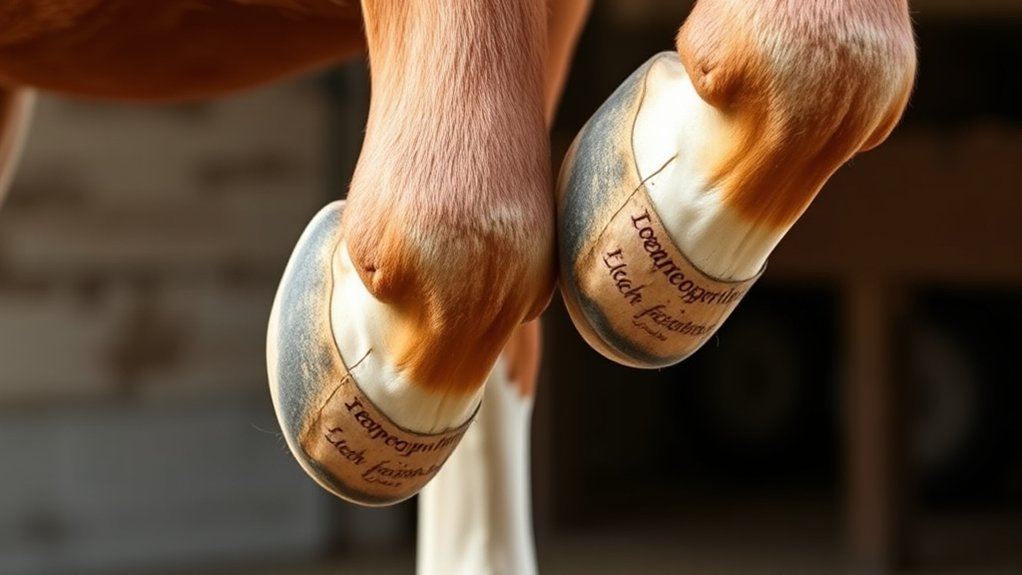
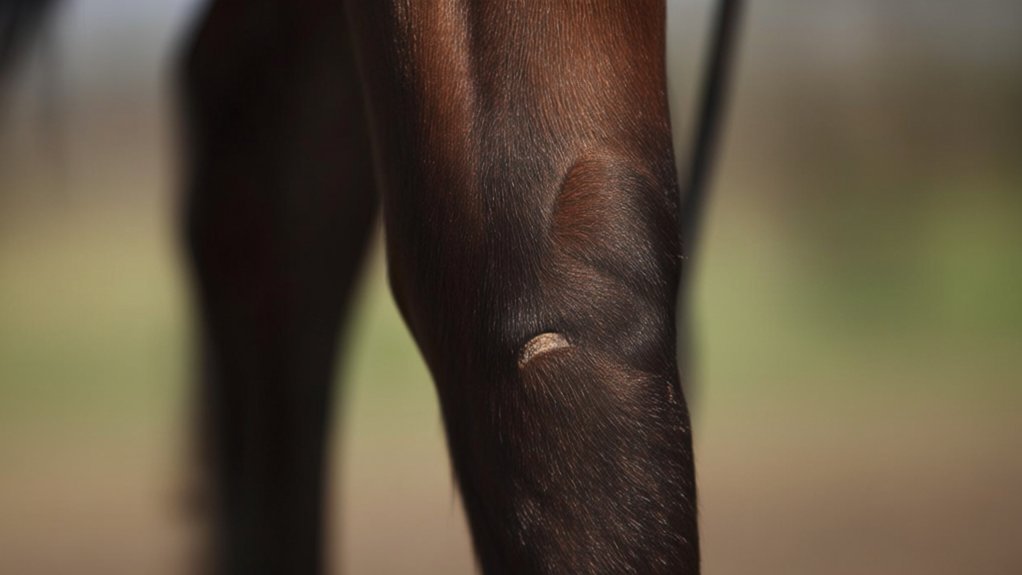
You’ll find that high ringbone affects the pastern joint, which is the area between the short and long pastern bones. It often shows up as a noticeable bump right above the hoof.
On the other hand, low ringbone targets the coffin joint, which is tucked inside the hoof capsule. Because of this, it’s much harder to spot without using radiographs.
Knowing where each type occurs really helps make sense of the different joints involved and the signs you might see.
Location Differences Explained
When you examine ringbone closely, you’ll find that its classification as high or low depends on the specific joint affected. High ringbone impacts the pastern joint, situated between the long and short pastern bones just above the hoof.
Low ringbone affects the coffin joint, located between the short pastern bone and coffin bone inside the hoof.
This distinction influences clinical signs and treatment approaches. It’s important to know which joint is involved because it changes what you might see and how you manage it.
Consider these location differences:
- High ringbone produces a palpable bony bump above the coronary band.
- Low ringbone is often less externally visible.
- Both result from joint degeneration but involve different joints.
- Severity and type of lameness vary by location.
- Identification helps tailor diagnostic and therapeutic strategies.
Understanding these differences is vital for effective management. It really helps you get the right diagnosis and pick the best treatment plan for the horse.
Joint Impact Variations
Since high and low ringbone affect different joints within the horse’s limb, understanding their distinct impacts is vital for accurate diagnosis and treatment.
High ringbone involves the pastern joint, causing visible bony swelling above the hoof. Low ringbone affects the coffin joint inside the hoof and often shows less obvious external signs. Radiographs are essential to pinpoint the exact location of the bony growth, which helps guide treatment.
| Aspect | High Ringbone |
|---|---|
| Joint | Pastern joint |
| Visibility | Bony bump above hoof |
| Symptoms | Swelling, palpable bumps |
| Treatment Implications | External joint involvement |
Low ringbone demands a different approach because it involves internal joint pain and less obvious external evidence. So, you really have to look deeper to understand what’s going on with low ringbone.
What Causes Ringbone In Horses? Including Hoof Conformation Risks
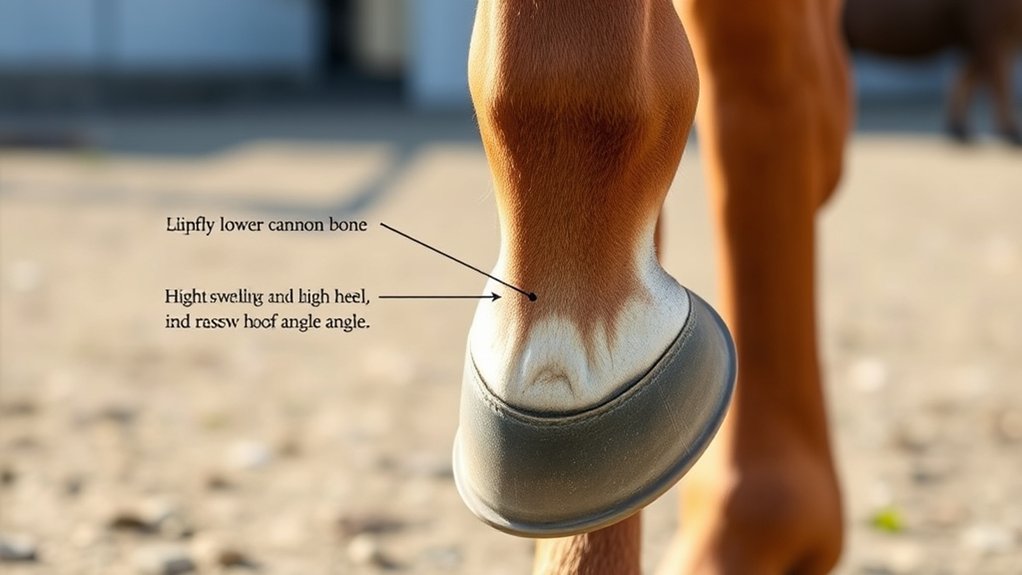
You’ll find that poor hoof conformation, like upright pasterns or low palmar angles, can really increase the risk of ringbone because it puts extra stress on the joints. When a horse has these conformational issues, the joints have to work harder than they should.
On top of that, repetitive activities like jumping or barrel racing don’t help—they cause chronic inflammation that encourages those bony growths to form.
And if a horse suffers an acute injury to the pastern or coffin joint, that trauma can set off abnormal bone growth, which leads right into ringbone developing.
Conformation-Related Risk Factors
Although multiple factors contribute to ringbone development, conformation-related risks play a significant role by increasing joint stress and abnormal loading patterns. When a horse’s limb structure deviates from ideal alignment, it alters biomechanics, concentrating strain on specific joints and encouraging bony proliferation.
You should closely evaluate hoof and limb conformation to identify potential risk factors.
Key conformation-related risk factors include:
- Upright pasterns that reduce shock absorption
- Pigeon toes causing uneven joint loading
- Small or narrow feet increasing localized stress
- Long toes with low heel angles disrupting hoof mechanics
- Poor hoof alignment and imbalanced trimming leading to abnormal pressure distribution
Addressing these issues with corrective trimming or shoeing can help mitigate joint stress and reduce the chance of ringbone development.
Impact Of Repetitive Stress
How does repetitive stress contribute to the development of ringbone in horses? Activities like jumping, barrel racing, and polo put a lot of pressure on joints and cause tiny injuries in the cartilage. This triggers inflammation and over time, leads to abnormal bony growth.
If your horse has poor hoof conformation, like upright pasterns or low palmar angles, it causes uneven pressure on the joints. This increases stress and speeds up joint degeneration.
Running or working on hard surfaces causes repeated concussion, which makes things worse. The body responds by depositing extra bone to try to stabilize these joints.
Working your horse too hard without proper hoof care adds even more stress. This encourages the bony growth that’s typical of ringbone.
Also, if your horse stands toed-in or pigeon-toed, it directs forces unevenly across the joints. This makes repetitive stress injuries even more likely.
Role Of Acute Trauma
When acute trauma strikes the pastern area, like a direct blow or sudden injury, it sets off inflammation that can lead to ringbone. This inflammation harms the cartilage, which then makes the body produce new bone to try and stabilize things.
Repeated minor injuries from activities such as jumping or racing also raise the risk of trauma. Horses with poor hoof conformation, like upright pasterns or low palmar angles, tend to be more prone to these injuries.
Sudden impacts that damage the joint surface speed up degenerative changes. This causes the bony growths that are typical of ringbone.
Key factors include:
- Direct blows causing acute inflammation
- Cartilage damage triggering bone growth
- Repetitive stress building up micro-injuries
- Hoof conformation increasing injury risk
- Joint surface damage speeding up degeneration
Early Signs And Symptoms Of Ringbone To Watch For
If you notice subtle lameness in your horse that worsens after exercise or when moving in certain directions, it could signal the early stages of ringbone. Early signs often include stiffness and a shortened stride, especially post-activity, indicating joint discomfort.
You might observe swelling or increased heat around the pastern or coffin joint before any bony protrusions form. Changes in gait, such as choppy or hesitant movement, also serve as initial indicators.
Palpable bumps or ridges are generally absent during these early phases but develop as abnormal bone growth progresses. Monitoring these symptoms closely helps you catch ringbone early, allowing for prompt management before the condition advances.
How Veterinarians Diagnose Ringbone
Recognizing early signs of ringbone prompts a veterinary examination to confirm the diagnosis and plan appropriate treatment. Your veterinarian will begin with a physical exam, palpating the joint for swelling or bony enlargements.
They’ll perform lameness evaluations, including flexion tests and nerve blocks, to pinpoint the source of pain.
Radiographs are essential to visualize bony proliferation and determine if the ringbone is high or low.
In complex or early cases, advanced imaging like ultrasound, bone scans, CT, or MRI may be necessary.
The diagnosis is finalized by correlating clinical signs with imaging results, ensuring differentiation from other lameness causes.
- Palpation for swelling or bony changes
- Lameness exams with flexion and nerve blocks
- Radiographic imaging for bone changes
- Advanced imaging in difficult cases
- Correlation of clinical and imaging findings
Non-Surgical Treatments And Corrective Shoeing For Ringbone
Although ringbone can be challenging to manage, you can effectively reduce pain and limit joint damage through non-surgical treatments combined with corrective shoeing. Administering NSAIDs helps control inflammation and alleviate discomfort.
Corrective shoeing plays an essential role. Using bar or open heel shoes supports the heel, decreasing joint stress and promoting better hoof conformation. Adjusting the breakover point rearward reduces pressure on the affected joint.
Supportive hoof pads like pour-in pads absorb shock, mitigating impact forces on the pastern or coffin joint.
Regular farrier care ensures these shoeing strategies remain effective. Additionally, joint injections and systemic medications can further manage pain and slow disease progression in mild to moderate ringbone cases.
This way, you can optimize your horse’s comfort and mobility without surgical intervention.
When And Why Fusion Surgery Is Used For Ringbone
When conservative treatments fail to alleviate severe, painful ringbone, fusion surgery offers a viable solution by eliminating joint movement that causes discomfort. This procedure fuses the affected joint, most commonly the pastern, to halt painful motion caused by bony overgrowth.
Fusion surgery aims to provide long-term relief while allowing your horse to perform light to moderate work.
Recovery requires strict management over 6 months to a year.
Key points to contemplate include:
- Recommended for severe, non-responsive ringbone cases
- Primarily targets the pastern joint; occasionally the coffin joint
- Fusion stops joint movement, reducing pain
- Recovery involves controlled activity and monitoring
- Enables preservation of some performance ability post-recovery
This surgical approach is a precise, durable option when conservative methods no longer suffice. It’s a way to help your horse feel better and keep moving, even if the usual treatments haven’t worked.
Long-Term Care Tips To Manage Ringbone Comfortably
After fusion surgery or other treatments, maintaining your horse’s comfort and joint health requires ongoing care tailored to ringbone management. Schedule regular farrier visits to adjust trimming and shoeing. This helps reduce joint stress and improves hoof conformation.
You can also use supportive shoeing techniques like bar shoes or pads. These help alleviate pain and enhance your horse’s mobility.
Keep a close eye on your horse’s weight too. Staying at a healthy weight minimizes pressure on the affected joints and can slow disease progression.
Consider adding joint supplements such as glucosamine and chondroitin. They support cartilage health and help reduce inflammation over time.
It’s also important to have a consistent, controlled exercise program designed specifically for your horse’s condition. This keeps joint function maintained without making stress worse.
Taking this all-encompassing approach will optimize your horse’s long-term comfort and functionality. It’s a great way to help your horse manage ringbone more effectively.
Preventing Ringbone Through Hoof And Joint Health
Since ringbone often results from excessive stress on the pastern and coffin joints, maintaining proper hoof balance through regular trimming and shoeing plays a crucial role in prevention. You should guarantee that your horse’s hooves are correctly balanced to reduce uneven pressure, which can accelerate joint degeneration.
Proper hoof balance through regular trimming and shoeing helps prevent joint stress and ringbone development.
Supportive footwear like bar shoes or pads absorbs impact, minimizing strain during movement.
Addressing conformation flaws such as upright pasterns or long toes will distribute weight more evenly, preventing abnormal joint stress. Additionally, keeping your horse on well-maintained, level footing decreases repetitive trauma to joints, reducing risk.
Regular farrier evaluations combined with veterinary assessments are essential for early detection and intervention to safeguard hoof and joint health.
- Schedule consistent hoof trimming and shoeing
- Use supportive shoes to absorb impact
- Correct conformation abnormalities promptly
- Provide even, stable footing environments
- Arrange routine farrier and veterinary check-ups
Managing Ringbone: What Horse Owners Need To Know
When it comes to managing ringbone, you’ll want to focus on treatment options that blend medical care with specialized farrier techniques.
Consistent farrier care—like customized hoof trimming and supportive shoeing—is really important because it helps reduce joint stress and ease the pain.
It’s a good idea to work closely with your veterinarian to make sure these adjustments fit your horse’s specific needs and how the condition is progressing.
Treatment Options Overview
Although ringbone has no cure, you can manage the condition effectively by focusing on reducing pain, slowing joint degeneration, and improving your horse’s mobility.
Treatment strategies usually combine medication, surgical options, and emerging therapies to optimize joint health and function.
Key treatment options include:
- NSAIDs and joint injections to control inflammation and pain
- Supplements like glucosamine and chondroitin to support cartilage integrity
- Surgical arthrodesis to fuse severely affected joints and eliminate pain
- Regenerative therapies such as PRP and stem cell injections to promote healing
- Farrier care (covered later) to reduce mechanical stress on joints
Farrier Care Importance
Managing ringbone effectively involves addressing not only medication and surgical options but also the mechanical factors that influence joint stress. Proper farrier care plays a vital role in reducing joint strain by optimizing hoof alignment and movement.
By supporting the heel with specialized shoeing techniques, you can decrease pressure on the pastern and coffin joints, slowing ringbone progression.
Regular trimming and shoe adjustments maintain correct hoof conformation, minimizing abnormal stresses that make the condition worse.
Farriers often use bar shoes or pour-in pads to improve comfort and joint support.
Working closely with your veterinarian and farrier helps create a hoof care plan tailored to your horse’s needs.
This kind of teamwork is essential for effective ringbone management and really helps improve your horse’s quality of life.
Frequently Asked Questions
Can Ringbone Affect a Horse’s Performance in Competitive Events?
Yes, ringbone can markedly impair your horse’s performance by causing pain, stiffness, and reduced joint mobility. This limits agility, alters gait, and decreases speed.
All of these factors ultimately impact competitive abilities and could even lead to lameness or retirement. So, it’s definitely something to watch out for if your horse is involved in any kind of competitive event.
Is Ringbone Hereditary or Passed Down Through Breeding?
You won’t get ringbone like a family heirloom chest, but conformation traits linked to it can sneak through breeding.
How Does Ringbone Impact a Horse’s Behavior or Temperament?
You’ll notice ringbone causes your horse to become irritable, resistant, and anxious due to chronic pain. It alters their temperament, making them more sensitive, easily startled, and reluctant to perform or accept handling and training.
It’s tough on them, and you can see that in how they act. They might not want to work like they used to, and even simple things can make them uneasy. This change is pretty common when they’re dealing with discomfort.
Are There Alternative Therapies Like Acupuncture for Ringbone Relief?
Like a gentle tide easing pain, acupuncture can reduce inflammation and improve mobility in horses with ringbone. You’ll want a trained veterinary acupuncturist, as effectiveness varies and it complements traditional treatments.
It’s not a magic fix, but many horse owners find it helpful alongside other care methods. Just keep in mind that results can differ from one horse to another. So, it’s always good to discuss this option with your vet before starting.
What Is the Typical Recovery Time After Ringbone Surgery?
You’ll typically see a 6 to 12-month recovery after ringbone surgery, depending on the joint and procedure extent. Strict rest, controlled exercise, and vet monitoring are essential for full healing and return to athletic activity.
It’s a slow process, but sticking to the plan really makes a difference. Your vet will guide you through each stage to help your horse get back in shape safely. Just take it one step at a time, and you’ll see progress.
Conclusion
Understanding ringbone is vital since it affects up to 15% of performance horses, often limiting their athletic potential. By recognizing early signs and causes like poor hoof conformation, you can take proactive steps.
Early diagnosis and treatments, including fusion surgery when necessary, improve outcomes considerably. Prioritizing joint health and proper hoof care helps manage discomfort and prevent progression.
Staying informed empowers you to maintain your horse’s comfort and performance over the long term.