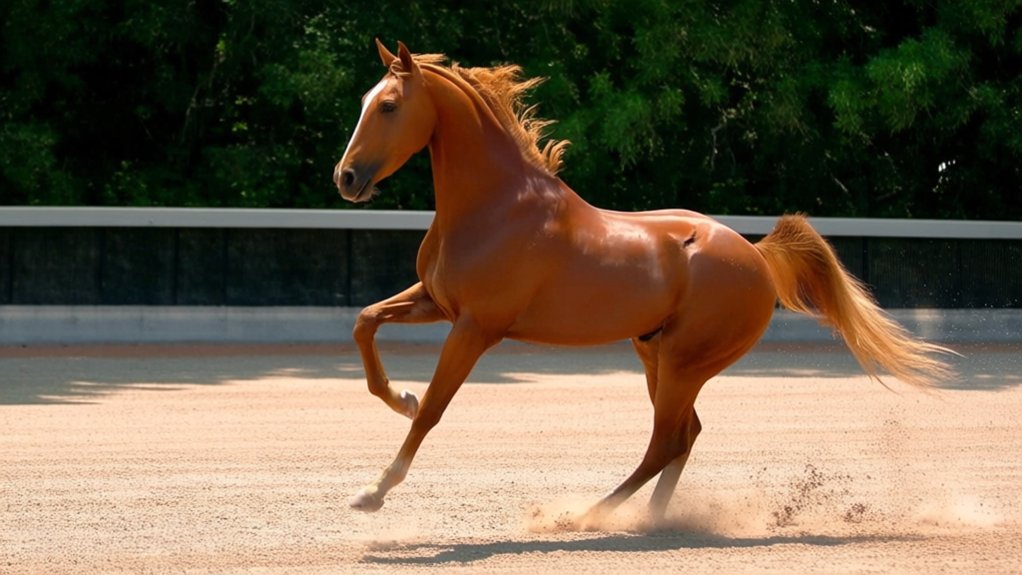
Are Tennessee Walking Horses Fast – What Science Says
You won’t find Tennessee Walking Horses winning sprints, as their speeds peak around 20 mph in the running walk. They prioritize smoothness and endurance over raw speed.
Their unique four-beat gaits reduce joint impact and conserve energy, making them comfortable for long distances rather than rapid bursts. Genetics contribute to their natural gait efficiency. Artificial enhancements, on the other hand, compromise speed.
When you understand these factors, it’s clear why their appeal lies in stamina and comfort rather than racing performance.
How Fast Do Tennessee Walking Horses Typically Move?
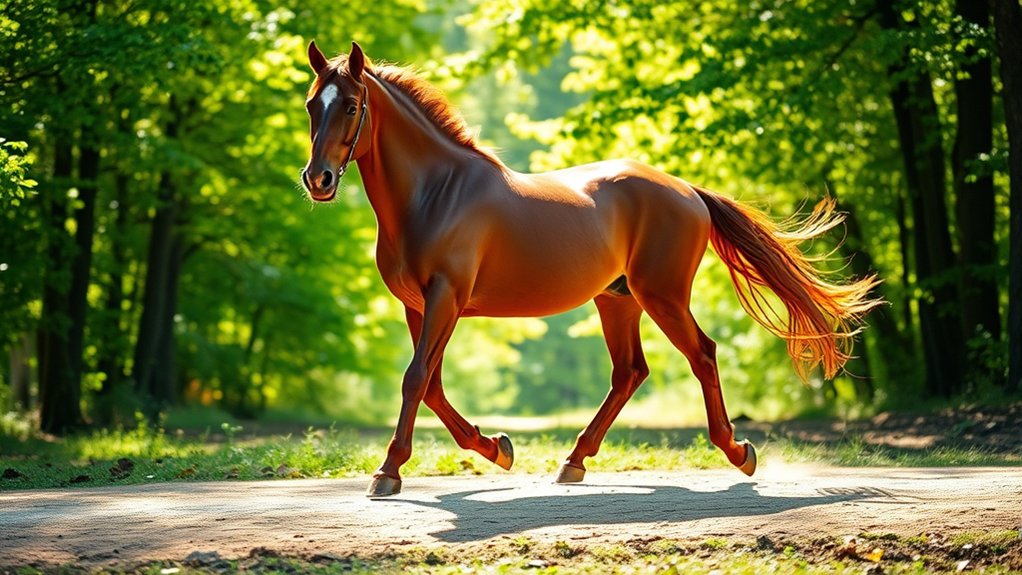
Although Tennessee Walking Horses aren’t bred for speed, they typically move at 4 to 8 mph during their flat walk gait.
When you observe their running walk, you’ll notice speeds increase to 10-20 mph while maintaining a consistent four-beat rhythm. Their smooth, long overstrides enable this comfortable pace without sacrificing stability.
If you measure their canter, it generally ranges between 15 and 20 mph, depending on the horse’s individual capabilities. These speeds reflect an optimization for comfort and endurance rather than maximum velocity.
How Their Unique Gaits Affect Speed and Comfort
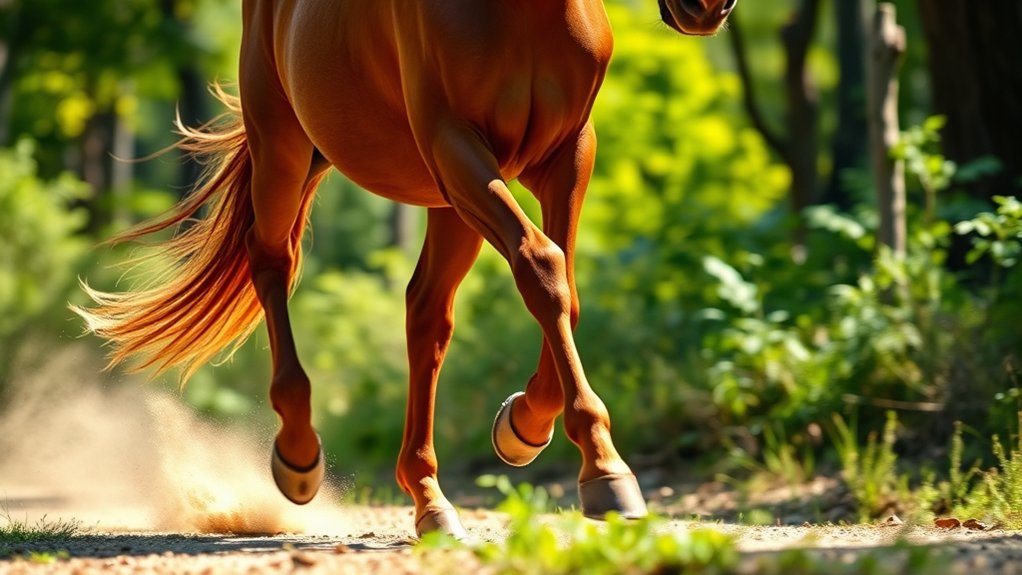
You’ll notice Tennessee Walking Horses use distinct gaits that really balance speed and rider comfort. Their flat walk and running walk change up the pace but always work to reduce impact with a smooth, rhythmic motion and overstride.
When you understand how these gaits affect speed and comfort, it becomes clear why this breed shines in smooth, long-distance riding rather than racing.
It’s all about keeping things comfortable over time.
Gaits And Speed
When you watch Tennessee Walking Horses in motion, their unique gaits really shape how fast they go and how comfortable the ride feels. They’ve a four-beat flat walk and a running walk that make their movement smooth and efficient. This helps them reach speeds from 4 to 20 mph.
The overstride feature is pretty cool—it reduces vertical motion, which helps them cover ground quickly without bouncing around too much. When they canter, they move at a moderate speed with a relaxed and flowing gait.
Here are some key points to keep in mind:
- Flat walk speed ranges between 4-8 mph.
- Running walk can reach 10-20 mph with a long, gliding stride.
- Overstride means the back hoof steps beyond the front hoof.
- Canter is a relaxed three-beat gait at moderate speeds.
- These gaits come naturally thanks to genetics, making the movement smooth and efficient.
All of these factors come together to give you a great mix of speed and a comfortable ride.
Comfort Through Motion
Because Tennessee Walking Horses have unique gait mechanics, they offer a riding experience that balances speed with exceptional comfort. Their signature running walk can reach speeds of 10-20 mph and reduces impact on your joints by minimizing vertical motion through even weight distribution and an overstride motion.
This four-beat flat walk ensures smoothness at different speeds, so you can stay comfortable without losing pace. The breed’s relaxed, flowing canter feels like a rocking-chair motion, which makes the ride even more comfortable as speed picks up.
Scientific studies show these gait mechanics reduce vertical jarring, making Tennessee Walking Horses great for long-distance travel. When you ride one, you’ll notice a seamless shift between speeds and a uniquely comfortable motion that combines efficiency with ease.
Genetics Behind Tennessee Walking Horse Gaits

Although the Tennessee Walking Horse‘s distinctive gaits may seem effortless, they actually come from specific genetic factors. These factors shape muscle structure and the neural pathways that govern movement.
It’s important to understand that these genetic influences determine how muscle fibers develop and how the nervous system controls gait patterns.
Some key aspects include the “gait-keeper” gene (DMRT3), which is linked to smooth, lateral, and running gaits. There are also genetic markers that affect muscle cell size and composition.
Plus, certain genes guide the nervous system’s development for better motor coordination.
Selective breeding plays a big role too, as it emphasizes these inherited gait traits.
On top of that, there are complex interactions among multiple genes that shape gait-specific motor patterns.
Why the “Big Lick” Gait Prioritizes Style Over Speed
If you focus on the “Big Lick” gait, you’ll notice it prioritizes dramatic, high-stepping movements over raw speed or efficiency. This gait emphasizes exaggerated vertical motion, which visually impresses but compromises biomechanical efficiency. That limits the horse’s ability to move quickly.
Trainers often use soring and specialized shoeing to artificially elevate the gait. This enhances style but comes at the expense of natural speed.
While Tennessee Walking Horses have natural gaits like the flat walk and running walk that let them move faster, the “Big Lick” is mainly designed for spectacle.
Scientific research confirms that these exaggerated movements disrupt the horse’s natural biomechanics. That makes the “Big Lick” less suited for speed.
In the end, this gait’s focus on showy appearance directly sacrifices the horse’s potential for efficient, fast movement.
How Natural Gaits Differ From Artificially Enhanced Movements
When you watch natural Tennessee Walking Horse gaits, you’ll see they keep a smooth, balanced rhythm with relaxed muscles. This lets them reach speeds up to 20 mph without any strain.
Artificially enhanced movements, on the other hand, exaggerate these natural patterns. This often leads to biomechanical stress on the horse.
Key differences include how natural gaits have a consistent four-beat rhythm and balanced stride lengths. Artificial gaits tend to have irregular stride lengths with exaggerated knee and hock action.
The natural running walk features gentle overstride and a subtle head nod. Artificial movements show extreme overstriding and high knee lifts that go beyond what’s natural.
Natural gaits are biomechanically sustainable. Artificial ones rely on forced extensions and external stimuli.
Ethical Training Practices That Influence Tennessee Walking Horse Speed
You’ll find that ethical training is all about helping a Tennessee Walking Horse develop its natural gait through proper conditioning—not by using forceful techniques.
This kind of approach actually works to strengthen the horse’s muscles and refine its movement.
Because of that, the horse can reach an ideal speed that fits within its natural abilities.
When you focus on developing the natural gait, you’re also taking good care of the horse’s health and preserving that smooth, characteristic style they’re known for.
Natural Gait Development
Because ethical training focuses on enhancing a Tennessee Walking Horse’s natural gait, you can achieve smooth performance at speeds between 10 and 20 mph during the running walk. Developing this gait naturally relies on conditioning that strengthens muscles and refines gait mechanics without forcing unnatural movements.
You’ll need to emphasize correct muscle engagement through consistent, humane exercises. Avoiding harmful practices like soring ensures the horse’s speed increase is genuine and pain-free. Scientific evidence confirms that well-trained horses reach their maximum natural gait speed safely.
Key factors in natural gait development include:
- Proper groundwork and conditioning
- Reinforcement of correct muscle use
- Avoidance of artificial gait exaggeration
- Respect for the horse’s comfort and biomechanics
- Consistent, ethical training routines
Ethical Conditioning Methods
Building on the foundation of natural gait development, ethical conditioning methods focus on reinforcing these movements through targeted exercises and positive reinforcement. You strengthen the muscles involved in the flat walk, running walk, and canter via proper groundwork, which enhances efficiency and speed without forcing exaggerated movements.
Scientific studies confirm that horses trained this way achieve higher speeds naturally, avoiding harmful practices like soring.
You’ll find that ethical training emphasizes patience and consistency, which improves gait quality and speed while preserving the horse’s health.
Furthermore, research shows that ethically conditioned Tennessee Walking Horses exhibit greater endurance and sustained speed over long distances due to healthier muscles and joints.
By prioritizing the horse’s well-being, you optimize performance through scientifically supported conditioning methods. It really pays off to focus on methods that respect the horse and build strength gradually.
This way, both you and your horse enjoy better results and a healthier partnership.
Comparing Tennessee Walking Horse Speed to Other Breeds
Although Tennessee Walking Horses excel in smoothness and endurance, their speed falls short compared to many other breeds. You’ll find their running walk tops out around 10-20 mph, which is well below the sprinting speeds of other race or performance horses.
Here’s a quick comparison to help you understand their speed relative to other breeds:
- Tennessee Walking Horse running walk: 10-20 mph
- Flat walk gait: 4-8 mph
- Thoroughbred gallop: over 40 mph
- Standardbred and Quarter Horse sprint: exceeding 55 mph
Their focus on smoothness and rhythm limits their top speed. This data shows Tennessee Walking Horses prioritize comfort and sustained movement rather than outright speed, making them quite distinct from breeds bred for racing or sprinting.
How Speed Shapes Tennessee Walking Horse Performance
Understanding the speed capabilities of Tennessee Walking Horses reveals how their unique gait mechanics influence overall performance. Their running walk, reaching 10-20 mph, combines speed with smoothness. This is thanks to pronounced overstride and rhythmic head nodding.
This gait reduces joint impact, allowing you to cover distances efficiently and comfortably. It’s pretty impressive how these horses balance speed and comfort so well.
| Gait Type | Speed Range (mph) |
|---|---|
| Running Walk | 10 – 20 |
| Flat Walk | 4 – 8 |
| Overstride | Enhances stride length and smoothness |
| Joint Impact | Minimizes shock for sustained movement |
| Performance | Optimized for speed and comfort balance |
Why Tennessee Walking Horses Are Valued More for Endurance Than Speed
Because Tennessee Walking Horses prioritize smooth, energy-efficient gaits, they excel in endurance rather than sheer speed. Their natural movement minimizes fatigue, making them ideal for extended rides rather than sprinting.
When you evaluate their value, consider these key points:
- Their running walk reaches a moderate speed of 10-20 mph, favoring comfort over velocity.
- The breed’s unique four-beat flat walk ensures sustained, stable movement.
- Their gait mechanics optimize energy conservation for prolonged activity.
- Cantering occurs at a relaxed pace, emphasizing stability, not racing speed.
- Scientific studies confirm their design supports stamina and ease during long distances.
Understanding these factors helps you appreciate why endurance, not speed, defines the Tennessee Walking Horse’s strength and appeal.
Frequently Asked Questions
What Is the History of the Tennessee Walking Horse Breed?
You’ll find the Tennessee Walking Horse originated in late 1800s Tennessee, bred from multiple breeds. Its unique gait came from Black Allan, its foundation sire, and it quickly gained popularity for smoothness and versatility.
This horse became famous for its comfortable ride, especially over long distances. People loved how it combined style with practicality.
Over time, the breed grew in numbers and reputation, becoming a symbol of Tennessee’s rich equestrian heritage. It’s still celebrated today for those very qualities.
How Do Tennessee Walking Horses Perform in Competitive Events?
You’ll find Tennessee Walking Horses excel in gaited competitions, judged on smoothness, rhythm, and correctness of their running walk, flat walk, and canter. They really showcase natural elegance and consistency that’s highly valued.
This makes them stand out in both English and Western disciplines. It’s pretty impressive how they maintain that quality no matter the event. They’re definitely a favorite among riders who appreciate a smooth ride.
What Are Common Health Issues for Tennessee Walking Horses?
You’ll frequently face footing and vision foes, like laminitis, navicular disease, and congenital stationary night blindness. Proper preparation prevents pain, so prioritize professional shoeing, sensible training, and regular veterinary vigilance to safeguard your Tennessee Walking Horse’s soundness.
Taking good care of your horse means staying on top of these common issues. It’s all about keeping them comfortable and healthy, so they can perform their best. Regular check-ins with your vet can catch problems early before they become serious.
How Do Tennessee Walking Horses Behave Temperamentally?
You’ll find Tennessee Walking Horses calm, obedient, and highly trainable. They behave politely and respond well to training, making them reliable companions for riders of all skill levels.
They’re especially great for beginners and those looking for gentle, cooperative horses. These horses really know how to keep things smooth and easy-going. Overall, they’re just plain nice to work with.
What Is the Typical Lifespan of a Tennessee Walking Horse?
While some horse breeds live shorter lives, you’ll find Tennessee Walking Horses typically live between 28 and 33 years. Sometimes they even reach 35 years old.
This is thanks to their solid health, good genetics, and your consistent care and proper management. Taking good care of them really makes a difference!
Conclusion
Think of Tennessee Walking Horses as the tortoise in a classic race, not the fastest but steady and enduring. Their unique gaits and genetics prioritize smoothness and stamina over speed.
While they might not outrun other breeds, their value lies in comfort and endurance. It’s much like a well-tuned engine designed for long journeys rather than quick sprints.
Understanding this helps you appreciate why speed isn’t their defining strength. Instead, it’s their graceful reliability that really stands out.