Do Horses Have Night Vision – Fact Check
You might think horses have exceptional night vision, but while their eyes are adapted for low light with more rods and a reflective layer, they don’t see better in the dark than humans. They need about 45 minutes to fully adjust, and their night sight lacks color and sharp depth perception, making navigation tricky.
Sudden light changes can also impair their vision. Understanding these limits helps you create safer environments and improve horse care after dark. Explore further to grasp how their vision really works.
How Does Horse Vision Differ From Human Vision?
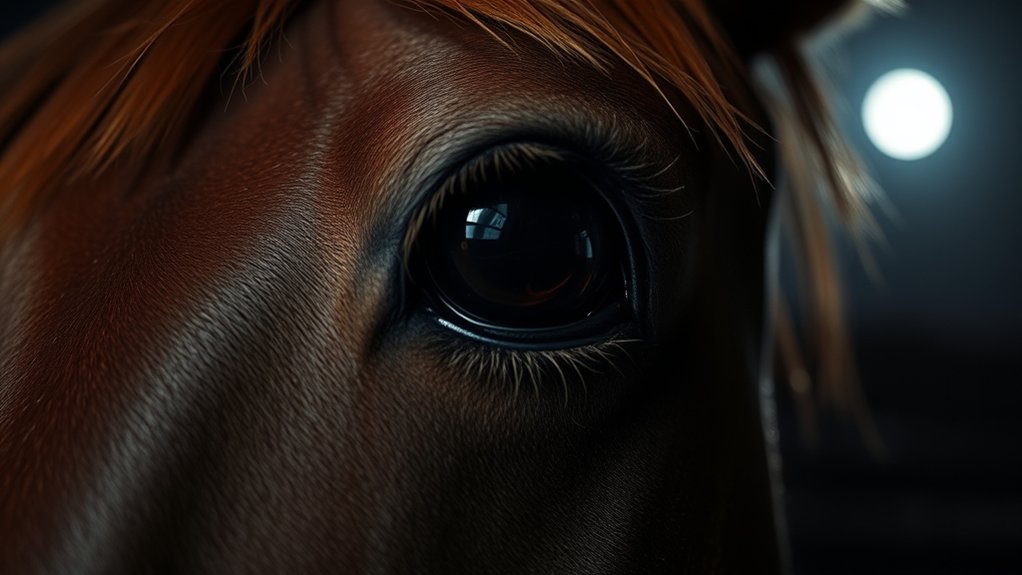
Although both horses and humans rely on their retinas to process visual information, horses’ vision differs markedly due to their higher number of rods compared to cones. This means they’re more sensitive to low light but don’t perceive colors as vividly as humans do.
So, you’ll notice horses see better in dim conditions but can’t distinguish colors as well as you can.
Their eye placement gives them nearly 360° panoramic vision, which helps them detect movement around them easily. However, this wide field of view comes at the cost of limited binocular depth perception. It’s a trade-off that works well for their needs in the wild.
When moving from bright to dark environments, horses need about 45 minutes to fully adjust their vision, which is considerably longer than humans.
Even though their dim-light vision is pretty good, horses can’t see clearly in complete darkness. Plus, their night vision doesn’t actually surpass what humans see during the day.
What Anatomical Features Affect Horse Night Vision?
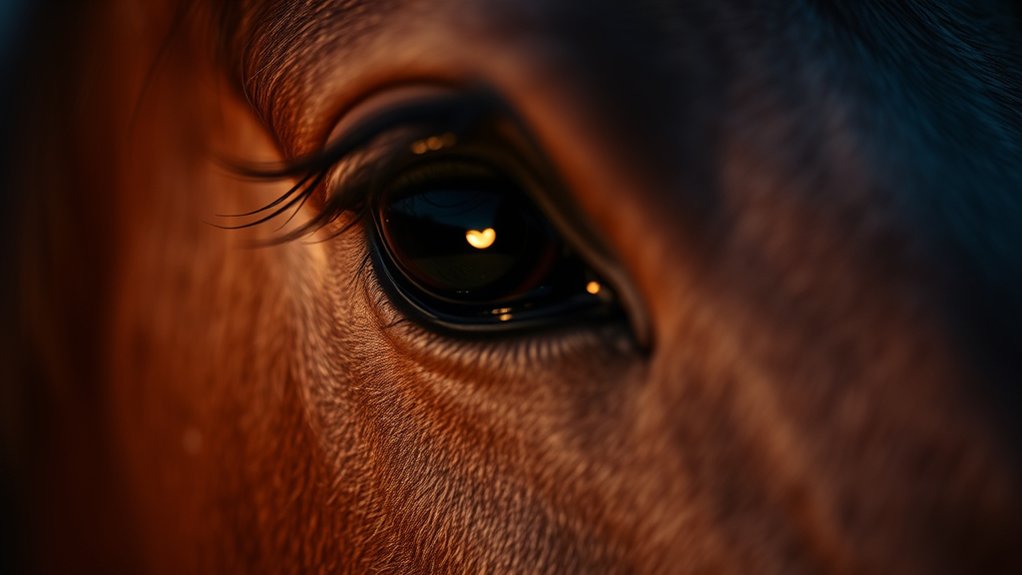
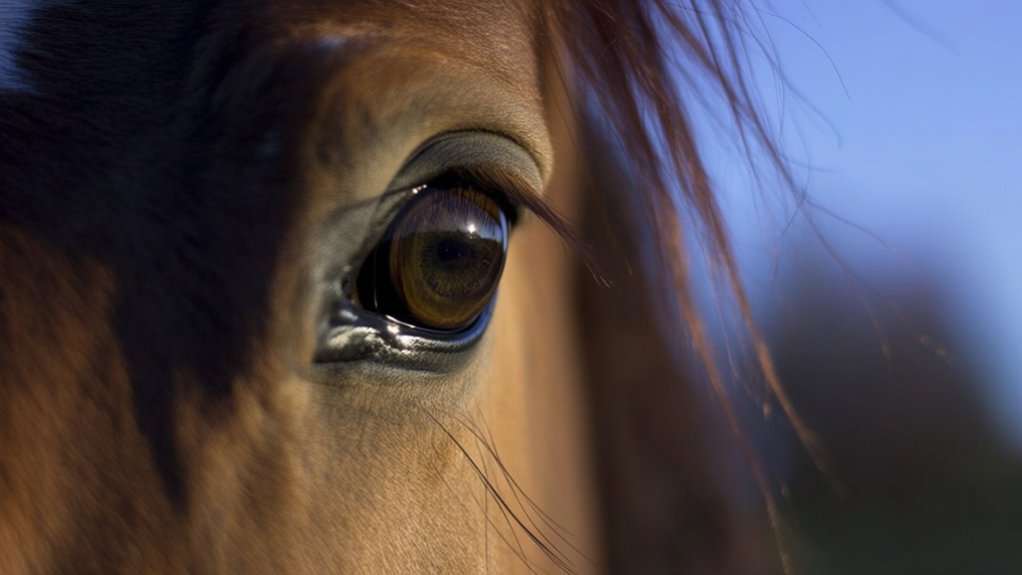
You’ll notice that the structure of a horse’s retina plays an essential role in its night vision. It has a high concentration of rods, which are specialized for detecting low light.
On top of that, there’s the tapetum lucidum—a reflective layer located behind the retina. This layer bounces light back to the photoreceptors, giving them a second chance to catch it.
Retina Structure and Function
When you examine the horse’s retina, you’ll find several specialized anatomical features that enhance its night vision. These adaptations optimize how horses perceive their environment in low light.
Key aspects include a dense concentration of rod cells, which are highly sensitive to dim light and essential for night vision. There’s also a relatively sparse distribution of cone cells, which limits color perception but prioritizes light sensitivity.
You’ll notice a horizontal streak of ganglion cells that sharpens resolution across the horizon, improving spatial awareness in darkness.
Plus, the pupil’s horizontal slit shape and size maximize light intake and provide a wide panoramic field.
Together, these retinal features enable horses to detect movement and navigate effectively during nighttime or low-light conditions. It’s pretty amazing how their eyes are built for the dark!
Tapetum Lucidum Role
How does the tapetum lucidum enhance a horse’s night vision? This reflective layer lies behind the retina and reflects light back through the photoreceptor cells. In low-light conditions, it effectively boosts the available light. This improves your horse’s ability to see in the dark.
You’ll notice their eyes glow at night, which is a clear sign of its presence. While it enhances sensitivity, the tapetum lucidum slightly reduces image sharpness. This means your horse might not recognize fine details as well in the dark.
| Feature | Function | Impact on Night Vision |
|---|---|---|
| Tapetum Lucidum | Reflects light back | Enhances light sensitivity |
| Photoreceptor Cells | Detect light | Improved visibility in dim |
| Visual Acuity | Image sharpness | Reduced detail at night |
This balance helps your horse survive as a prey species. It’s all about seeing well enough to stay safe when the light is low.
How Quickly Do Horses’ Eyes Adjust to Darkness?
Although horses rely on strong night vision to navigate low-light environments, their eyes take about 16 to 20 minutes to fully adjust to darkness. This adjustment period is vital for their visual system to optimize sensitivity in dim conditions.
Here’s how the process unfolds:
- Pupils begin to dilate immediately upon entering darkness, allowing more light to enter the eye.
- Rod cells in the retina activate progressively, enhancing the ability to detect low light.
- Complete dark adaptation occurs within 16 to 20 minutes, faster than many expect.
- Initial minutes provide limited vision until both pupil dilation and rod activation reach peak efficiency.
Understanding this timeline helps you appreciate how horses safely navigate their environment after sundown.
How Well Can Horses See in Low-Light Conditions?
You should know that horses’ night vision has its limits. They struggle to see fine details when the light is low.
Their eyes take about 45 minutes to adjust, but even after that, what they see is kind of like partial moonlight—no color or texture.
Because of this, horses can’t really depend on sharp sight when moving from bright areas to dark ones.
Night Vision Limitations
Because horses rely heavily on their vision for navigation, understanding their limitations in low-light conditions is essential. While horses have more rods in their retinas to aid night vision, their ability to see in darkness is still limited. Here’s what you should know about their night vision limitations:
Horses can’t see well in complete darkness; they need about 45 minutes to adjust to low-light environments. Their vision in dim light resembles partial moonlight, lacking color and detailed textures. Depth perception decreases markedly at night, complicating navigation.
Sudden changes from bright to dark conditions temporarily impair their sight until full adaptation occurs. These factors collectively restrict how effectively horses perceive their surroundings in low-light settings.
Dark Adaptation Challenges
How well can horses see when light levels drop? Horses need about 16 to 20 minutes for their eyes to fully adapt to darkness because of the retinal dark adaptation process. Their retinas have a high density of rods, which are specialized for low-light detection. This helps them perceive shapes in dim environments.
Also, the tapetum lucidum reflects light within the eye, boosting sensitivity and making their eyes glow at night. But during the changeover from bright to dark, their vision clarity temporarily decreases.
Even after they fully adapt, their night vision doesn’t quite match how sharp their eyesight is during the day.
What Are Common Myths About Horses’ Night Vision?
Although many believe horses have superior night vision, their ability to see in low light is actually limited and requires about 45 minutes to adjust fully. You might find these common myths misleading:
- Horses see better in the dark than humans. They actually struggle to distinguish details in dim light.
- They possess color and texture vision at night. Horses only detect shapes and edges with no color.
- Horses can navigate easily in total darkness. Complete darkness impairs their vision more than humans’.
- Their eyes adapt quickly to darkness. This adaptation is slow, increasing risks during night handling.
Understanding these misconceptions helps you provide better care and ensure safety for horses in low-light conditions. It’s good to keep these facts in mind, especially if you’re working with horses after sunset.
How Do Environmental Changes Affect Horse Night Vision?
Misunderstandings about horses’ night vision often overlook how environmental lighting changes impact their sight. When your horse moves from bright outdoor light to a dim barn, their eyes need about 45 minutes to fully adapt to the lower light.
Conversely, stepping from a dark area into bright light temporarily impairs their vision because their pupils constrict slowly. These shifts can cause your horse to hesitate or act cautiously as their vision adjusts. This is especially true when entering indoor arenas from outdoors.
Managing lighting alterations carefully helps reduce visual confusion and supports your horse’s navigation and safety. Sudden, drastic changes in ambient light impair depth perception and obstacle awareness, increasing accident risks.
Understanding these effects lets you better accommodate your horse’s visual needs during environmental changes.
What Safety Concerns Come From Horse Night Vision Limits?
Because horses have limited night vision, their ability to detect obstacles in low-light conditions diminishes considerably. This increases the risk of injury or accidents. You need to be aware that this limitation affects safety in several ways.
For example, misjudging hazards like uneven terrain or overhanging branches can lead to injuries for both horse and handler. Also, rapid shifts from bright to dark environments may cause horses to hesitate or startle. This can pose risks during rides or handling.
Relying on natural light alone often means missing obstacles, which raises the chance of falls or kicks. Plus, underestimating these vision limits can compromise how well you manage and protect your horse.
How Can Owners Improve Visibility for Horses After Dark?
When managing horses after dark, you can substantially enhance their safety by improving visibility through well-planned lighting solutions. Use consistent, even lighting in stables and pathways to reduce stress and aid vision. Opt for low-intensity, diffused lights to minimize glare and replicate natural conditions.
Avoid sudden lighting changes to help horses’ eyes adjust gradually. Outdoor lighting along fences and walkways prevents accidents. Regular maintenance guarantees ideal function.
| Strategy | Benefit | Implementation Tip |
|---|---|---|
| Consistent Lighting | Reduces stress, aids vision | Use uniform fixtures in stables |
| Low-intensity, Diffused | Minimizes glare | Select soft white LED bulbs |
| Gradual Light Transition | Allows eye adaptation | Dim lights when moving horses |
| Outdoor Walkway Lighting | Prevents accidents | Install solar or motion lights |
| Regular Maintenance | Ensures steady illumination | Schedule monthly checks |
Why Should You Understand Horse Night Vision for Better Care?
While horses do have some night vision, it’s pretty limited and works best under moonlight-like conditions. So, understanding these limits helps you create safer spaces for them when it’s dark. By knowing this, you can step up your horse care and avoid accidents.
Horses’ night vision is limited and best in moonlight, so knowing this helps ensure safer dark environments.
Horses need about 45 minutes to fully get used to the dark, so try not to switch them quickly between bright and dim areas. Their night vision also means they don’t see depth very well, so having good lighting is super important to keep them safe.
It’s good to know that horses don’t actually see better than humans in the dark. This clears up some myths and helps with safer handling.
Making changes to their environment, like adding proper lighting, really supports their well-being and safety at night.
Knowing all this lets you adjust how you manage your horses in ways that match how they actually see in low light.
Frequently Asked Questions
Do Foals Have the Same Night Vision as Adult Horses?
Foals don’t have the same night vision as adult horses because their eyes and tapetum lucidum aren’t fully developed. You’ll notice their low-light vision improves gradually, reaching adult-level clarity by about 6 to 12 months.
Can Horses See Colors at Night?
You can’t expect horses to see colors vividly at night. Their dichromatic vision limits color perception in low light.
Instead, they mainly detect shades of blue, yellow, and gray. They focus more on motion and contrast rather than color details. Makes sense, right?
How Does Horse Night Vision Compare to Other Nocturnal Animals?
If you expect horses to out-see owls at night, think again. They’re more like the dim bulbs of nocturnal vision. Their limited tapetum lucidum and fewer rods mean they struggle compared to true night hunters.
Are Certain Horse Breeds Better at Seeing in the Dark?
You won’t find specific horse breeds better at seeing in the dark; all share similar retinal structures.
Instead, factors like individual health, age, and eye size slightly influence low-light vision, not breed differences.
Does Aging Affect a Horse’s Night Vision Ability?
You should know that aging reduces a horse’s night vision by about 30% due to decreased rod cell efficiency and slower dark adaptation. This means their eyes don’t adjust to low light as quickly as they used to.
Because of this decline, they don’t see as well in dim conditions. So, regular eye care becomes really important to help keep their vision in good shape.
Conclusion
You might think horses have perfect night vision, but the reality is more nuanced. While their eyes adapt faster and see better in low light than yours do, they’re not equipped for total darkness. Understanding these limits helps you create safer environments and avoid myths that overestimate their abilities.
By recognizing how environmental changes affect their vision, you can provide better care and guarantee their safety when light fades. It’s all about knowing what horses can and can’t see at night, so you’re prepared to help them when it gets dark.