What Are Friesian Horses Used For?
You’ll find Friesian horses excel in dressage, driving, trail riding, and ceremonial roles thanks to their muscular build, calm temperament, and elegant, high-stepping gait. Their strength and endurance made them valued warhorses historically, while their friendly nature suits riders of all levels in leisure activities.
They’re also favored in entertainment for their striking appearance and reliable behavior. Understanding their versatile uses reveals why breeders maintain strict standards and genetic health protocols.
Key Traits That Make Friesian Horses Ideal for Multiple Uses?
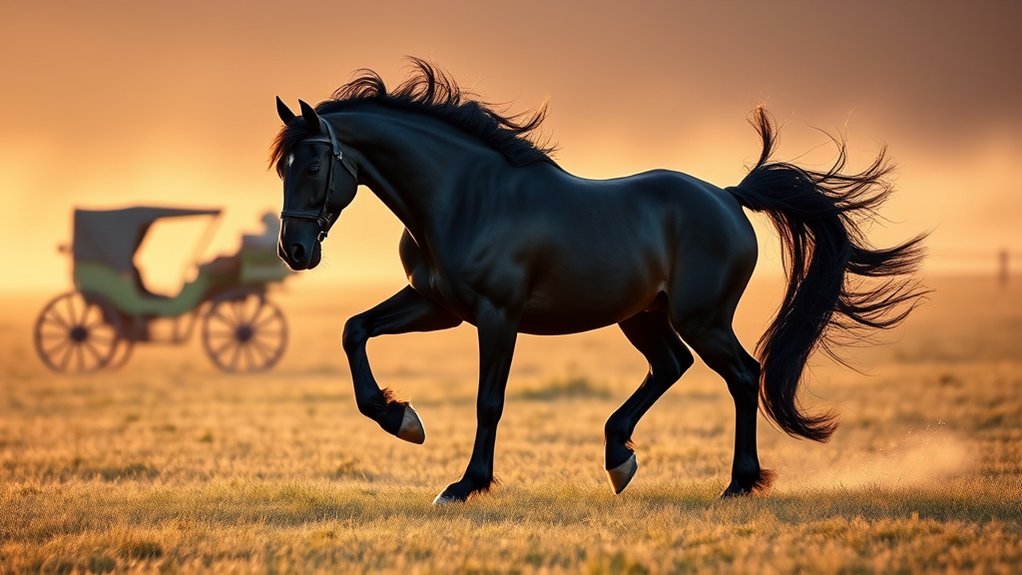
Because Friesian horses combine a calm temperament with high intelligence, you’ll find them highly trainable across diverse disciplines. This breed’s strong conformation and muscular build provide the physical foundation necessary for demanding activities such as dressage, carriage driving, and draft work.
You’ll also appreciate their striking black coat, flowing mane, and feathered legs, which enhance their presence in ceremonial and entertainment settings. The Friesian breed exhibits notable agility and stamina, supporting performance in show jumping and traditional equestrian events.
Additionally, their gentle, dependable nature makes them ideal for beginner riders and therapeutic programs. Overall, the Friesian’s combination of mental acuity, physical capability, and aesthetic appeal makes this breed exceptionally versatile and well-suited for multiple equine uses.
How Friesian Horses Served as Warhorses in History?
You’ll find that Friesian horses really stood out as warhorses in medieval battles. Their exceptional strength and endurance meant they could carry heavily armored knights through intense combat without tiring.
Plus, their muscular build and spirited temperament gave them the agility and power needed for effective charges and quick maneuvers on the battlefield.
If you look into historical records, you’ll see how these qualities made Friesians a top choice for knights who wanted a reliable and noble-looking mount. It wasn’t just about strength — it was also about presence and performance when it mattered most.
Medieval Battle Roles
Although many horse breeds served in medieval warfare, Friesian horses stood out for their unique combination of strength, stamina, and temperament. This made them exceptionally suited to carry armored knights into battle.
You’ll find their compact, muscular build provided durability and agility vital for battlefield maneuvers. Their calm disposition allowed them to endure the chaos of medieval battle without losing composure. This made them reliable mounts for heavy cavalry charges.
| Attribute | Description | Impact on Medieval Battle |
|---|---|---|
| Strength | Muscular build | Carried heavy armor and weapons |
| Stamina | Endured long charges | Maintained speed and power |
| Temperament | Calm under pressure | Reliable in chaotic combat |
| Appearance | Noble, imposing | Boosted knight’s presence |
| Historical Role | Depicted since 11th century | Prized warhorse across Europe |
Strength and Endurance
When you examine the role of Friesian horses in medieval warfare, their extraordinary strength and endurance stand out as key factors that made them indispensable warhorses. The Friesian horse’s muscular build enabled it to carry heavily armored knights over extended distances without fatigue.
This strength allowed for sustained charges critical in battle, where stamina determined survival and effectiveness. Moreover, their robust cardiovascular capacity supported prolonged exertion, while their calm temperament ensured composure under combat stress.
Historical and archaeological evidence confirms the Friesian’s durability and reliability, as they bore heavy armor and equipment across diverse terrains in the Middle Ages and Crusades.
You can appreciate how this combination of strength and endurance positioned the Friesian horse as a crucial asset in medieval European cavalry forces.
Knight Mount Characteristics
Building on their remarkable strength and endurance, Friesian horses possessed specific characteristics that made them ideal mounts for medieval knights. Their compact, muscular build delivered the power necessary to carry heavily armored knights without sacrificing mobility.
This combination of strength and agility allowed Friesians to execute complex battlefield maneuvers essential in medieval warfare. Their high stamina ensured sustained performance during prolonged engagements, while their calm temperament minimized spooking under combat stress.
Moreover, their noble appearance enhanced the knight mount’s imposing presence, boosting morale and intimidation.
Archaeological evidence from the 11th century confirms Friesian-like horses featured prominently in medieval warfare depictions, underscoring their historical role.
When you consider a knight mount, Friesians exemplify the best balance of physical capability and psychological steadiness demanded by medieval combat scenarios.
Why Friesian Horses Were Essential for Agricultural Work?
You’ll find Friesian horses really shine in fieldwork because of their exceptional strength and muscular build. This makes them great at plowing and hauling with ease.
Plus, they’ve impressive endurance, so they can keep up consistent performance over long hours. That makes them super reliable for those extended agricultural tasks.
On top of that, they’re quite versatile. They can handle a variety of farm duties, whether it’s pulling carriages or operating different types of equipment.
Strength In Fieldwork
Because Friesian horses combine a muscular build with exceptional stamina, they became indispensable for agricultural tasks like plowing and hauling heavy loads. You’ll find their strength in fieldwork rooted in three key attributes:
- Muscular frame and powerful legs These provide the raw power needed to pull heavy farm implements through tough soil.
- Compact body structure It delivers ideal leverage and stability, allowing efficient transfer of force during plowing and hauling.
- Calm temperament This trait lets Friesian horses maintain controlled, consistent effort critical for demanding agricultural work.
Their natural combination of strength and endurance made Friesian horses the backbone of farming operations before mechanization. This enabled you to manage challenging agricultural work effectively.
Endurance For Long Hours
Although agricultural work demanded long hours of continuous effort, Friesian horses’ exceptional endurance made them indispensable for such tasks. Their strong, muscular build supports sustained physical exertion, so you can rely on them for prolonged periods without rapid fatigue.
The breed’s efficient gait and high-stepping trot help with the consistent transport of heavy loads and steady plowing of fields. You’ll find their physical resilience critical when performing extended farm labor, as they maintain energy and stability throughout.
Moreover, Friesians’ calm temperament ensures they stay focused and manageable during continuous work, which reduces the risk of stress-related performance drops.
This combination of stamina and reliability makes Friesian horses essential partners in enduring the demanding, long-duration agricultural work typical before mechanization.
Versatility In Farm Tasks
How did Friesian horses become indispensable for diverse agricultural tasks? The Friesian Horse Association records that far back, these horses have supported farm work due to their unique attributes.
You’ll find their versatility unmatched because of:
- Strength and endurance, enabling them to plow fields, haul heavy loads, and manage farm transportation efficiently.
- A calm temperament, which guarantees reliable cooperation with farmers during demanding agricultural activities.
- Structural advantages, such as a compact, muscular build and feathered lower legs, providing durability in rough, muddy terrains.
These features allowed Friesian horses to not only perform essential farm labor but also participate in ceremonial parades, demonstrating their dual utility in agriculture.
Their practical and elegant design made them a cornerstone of farm work far back in history.
Why Friesian Horses Are Perfect for Trail Riding and Leisure?
When you choose a Friesian horse for trail riding and leisure, you benefit from its calm temperament and muscular build. These traits guarantee stability and confidence on uneven terrain.
The Friesian breed combines sure-footedness with a strong frame, enabling it to navigate varied landscapes safely.
Its smooth, high-stepping trot reduces rider fatigue, making long rides more comfortable. This breed’s friendly nature simplifies handling, accommodating riders of all skill levels, including beginners.
Beyond trail riding, Friesians excel in recreational driving due to their steady disposition and powerful movement. This enhances casual outdoor activities.
Their striking appearance adds to the enjoyment, making every ride visually and physically rewarding. Overall, Friesians perfectly balance strength, temperament, and elegance for trail and leisure pursuits.
How Friesian Horses Excel in Dressage Competitions?
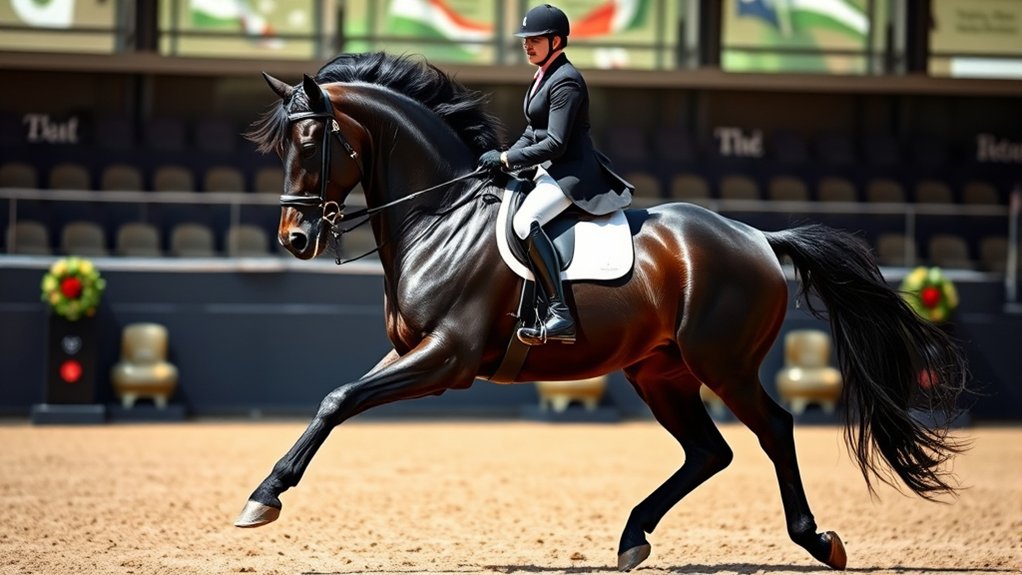
You’ll notice Friesian horses really shine in dressage because of their elegant, high-stepping trot and expressive gaits. These movements perfectly match the strict standards required in competitions.
Plus, their calm temperament makes them great learners, eager to master even the most complex dressage patterns.
When you put all these qualities together, you get a perfect blend of power and finesse that’s key to winning in the ring.
Elegant Movement Traits
Although Friesian horses possess a naturally high-stepping and expressive trot, their true advantage in dressage lies in the combination of innate balance and impulsion. This enables precise execution of advanced movements.
When you observe their elegant movement, three key traits stand out:
- The breed’s long, arched neck and elevated carriage enhance visual grace and facilitate collection essential for dressage.
- Their natural balance stabilizes progression between gaits, allowing you to perform complex figures with fluidity and accuracy.
- Impulsion generated from powerful hindquarters drives energy forward, supporting sustained high-stepping action without sacrificing control.
Temperament Enhancing Performance
Because Friesian horses combine a calm, willing temperament with strong expressive movement, they excel in dressage competitions by responding smoothly and reliably to rider cues. You’ll notice their natural elasticity and elevated trot allow them to perform advanced movements like piaffe and passage with remarkable precision.
Their calm demeanor facilitates easy trainability, enabling you to execute complex routines harmoniously with minimal resistance. The breed’s distinctive mane and noble carriage enhance their aesthetic appeal, often contributing to higher presentation scores.
This combination of physical prowess and steady temperament ensures you achieve ideal grace, rhythm, and impulsion in performance. When you work with a Friesian, their gentle nature and striking presence not only improve responsiveness but also elevate overall dressage execution to a competitive standard.
Why Friesian Horses Are Popular in Driving and Carriage Work?
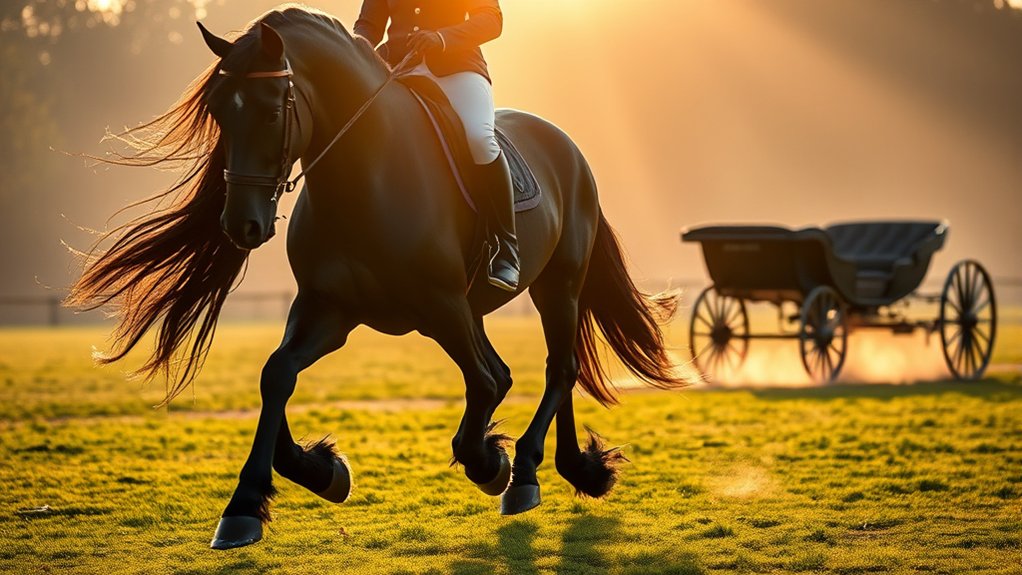
When you assess the qualities essential for driving and carriage work, Friesian horses stand out due to their combination of strength, elegance, and temperament. Their muscular build and smooth, elevated gait deliver a powerful yet refined presence, which is vital for harness performance. You’ll find their calm demeanor guarantees reliability in varied driving conditions.
Friesian horses combine strength, elegance, and calm temperament for reliable, refined driving and carriage performance.
Key reasons why Friesians excel in this role include:
- Physical Attributes: Strong musculature and feathered legs enhance both function and aesthetic appeal in carriage settings.
- Temperament: Their willingness and steady nature make them dependable for professional and recreational driving.
- Historical Legacy: Their use in medieval processions translates to a noble carriage that complements traditional and competitive driving events.
These factors make Friesian horses highly sought after for driving and carriage tasks.
Why Friesian Horses Are Chosen for Funeral and Ceremonial Events?
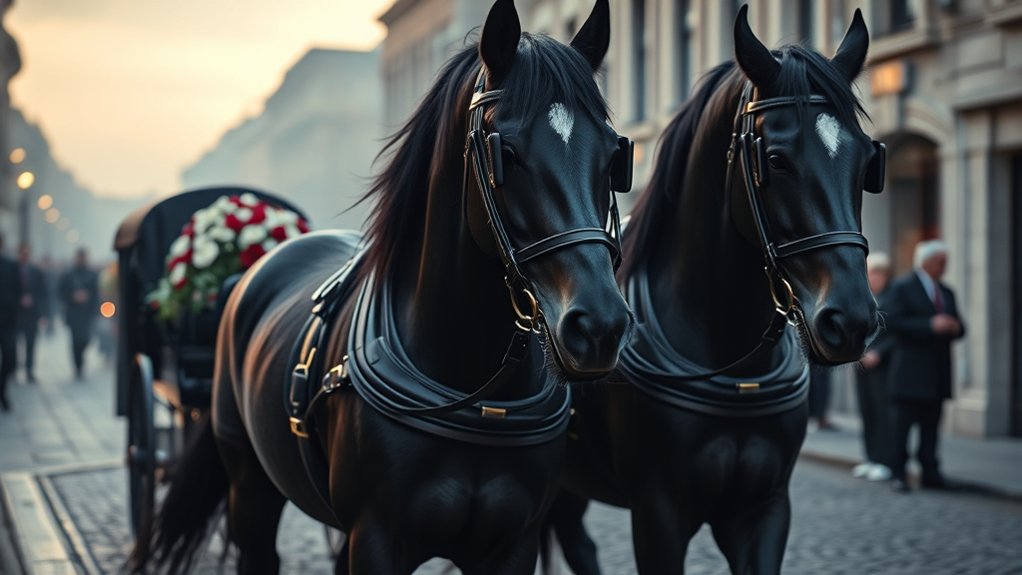
Since you need a horse that embodies dignity and calm, Friesians are a prime choice for funeral and ceremonial events. Their noble demeanor and striking appearance ensure they convey solemnity and respect, essential for such occasions.
Friesians exhibit an exceptionally calm temperament, allowing them to maintain composure amid the emotional intensity of funerals and formal ceremonies.
Historically, their role in Victorian funeral corteges underscores their established connection to mourning rituals.
Furthermore, their elegant, majestic movement enhances the ceremonial atmosphere, reinforcing the gravity and grandeur of the event.
When you select Friesian horses for these roles, you benefit from their cultural significance and ability to uphold the solemn tone required. This makes them indispensable for both funeral processions and official ceremonial functions.
How Friesian Horses Shine in Movies, TV, and Entertainment?
Although many horse breeds appear on screen, Friesian horses consistently stand out due to their striking black coats, flowing manes, and feathered legs. These features create an instantly recognizable and visually mesmerizing presence.
Their use in visual media extends across various entertainment formats because of these unique attributes.
Friesian horses often portray regal, mystical, or historic characters in films like *Clash of the Titans* and *The Chronicles of Narnia*. This helps enhance the authenticity of the story.
Their calm temperament and impressive gait make it easier to capture complex close-up shots and dynamic performance scenes. This ensures they behave reliably on set.
You’ll also see them frequently in ceremonial and parade scenes. Their elegant, dramatic appearance really amplifies the visual impact.
All these factors together make Friesian horses a preferred choice in movies, TV, and visual media productions.
Why Friesian Horses Make Great Circus and Performance Horses?
Because Friesian horses combine a calm temperament with exceptional trainability, they excel in circus and performance settings where precision and reliability are essential. You’ll appreciate their ability to perform intricate, high-stepping movements with ease, enhancing choreographed routines.
Their flowing mane and feathered legs add dramatic visual appeal, mesmerizing audiences during theatrical acts. This breed’s strong, muscular build enables you to confidently use them in performances involving a high-wheeled cart, demonstrating both power and elegance.
Their gentle disposition allows for efficient training of complex tricks and seamless interaction with performers. With these attributes, Friesians consistently deliver reliable performances, making them indispensable in circus environments demanding both grace and strength.
Breeding Practices and Genetic Health of Friesian Horses
When you manage Friesian breeding, adhering to the strict regulations set by the KFPS is vital to maintain genetic purity and breed standards. The KFPS enforces rigorous breeding practices, including DNA parentage verification and genetic health testing to detect disorders like dwarfism and hydrocephalus.
You must follow these key protocols:
- Use only KFPS-approved stallions that pass conformation and performance inspections at keuring events to ensure breed consistency.
- Conduct genetic tests on mares to monitor and minimize the incidence of hereditary conditions affecting the breed.
- Employ identification methods such as tongue tattoos (pre-1997) and microchips (post-1997) to maintain accurate pedigree records and traceability.
These measures collectively preserve the Friesian’s genetic health and uphold breed integrity.
Frequently Asked Questions
What Is the Average Lifespan of a Friesian Horse?
You’ll find the average lifespan of a Friesian horse ranges from 15 to 17 years, though with meticulous horse grooming techniques and attentive care, some live up to 20 years.
Their Friesian breed history includes genetic predispositions like dwarfism and hydrocephalus, which can affect longevity.
To maximize lifespan, you must focus on proper nutrition, regular veterinary check-ups, and maintain their distinctive coat and mane through specialized grooming methods tailored to this elegant breed.
How Much Does a Friesian Horse Typically Cost?
If you’re eyeing Friesian horse pricing, expect to invest $15,000 to $25,000 for a well-trained horse. Show-quality ones can climb past $30,000.
Foals start around $8,000 but prices rise as they mature.
Don’t overlook important horse purchase considerations like pedigree, training, and healthcare, which add significant costs.
Imported or champion-line Friesians command premium prices due to their rarity and lineage.
What Are Common Health Issues in Friesian Horses?
You’ll find Friesian horses prone to genetic disorders like dwarfism, hydrocephalus, and aortic rupture tendency. Their immune system vulnerabilities and digestive issues require careful management.
Horse grooming must be meticulous to prevent insect bite hypersensitivity and verrucous pastern dermatopathy.
Breeding practices play an essential role, so genetic testing is necessary to reduce risks.
Tendon and ligament laxity also affect movement, so regular veterinary screening is critical for maintaining their health.
How Do Friesian Horses Behave Around Children?
You’ll find Friesian horse temperament exceptionally gentle and calm around children, which enhances child safety markedly. Their steady disposition reduces unpredictable reactions, making them reliable companions for young riders.
With proper training, they exhibit patience and tolerance, minimizing risks during interactions. Their natural trust and docile nature ensure they form strong bonds with kids, promoting a safe and positive environment.
Monitoring behavior continuously ensures ongoing safety and comfort for both child and horse.
What Kind of Diet Is Best for Friesian Horses?
Imagine a Friesian’s powerful muscles fueled by lush hay against the delicate shimmer of its feathered legs.
For ideal horse nutrition, you balance high-quality forage with concentrated feeds like grains, especially in colder months or training periods.
Incorporate dietary supplements rich in vitamins and minerals to support skin and coat health.
Always provide fresh water, adjust portions to prevent obesity, and tailor the diet precisely to your horse’s age and activity level for peak condition.
Conclusion
You might think Friesian horses are just showpieces, but their versatility proves otherwise. Their powerful build and agile movement make them perfect for dressage, trail riding, and even farm work.
Imagine a Friesian shifting seamlessly from ceremonial parades to rugged agricultural fields, showcasing strength, grace, and endurance. Their historical use as warhorses and modern roles in entertainment confirm their unmatched adaptability.
Friesians aren’t just beautiful—they’re functional athletes with diverse capabilities.