What Is Horse Jumping Called?
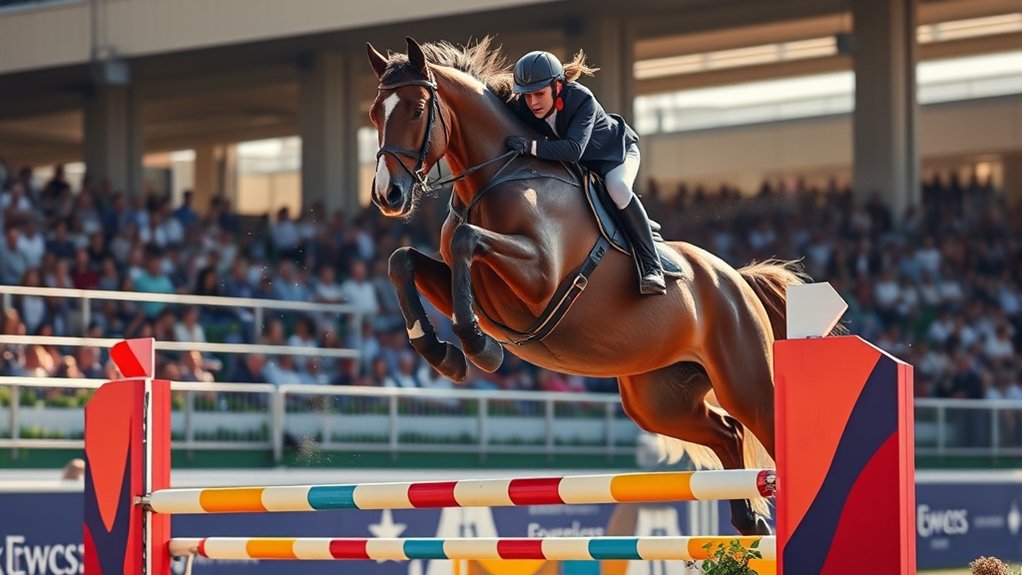
You call horse jumping “show jumping,” the precise equestrian sport where you and your horse navigate a course of obstacles emphasizing speed and accuracy. Depending on the region, it’s also known as “Jumping,” “Hunter Jumper,” or by French terms like “Concours de Saut.”
Governed internationally by the FEI, the sport challenges your skill in faultless clearance and timing. Keep exploring to uncover how scoring, course design, and attire play vital roles in this discipline.
What Is Show Jumping?
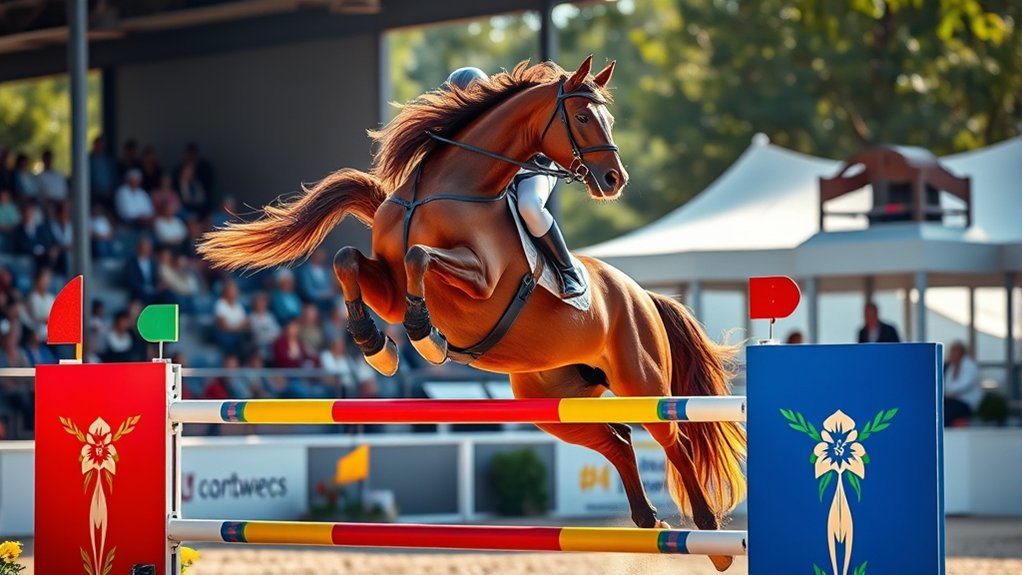
What exactly is show jumping? Show jumping is an equestrian sport where you and your horse navigate a course of obstacles designed to test agility, speed, and control.
The course includes various jumps like verticals, oxers, and combinations that challenge both horse and rider. Your goal is to complete the course cleanly, avoiding faults such as knocking down rails, refusals, or exceeding the time allowed.
Each fault results in penalties that add to your score. Precision and timing are critical because the rider must balance speed with accuracy to minimize faults.
If multiple pairs clear the course without faults, a jump-off determines the winner based on the fastest clear round. The sport operates under strict rules established by governing bodies like the FEI, ensuring standardized competition worldwide.
How Show Jumping Fits Into Equestrian Sports
Show jumping stands out among equestrian disciplines by emphasizing the horse and rider’s ability to clear a series of obstacles within a set time. As a key branch of equestrian sports, show jumping demands precision in course design and strict adherence to rules.
Competitions penalize jumping faults such as knockdowns or refusals, and time penalties further influence scoring. Its inclusion in the Olympic Games alongside dressage and eventing underlines its elite status in international competition.
| Aspect | Description | Impact on Competition |
|---|---|---|
| Course Design | Varied obstacles and layout | Tests agility and strategy |
| Jumping Faults | Knockdowns, refusals | Penalty points added |
| Penalties | Time faults, course errors | Affects final ranking |
| Olympic Games | Official equestrian discipline | Global recognition |
| Competition | Timed rounds with scoring system | Determines winner |
The History of Show Jumping
How did jumping over fences evolve into the structured sport recognized worldwide today? Show jumping’s history began in the late 19th century, developing from fox hunting fences and cross-country jumping competitions in France and Britain.
Show jumping originated in the late 19th century, evolving from fox hunting and cross-country jumping events.
The first major show jumping event took place at Olympia, London, in 1907, marking its rise in prominence.
Formal rules emerged in the 1920s, with the British Showjumping Association founded in 1925 to standardize competition.
Show jumping debuted as an Olympic discipline in 1900, gradually refining rules to emphasize speed, accuracy, and fault elimination.
Today, the FEI governs show jumping internationally, ensuring uniform regulations for fences, course design, and judging.
This evolution from informal fence jumping to a precise, rule-driven sport highlights its technical demands and global appeal.
What Is Show Jumping Called Around the World?
Although the sport maintains consistent fundamentals worldwide, its name varies across regions, reflecting local traditions and language. In the United Kingdom, you’ll hear it called “Jumping,” while in North America, the term “Hunter Jumper” dominates. This emphasizes the discipline’s roots in hunting-style equestrian events.
France refers to show jumping as “Concours de Saut” or “Saut d’Obstacle,” highlighting the technical challenge of maneuvering a course of obstacles.
Many European countries, including Germany and Italy, use “Jumping” or “Jumping Course” to describe these competitions.
In Australia and New Zealand, the terminology aligns with the United States, commonly using “Show Jumping.”
At international competitions like the Olympics and FEI events, “Jumping” serves as the standard term, underscoring its global recognition within equestrian disciplines.
How Show Jumping Differs From Other Jumping Sports
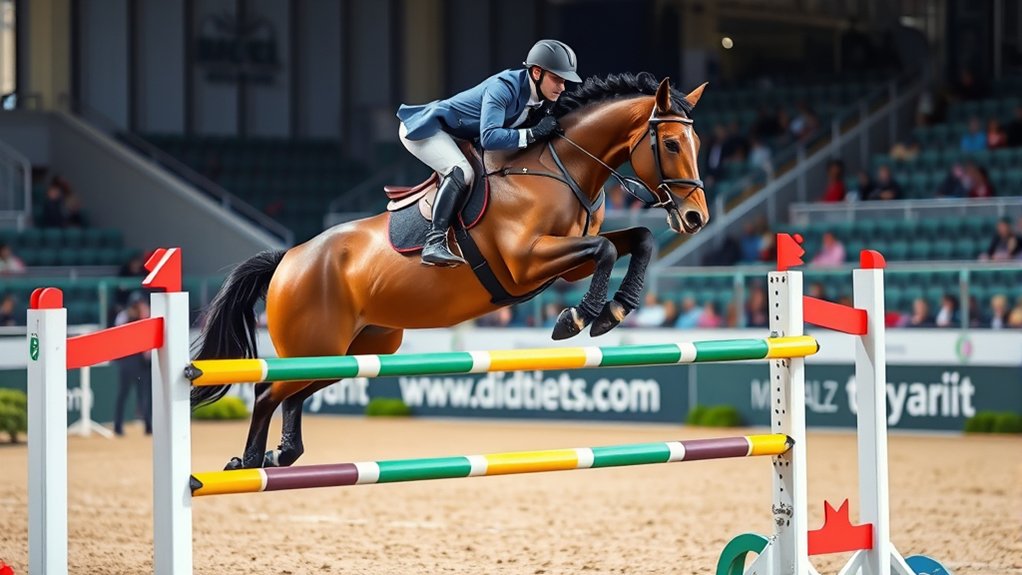
You’ll find that show jumping is all about navigating a set course of obstacles quickly and accurately, all within a controlled arena. It’s pretty different from eventing, which mixes cross-country endurance and dressage into one challenge.
Show jumping zeroes in on clear rounds and fast, flawless performances.
Then there are hunter classes, which take a different approach altogether. Instead of speed and precision, they focus more on style and form, making them quite distinct from the fast-paced demands of show jumping.
Show Jumping Basics
When you watch show jumping, you’ll notice it emphasizes speed and accuracy as horse and rider navigate a carefully designed course within an enclosed arena.
In show jumping, the course consists of a series of man-made jumps and obstacles arranged to test agility and precision.
Each jump is constructed for safety and consistency, often brightly colored to enhance visibility.
Your goal is to clear all jumps without faults, which are penalties assigned for knockdowns, refusals, or exceeding time limits.
Unlike other equestrian jumping disciplines, show jumping strictly governs fault penalties and course design, ensuring a standardized competitive environment.
The sport also features jump-offs to break ties, prioritizing the fastest clear round.
This focus on speed, accuracy, and controlled obstacles distinctly defines show jumping.
Comparison With Eventing
Show jumping centers on speed and accuracy within a controlled arena, but comparing it to eventing reveals key differences that affect how you approach each discipline.
In show jumping, you navigate a course of man-made obstacles designed for precision and quick recovery, focusing solely on faults and time penalties within the arena.
Eventing, however, tests versatility across three phases: dressage, cross-country, and show jumping. The cross-country phase challenges you with natural, varied obstacles like ditches, water crossings, and banks over diverse terrain at higher speeds. It demands endurance and adaptability.
Unlike show jumping’s isolated scoring, eventing combines penalties from all phases into a cumulative total, reflecting overall performance.
Understanding these distinctions helps you tailor your training and strategy depending on whether you’re competing in the specialized show jumping arena or the multifaceted eventing competition.
Differences From Hunter Classes
Although both disciplines involve jumping, show jumping and hunter classes differ markedly in focus and judging criteria. Show jumping prioritizes speed, technical skill, and faultless clearance of complex obstacles within a timed course.
In contrast, hunter classes emphasize the horse’s style, manners, and smooth movement over speed. Course design in show jumping includes challenging elements like oxers and combinations, testing precision, while hunter courses flow more naturally. Faults in show jumping are strictly scored, unlike the more subjective style-based judging in hunter classes.
| Aspect | Show Jumping | Hunter Classes |
|---|---|---|
| Focus | Speed, faults, technical skill | Style, manners, smoothness |
| Course Design | Complex, technical obstacles | Flowing, natural jumps |
| Judging | Objective fault scoring | Subjective style and presentation |
| Competition | Timed rounds, jump-offs | Consistency and form emphasized |
The Types of Jumps in Show Jumping Courses
You’ll come across all sorts of jump types in show jumping courses, like verticals, oxers, and combination jumps. Each one challenges different parts of your horse’s athletic ability.
How a jump is built—its height, width, and where it fits in a combination—really changes how you need to approach it.
Common Jump Types
When maneuvering a jumping course, you’ll encounter various obstacle types designed to test both horse and rider. Verticals are straightforward jumps with upright poles and no spread, requiring precise timing.
Oxers, a common jump type, feature two standards supporting a spread fence, demanding your horse clear both height and width. They can be double or triple, but the spread never exceeds the height.
The triple bar, with three ascending rails, challenges your horse’s power and control.
Water jumps, like the Liverpool, incorporate a water tray or ditch beneath the obstacle, testing bravery and adaptability.
Course design often integrates these jump types to create varied technical demands. Understanding each jump’s characteristics helps you adjust stride and approach, optimizing performance across the course.
Combination Jump Challenges
Since combination jumps consist of two or three obstacles placed closely together, you must execute precise stride adjustments to navigate them successfully. These sequences often combine verticals and oxers, demanding quick rebalancing between elements.
Effective course navigation begins with careful course walking to determine exact stride counts between fences. Misjudging this can lead to faults, as failing to clear any element within the combination results in penalties and possibly a re-jump of the entire sequence.
Maintaining rhythm and balance is critical; abrupt changes compromise your horse’s approach and jump quality.
Mastering combination jumps requires anticipating stride length and adjusting dynamically to guarantee smooth transitions, minimize faults, and preserve competitive time throughout the course.
Jump Construction Features
How do different jump types challenge both horse and rider in show jumping courses? Verticals require precise clearance of jump height without spread, demanding careful timing and accuracy.
Oxers increase complexity by combining height and spread, forcing horses to exert both upward and forward effort simultaneously.
Combination jumps, arranged closely, test your ability to manage stride length and rhythm efficiently through two or three sequential obstacles.
Course design strategically integrates these jump types, balancing technical difficulty and flow.
Additionally, specialized jumps like the Liverpool introduce a water element, which can affect the horse’s takeoff and landing mechanics.
Understanding these construction features helps you anticipate the physical and mental demands placed on horse and rider, enabling more effective preparation and execution during competition.
How Scoring Works in Show Jumping Competitions
Although completing a show jumping course quickly is important, your score hinges primarily on avoiding faults like knocking down rails or refusals. These typically add four penalty points each.
Your overall score combines penalty points from faults and time faults incurred when exceeding the allotted time.
Your final score reflects both faults and any penalty points from exceeding the time limit.
Here’s how scoring works:
- Faults: Each rail knocked down or refusal adds four penalty points to your score.
- Timing: You must complete the course within the time limit. Exceeding it results in time faults, usually one penalty point per second over.
- Clear Round: Achieving zero faults and staying within time grants a clear round. This often advances you to a jump-off where the fastest faultless round wins.
Your goal is to minimize faults and time faults for the lowest possible score.
Tack and Rider Attire in Show Jumping
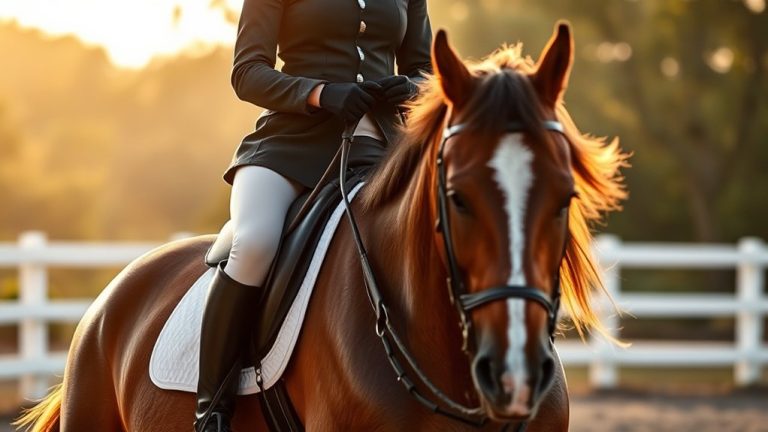
When you prepare for show jumping, your choice of tack and attire plays a crucial role in both performance and safety. Your rider attire must comply with the show jumping dress code, which typically includes a fitted jacket in dark or tweed fabrics, white or light-colored breeches, and a light-colored shirt paired with a choker or stock tie.
Always wear a certified riding helmet with a secure harness and tall black riding boots for protection and maximum grip. The saddle design is critical; a forward, close-contact saddle with shorter stirrups helps you maintain balance and security over jumps.
Furthermore, your horse should wear protective equipment such as tendon, fetlock, or splint boots to prevent leg injuries during rounds. This precise combination ensures you meet competition standards while maximizing safety and control.
Popular Show Jumping Competition Formats
You’ll come across several competition formats in show jumping, and each one has its own set of scoring rules. These rules mainly focus on faults and time.
Faults usually happen when there are knockdowns, refusals, or when the rider exceeds the allowed time. These faults directly affect your score.
Common Competition Types
Since horse jumping includes various formats, understanding the common competition types is key to grasping the sport’s structure.
In show jumping, you’ll find distinct event categories, each with unique rules and obstacle specifications:
- Grand Prix: This top international event features obstacles up to 1.6 meters. Riders compete in timed rounds, often leading to jump-offs to break ties.
- Nations Cup: Teams represent their countries across multiple rounds and disciplines, focusing on collective strategy and consistency.
- Speed Classes: These focus on completing courses quickly and without faults, with strict time limits and penalties for going over.
Plus, the puissance tests horses’ ability to clear very high walls, sometimes over 7 feet, showcasing raw jumping power within the sport’s competitive range.
Scoring And Faults
Although show jumping emphasizes speed and agility, accurate scoring hinges on fault assessment and time penalties. Faults are penalties incurred for errors like knocking down rails (4 faults), refusals, or exceeding the allotted time.
Time penalties add faults, usually 1 per second over the limit, impacting your overall score. Achieving a clear round, where you complete the course without faults, often leads to a jump-off if multiple riders remain fault-free.
The jump-off is a shortened, faster round designed to test your precision and speed, with the lowest combined faults and fastest time determining the winner.
In scoring, minimizing faults and time penalties is critical.
Refusals and knockdowns directly raise your penalties incurred, so you must balance speed with control to excel in competition.
Why Is Show Jumping Called “Stadium Jumping”?
Three key factors explain why show jumping is called “stadium jumping.” The term originates from the sport’s shift into enclosed arenas designed specifically for spectator viewing, where horse and rider navigate a predetermined course of jumps.
You’ll find that stadium jumping emphasizes a controlled environment within an enclosed arena, differentiating it from outdoor or cross-country jumping. The obstacle course is designed for indoor competition, making it a true spectator sport with clear visibility and regulated conditions.
This format highlights precision and speed as horse and rider tackle jumps in a confined, stadium-like setting, often showcased in major events such as the Olympics.
Understanding these points clarifies why “stadium jumping” reflects the sport’s evolution into a highly organized, spectator-friendly discipline within indoor venues.
Frequently Asked Questions
How Do Horses Train Specifically for Show Jumping?
You train horses for show jumping by combining fitness training with dressage techniques to improve balance and responsiveness.
Start with warm-up exercises to prevent injury, followed by saddle fitting to guarantee comfort and control.
Incorporate grooming routines to maintain coat health and monitor condition.
Develop nutrition plans tailored for energy and recovery.
Don’t forget mental preparation. Desensitization and confidence-building exercises help horses stay calm and focused during complex courses.
What Breeds Are Best Suited for Show Jumping?
Imagine knights selecting steeds before tournaments. Today, you’d choose Warmbloods like Dutch Warmbloods or Hanoverians for their ideal horse breed characteristics: athleticism, strength, and temperament.
Thoroughbreds excel in speed and agility, which are essential for show jumping. The history and competition scoring system demands these qualities.
Equine training methods and rider qualification criteria emphasize breeds like Selle Français and Irish Sport Horses.
How Long Does a Typical Show Jumping Round Last?
A typical show jumping round lasts 60 to 90 seconds, depending on course design and obstacle types. You’ll need precise horse jump techniques and maintain ideal rider posture to meet jump height standards efficiently.
Timing strategies are essential to avoid penalties under show jumping rules. Faster rounds, like jump-offs, last 30 to 60 seconds.
Mastering these elements lets you navigate the course smoothly while staying within the allowed time.
Are There Age Limits for Riders in Show Jumping?
You won’t find universal age limits in show jumping, as rules vary by equestrian competitions and governing bodies. Training techniques and riding positions are adapted for juniors through seniors.
Famous show jumpers often start young, benefiting from horse jumping history insights. While some high-level events enforce minimum ages, most local shows include categories by age.
Understanding jump obstacle types and show jumping rules helps tailor your progression effectively.
What Safety Gear Is Mandatory for Riders During Competitions?
When it comes to safety, you can’t put all your eggs in one basket. Helmet safety is non-negotiable, requiring certified helmets with proper harnesses.
Protective vests or body protectors safeguard your torso, while riding boots ensure ankle support and grip.
Gloves gear improves rein control, and safety stirrups reduce fall risks.
Reflective clothing isn’t always mandatory but enhances visibility.
Together, these elements form an extensive safety system during competitions.
Conclusion
Now that you’ve unraveled the world of show jumping, you see it’s more than just horses clearing fences. It’s a symphony of precision, skill, and timing.
Whether you call it stadium jumping or show jumping, this sport demands a sharp eye and steady hand. Like a finely tuned machine, every detail from scoring to attire works together seamlessly.
This makes show jumping a thrilling blend of athleticism and strategy you won’t want to miss.