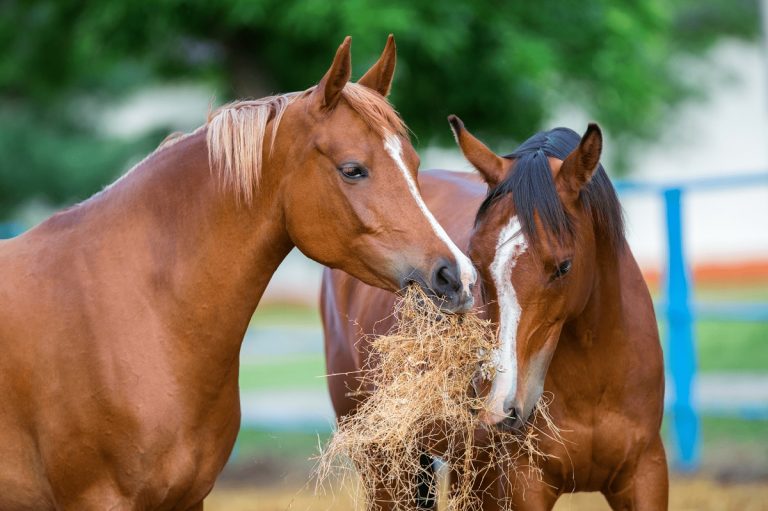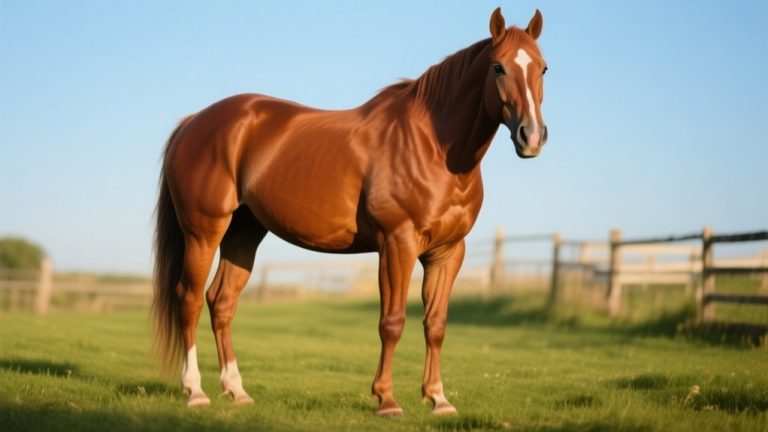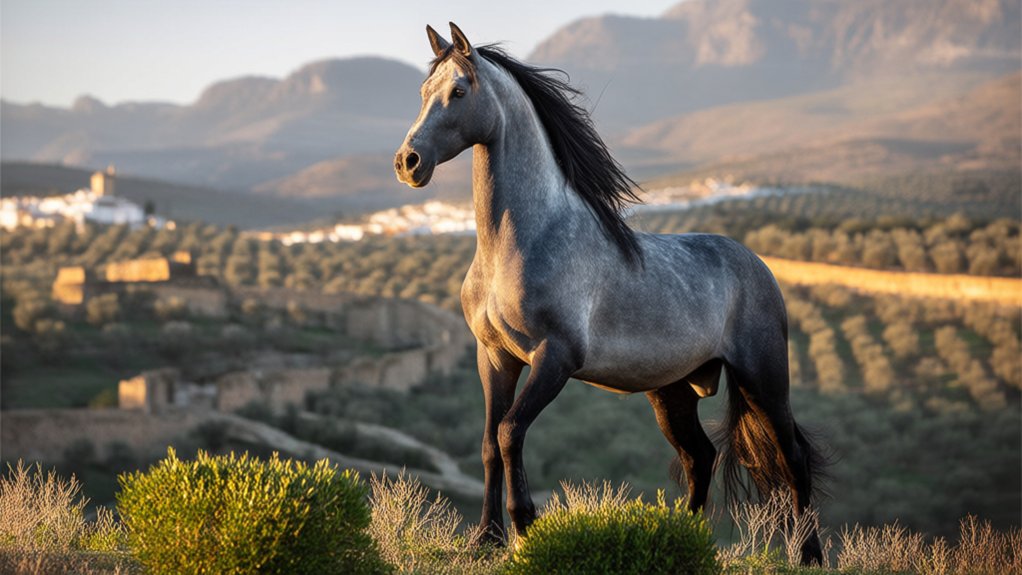
Where Do Andalusian Horses Come From – The Full Story
You’ll find Andalusian horses trace back over 20,000 years to prehistoric Iberian horses. They were shaped by Roman cavalry and Moorish Barb bloodlines, which enhanced their agility, stamina, and noble gait.
Carefully preserved by Carthusian monks since the 16th century, this breed developed distinct standards and refined traits that symbolize European aristocracy. They were bred for elegance and endurance.
Andalusians spread globally and influenced many other breeds. Exploring further reveals their rich heritage, breed variations, and ongoing preservation challenges.
Ancient Origins of Andalusian Horses on the Iberian Peninsula
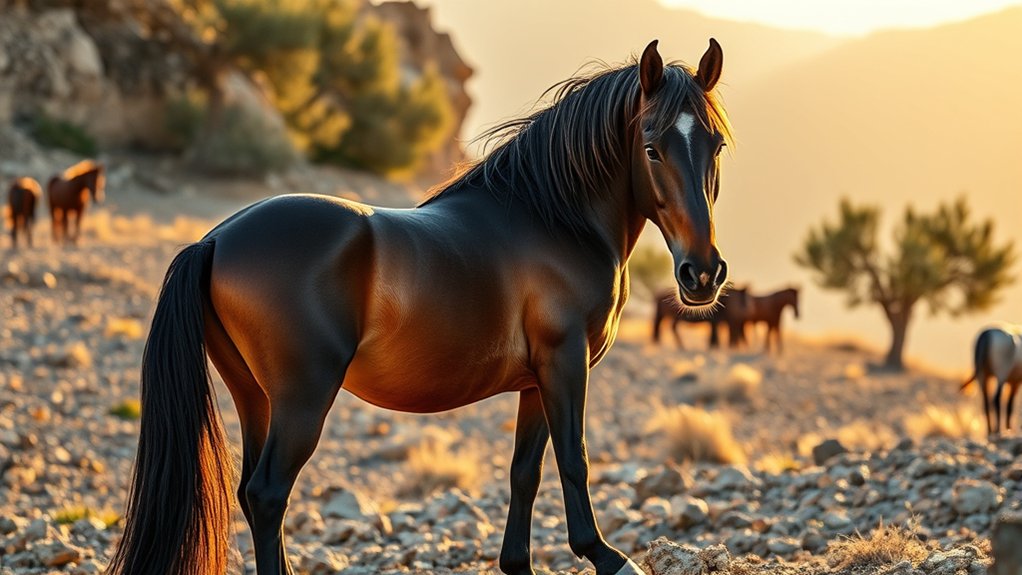
Although the Andalusian horse is celebrated today for its elegance and strength, its origins trace back over 20,000 years to the ancient Iberian horses that roamed the peninsula. You can see evidence of these early horses in cave paintings from Altamira and Casa Cusau, dating between 12,000 and 30,000 years ago. These paintings depict horses resembling modern Andalusians in build.
Genetic studies confirm a direct link between these prehistoric horses and the Andalusian lineage. They highlight traits like a calm temperament and robust bone structure. The Iberian Peninsula’s location allowed early domestication and selective breeding. This made these horses among Europe’s oldest breeds.
Paleolithic artifacts also reveal the cultural significance horses held for early Iberian societies. This underscores their integral role from prehistoric times. So, the Andalusian horse isn’t just a beautiful breed today—it carries a rich history that goes way back.
Roman and Moorish Influences on the Andalusian Breed
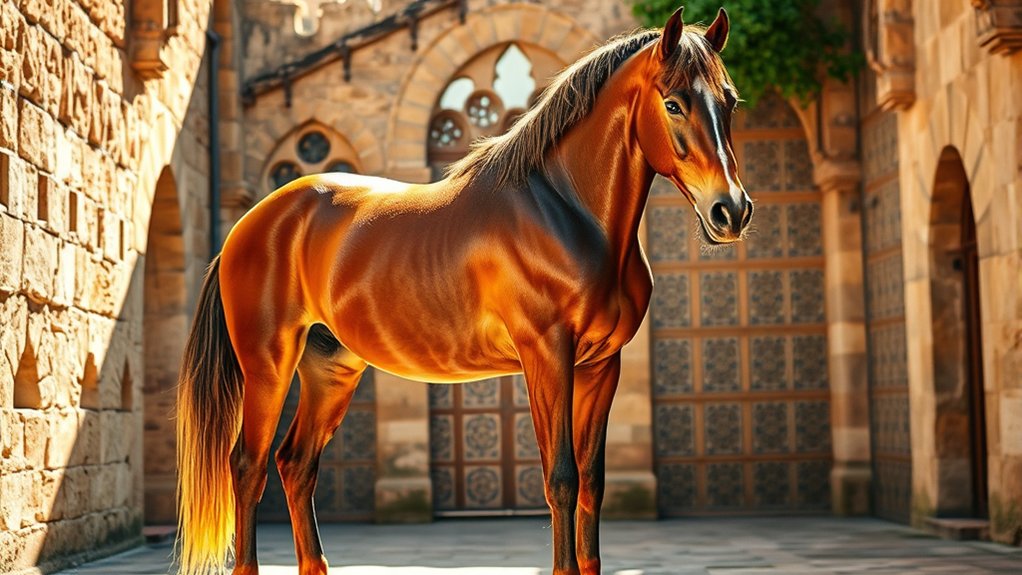
You’ll notice that Roman cavalry really valued Iberian horses because of their strength and calm temperament. This appreciation set the stage for selective breeding.
Then, when the Moors arrived, they brought Barb horses with them. These horses added greater stamina and a more refined gait to the local horses.
Roman Cavalry Contributions
When you examine the origins of the Andalusian horse, the Roman cavalry’s reliance on Iberian horses stands out as a pivotal influence. Romans prized these horses for their agility, strength, and versatility, making them ideal mounts in battle.
Historical records and inscriptions highlight Iberian horses as elite cavalry partners, driving selective breeding to enhance desired traits.
This Roman preference helped shape the Andalusian’s foundational characteristics. Key contributions include:
- Enhanced agility and strength favored in Roman military campaigns
- Elite status in the Roman cavalry, influencing breeding standards
- Spread of Iberian bloodlines across the Roman Empire, increasing genetic diversity
All these factors laid the groundwork for the Andalusian’s noble stature, athleticism, and trainability that persist today. It’s pretty amazing how much the Romans influenced these horses we admire now.
Moorish Bloodline Impact
Building on the Roman influence, the Moorish Barb horses brought to the Iberian Peninsula during the 8th century introduced new bloodlines that deeply shaped the Andalusian breed. These Moorish breeders selectively enhanced the Barb traits, emphasizing agility, stamina, and an elegant, expressive gait.
Genetic studies confirm crossbreeding between Andalusian and Barb horses across the Strait of Gibraltar, which contributed markedly to the breed’s distinctive characteristics. The Moors also introduced advanced riding techniques and refined breeding practices, which elevated the Andalusian’s reputation as a highly trainable and versatile warhorse.
This integration of Moorish bloodlines not only enhanced physical traits but also helped establish the Andalusian as a noble breed prized throughout Europe and beyond. It really cemented the breed’s historical and cultural importance.
Gait and Stamina Enhancements
Although the Andalusian breed’s elegance is often celebrated, its exceptional gait and stamina come from centuries of selective breeding influenced by Roman and Moorish cavalry needs. You can actually trace the breed’s endurance and fluid movement back to two key historical bloodlines that shaped its abilities.
The Romans really valued Iberian horses for their stamina and agility during long campaigns.
Then the Moors introduced Barb bloodlines, which helped boost strength and quickness. This mix made the Andalusian perfect for both warfare and extended riding.
Some key enhancements include improved endurance for long-distance travel and battle.
The breed’s energetic, powerful gait is ideal for cavalry maneuvers.
Plus, there’s increased resilience and strength thanks to the Barb genetics.
You can clearly see these traits reflected in the Andalusian’s renowned performance and stamina even today.
How Carthusian Monks Preserved Andalusian Bloodlines
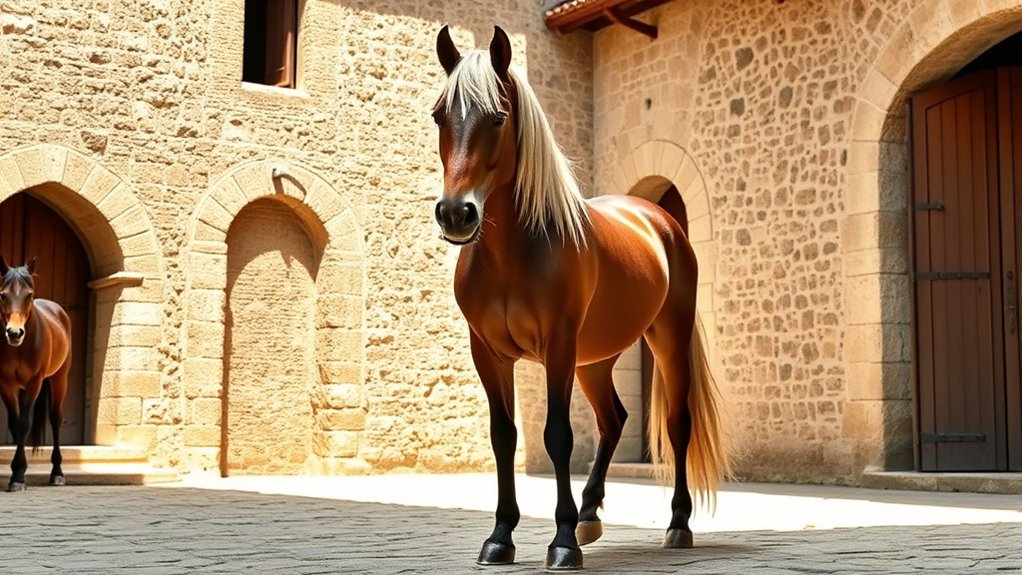
Since the early 18th century, Carthusian monks have played an essential role in preserving the purest Andalusian bloodlines by meticulously breeding horses that embody the breed’s classical traits. They kept detailed pedigrees and breeding records, which safeguarded the genetic integrity of their stock across generations.
The Carthusian strain is notable for its distinctive oriental head shapes and frequent gray coat coloration, setting it apart within the Andalusian breed. Despite significant losses during the Peninsular Wars, families like the Zapatas revived and maintained this lineage.
When you study the Carthusian line today, you see a crucial, highly prized subset of Andalusians that directly connects to the breed’s historic purity and foundational characteristics. It’s pretty fascinating how these monks and families managed to keep this bloodline alive against the odds.
Development of Pure Spanish Horse Breed Standards
The meticulous efforts of Carthusian monks to preserve Andalusian bloodlines laid the groundwork for formalizing breed standards that would define the Pure Spanish Horse (PRE). In 1567, King Philip II officially established these standards to protect the breed’s purity and quality.
Carthusian monks and King Philip II pioneered the Pure Spanish Horse breed standards in 1567.
At the Royal Stables of Córdoba, selective breeding focused on enhancing key traits.
When you explore PRE standards, you’ll notice they emphasize a height of at least 15.0 hands for males and 14.3 hands for females, with elite stallions reaching 15.1 hands or more. They also highlight nobility in appearance and classical, expressive movement.
Plus, athletic ability suited for classical equestrian disciplines is a big part of the standard.
Pedigree records, maintained since the 13th century, ensured these traits were preserved and refined. This long history helped establish the Andalusian as a symbol of equestrian excellence worldwide.
It’s pretty impressive how these traditions have lasted so long and still influence the breed today.
The Spread of Andalusian Horses Across Europe and the Americas
You’ll notice how European royal courts really valued Andalusian horses for their elegance and versatility. They became symbols of status and power.
Then, when the Conquistadors headed to the New World, they brought these horses along. Their strength and agility played a big role in shaping colonial cavalry and breeding programs there.
On top of that, Andalusians were often given as diplomatic gifts, which helped spread their influence even further. This really cemented the breed’s reputation across continents.
European Royal Favor
Although Andalusian horses originated in Spain, their influence quickly extended across Europe and the Americas due to the strategic interests of European monarchs.
Kings like Louis XV and Louis XVI of France championed the breed for its nobility and athleticism, often immortalizing them in royal portraits.
Spain granted export rights exclusively to royal and noble families, establishing the Andalusian as the “Royal horse of Europe.”
Their spread came through diplomatic gifts, royal marriages, and military alliances, embedding them deeply in European aristocracy.
You’ll find key factors in their widespread favor:
- Preferred mounts in European cavalry and aristocratic riding schools
- Diplomatic tools strengthening alliances across France, Italy, and Austria
- Revered for bravery, elegance, and versatility on multiple continents
This royal patronage cemented the breed’s prestigious reputation well beyond Spain.
It’s no wonder they became such a symbol of nobility and grace across the continent.
Conquistadors And New World
European monarchs’ admiration for Andalusian horses set the stage for their journey beyond the continent, carried by Spanish conquistadors during the 16th century. You’ll find that these horses were essential for explorers, prized for their agility, strength, and intelligence in steering the New World.
As conquistadors advanced through the Americas, they depended heavily on Andalusians, which markedly influenced local breeds like the Mexican Azteca and Criollo.
Back in Europe, the breed’s reach expanded through military campaigns and royal patronage, becoming a symbol of status and power.
Andalusians also played a vital role in founding prominent European breeds such as the Lipizzaner and Friesian. This widespread distribution established a lasting legacy, linking the breed’s noble Spanish origins with its enduring global influence today.
Diplomatic Gifts And Influence
When Spanish royalty sent Andalusian horses as diplomatic gifts to monarchs across Europe, they weren’t just exchanging animals. They were forging alliances and projecting Spain’s power. These horses symbolized prestige and nobility, becoming treasured assets in royal courts.
You’ll find their influence evident in the 15th and 16th-century European courts, where Andalusians featured prominently in royal ceremonies and portraits, especially in France and England.
In the Americas, 16th-century Spanish explorers introduced Andalusians. This shaped breeds like the Mexican Azteca and American Quarter Horse.
There was widespread admiration that earned Andalusians the title “Royal Horse of Europe.” That really cemented their status across aristocratic circles.
Distinct Physical Traits and Movement of Andalusian Horses
If you examine Andalusian horses closely, you’ll notice their distinct physical traits that set them apart from other breeds. They stand around 15.0 hands for males and 14.3 for females, with elite stallions exceeding 15.1 hands. Their build is strong yet elegant, featuring a straight or slightly convex profile, long broad necks, well-defined withers, short backs, and broad hindquarters.
Their movement is equally distinctive. It’s extended, elevated, and balanced, combining roundness with forward motion. Agile and quick learners, they excel in dressage and advanced riding.
| Trait | Description | Significance |
|---|---|---|
| Height | 15.0+ hands (males), 14.3+ (females) | Ideal stature for versatility |
| Profile | Straight or slightly convex | Elegant appearance |
| Movement | Elevated, harmonious gait | Suited for dressage precision |
| Hindquarters | Broad, powerful | Provides strength and balance |
Subtypes, Bloodlines, and Unique Andalusian Strains
Although Andalusian horses share common ancestry, their subtypes and bloodlines reveal distinct genetic and phenotypic variations that affect their traits and uses. The renowned Carthusian strain, dating back to the early 18th century, is the purest, distinguished by a specific pedigree and dominant gray coat. While only about 12% of Andalusians belonged to this line historically, its preservation underscores its significance.
Andalusian horses exhibit unique traits shaped by distinct bloodlines, with the Carthusian strain renowned for its purity and gray coat.
Beyond Carthusian, other bloodlines like the Lusitano and regional variants offer diverse physical and performance traits. Understanding these subtypes helps you appreciate the breed’s complexity.
Here’s a quick look:
- Carthusian Andalusians: purest strain with royal origins and unique gray coloration
- Lusitano bloodline: closely related but with regional adaptations
- Crossbreeds like Warlander and Spanish-Norman: integrating Andalusian traits into new breeds
Andalusian Influence on Modern Horse Breeds Worldwide
Because Andalusian horses possess exceptional movement and temperament, they’ve played a crucial role in shaping many modern horse breeds across the globe. You’ll find their influence in European breeds like the Lipizzaner, Friesian, and Peruvian Paso, where Andalusian traits enhanced elegance and gait quality.
When Spanish conquistadors brought Andalusians to the Americas, they greatly impacted breeds such as the Quarter Horse, Mustang, and Azteca. Their influence improved agility, stamina, and versatility.
Their bloodlines also contributed to European warmbloods, refining performance in dressage and show jumping.
Today, you can still recognize Andalusian influence in the refined conformation, elevated movement, and noble bearing of many modern horses worldwide. It just goes to show the breed’s enduring legacy in equine development.
Global Distribution and Breeding Challenges Today
Where can you find Andalusian horses today, and what challenges do breeders face in maintaining this iconic breed? You’ll find them mainly in Spain, with about 185,926 registered as of 2010. There are also growing populations in the United States and Australia.
Since Spain began exporting Andalusians worldwide in 1962, international interest has surged. This became especially true after Australia eased quarantine restrictions in 1999. It really opened the door for more breeders and enthusiasts around the globe.
Spain’s 1962 exports and Australia’s 1999 quarantine easing sparked global enthusiasm for Andalusian horses.
However, breeders do face some significant hurdles. They need to maintain genetic diversity to prevent inbreeding. At the same time, preserving pure bloodlines can be tricky when population sizes fluctuate.
There are also historical and economic factors that impact the breed’s sustainability. Despite these challenges, sustainable breeding programs are in place. Plus, global collaborations are actively working to preserve the Andalusian’s cultural and historical legacy.
All of this helps ensure the future of the breed remains bright and authentic. It’s great to see so much dedication keeping this beautiful horse thriving worldwide.
Frequently Asked Questions
What Is the Average Lifespan of an Andalusian Horse?
You’ll find the average lifespan of an Andalusian horse ranges between 25 to 30 years. With proper care, nutrition, and veterinary attention, you can often extend their lives into their late twenties or early thirties.
It’s pretty amazing how much good care can make a difference. Just a little extra attention goes a long way in keeping these horses healthy and happy. So, if you’re thinking about having one, be ready to invest some time and love!
How Much Does an Andalusian Horse Typically Cost?
Buying an Andalusian horse can cost you anywhere from $10,000 to $50,000, depending on age, training, and bloodlines. Elite champions might exceed $100,000.
On the other hand, young, untrained ones usually start around $5,000 to $8,000. So, it really depends on what you’re looking for and how much experience the horse has.
What Are Common Health Issues in Andalusian Horses?
You’ll encounter common Andalusian health issues like navicular disease, arthritis, and genetic disorders such as epilepsy. Watch for equine herpesvirus outbreaks and fungal infections in their thick mane and tail.
It’s important to ensure regular vet care and genetic screening to keep your horse healthy. Staying on top of these can really make a difference.
How Do You Train an Andalusian Horse for Dressage?
You’ll find that 70% of successful dressage trainers start by building trust and responsiveness through groundwork. Focus on agility with shifts and lateral movements. Gradually teach advanced movements using positive reinforcement and careful evaluation to avoid strain.
It’s important to go step by step and keep your horse comfortable throughout the process. Patience really pays off when you’re working on those tricky dressage techniques. Just remember, every horse learns at its own pace, so adjust your training accordingly.
What Kind of Diet Is Best for Andalusian Horses?
You should feed Andalusians high-quality forage like hay. Supplement with grains during heavy work, and always provide constant fresh water.
Adding vitamins or minerals is important too. Make sure to adjust their diet based on their age, activity, and health. This helps avoid deficiencies or obesity.
It’s all about balancing their needs to keep them healthy and happy!
Conclusion
Now that you’ve explored the rich history and enduring legacy of Andalusian horses, can you overlook their profound influence on equine breeds worldwide?
From ancient Iberian roots and Moorish enhancements to Carthusian monks’ careful preservation, these horses embody a unique blend of strength, elegance, and tradition. Understanding their distinct traits and global spread helps you appreciate not just their beauty but the complex genetic and cultural journey.
This journey continues to shape their future in breeding programs globally. It’s pretty amazing how much history and heritage come together in these magnificent animals.