How Do Horses Communicate?
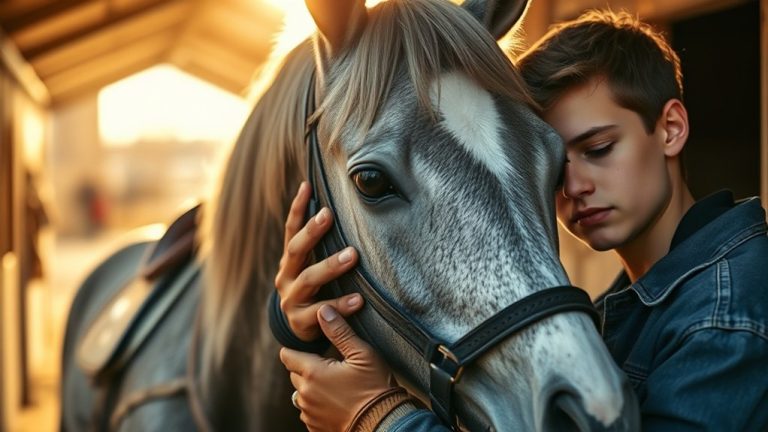
You can understand horses by observing their body language, including ear positions. Forward means alert, and pinned back signals aggression. Eye expressions also tell a lot—wide eyes show fear, while soft blinking indicates trust.
Tail movements reveal excitement or irritation, and vocalizations convey social and emotional messages. Recognizing these subtle cues helps you respond calmly and build trust.
As you explore further, you’ll discover how environment, social learning, and your own responses deepen communication and strengthen your bond.
How Horses Use Body Language
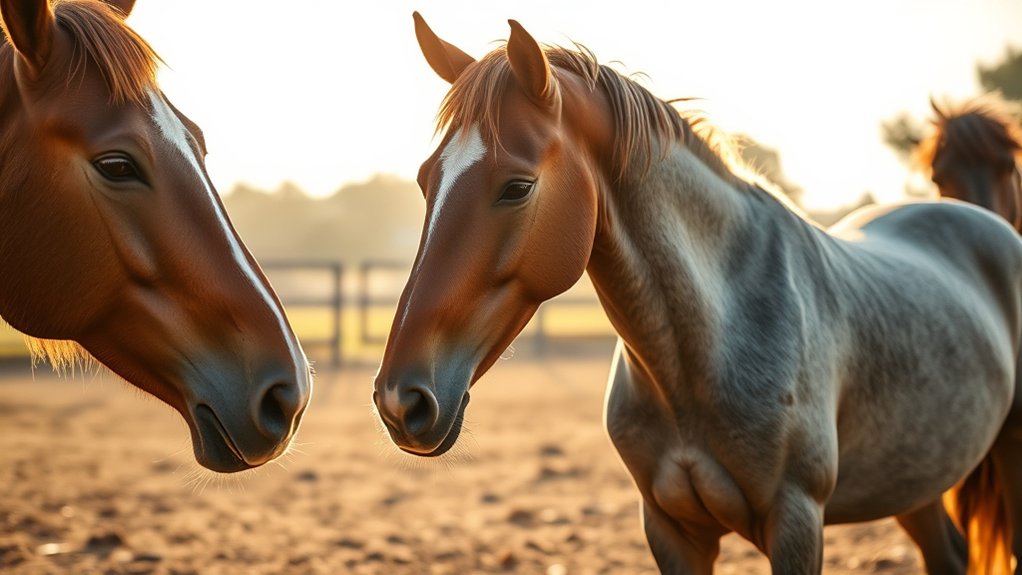
How exactly do horses convey their emotions without words? They rely heavily on body language, which offers you clear insights into their feelings. Tense muscles and a high-neck posture, for example, indicate fear or excitement.
You can observe a relaxed horse through its fluid, calm gait and soft, downward gaze, while stiff movements and wide eyes reveal tension. Tail position also communicates energy levels: a high tail signals excitement or alarm, whereas a low, limp tail suggests relaxation.
Subtle body shifts, like weight shifting or turning, help horses request attention, show submission, or establish social hierarchies within a herd. Paying close attention to these body language cues enables you to better understand a horse’s emotional state without hearing a single sound.
What Horse Ear Positions Mean
When you watch a horse’s ear positions, you get a pretty clear idea of how it’s feeling and what it’s paying attention to. For example, when its ears are pointing forward, the horse is usually curious or alert.
On the other hand, if the ears are pinned back, that often means the horse is feeling aggressive or uncomfortable.
It’s also helpful to look at the horse’s facial expressions along with its ear movements. Putting both together gives you a much better sense of what the horse is trying to tell you.
Ear Positions And Emotions
Why do horses move their ears in such distinct ways? The ear position of a horse plays a vital role in horse communication, often revealing their emotional state.
When you observe a horse with ears forward, paired with attentive horse’s eyes, it signals curiosity or interest.
Conversely, ears flattened back against the head usually indicate anger or irritation. You can confirm this by noting tense facial expressions.
If the ears rest sideways, the horse is likely calm or relaxed.
Horses can move their ears independently, allowing them to monitor their surroundings and communicate alertness.
Rapidly swiveling ears or ears pinned back often signal agitation or fear.
Ears Signal Attention
Observing a horse’s ears gives you clear insights into its level of attention and emotional state. When a horse’s ears point forward, it usually signals curiosity or alertness, showing the animal is focused on something in its environment.
If the ears are held sideways or slightly back, the horse tends to be relaxed, calmly taking in its surroundings without immediate concern.
Conversely, when the ears are pinned back flat against the head, this indicates anger, discomfort, or aggression.
The subtle movements and positioning of the ears act as a dynamic communication tool, allowing you to interpret what the horse is focusing on or feeling at any moment.
Ears Versus Facial Cues
Although facial expressions provide some clues to a horse’s emotions, their ear positions offer more direct and dynamic insights into what they’re feeling and focusing on. Ear direction reveals a horse’s immediate mood and attention more clearly than subtle facial cues.
When you observe a horse’s ears, you’re watching its primary channel for nonverbal communication.
Notice these key ear positions:
- Forward ears signal curiosity or interest in the environment.
- Pinned back ears indicate anger, discomfort, or defensive aggression.
- Constantly moving ears or those directed toward a sound show active information gathering.
How Horses Use Eye Signals in Communication
Because horses rely heavily on nonverbal cues, their eye signals play an essential role in communication. When a horse’s eyes widen, it often signals fear or alertness, while a downward gaze indicates submission or relaxation.
You can observe their focus by noting the direction of their eyes, revealing whether they’re attentive to a threat, food, or a handler. Softened eyes combined with slow blinking signal comfort and trust, showing the horse feels safe.
Conversely, narrowing or pinning the eyes signals irritation, aggression, or dominance, conveying mood without sound.
Tail Movement in Horse Communication
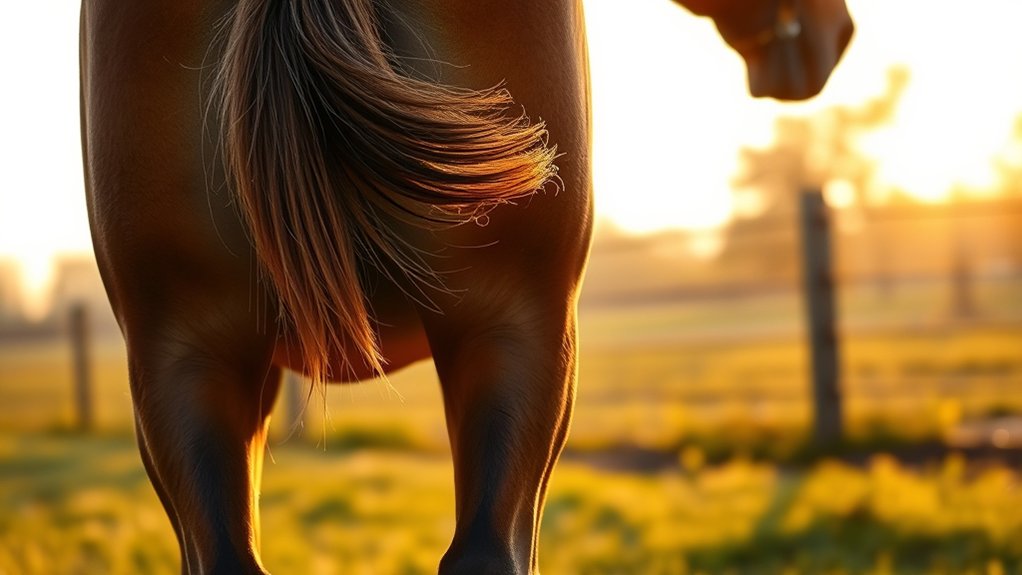
When a horse raises its tail high, it often signals excitement, fear, or alarm. This immediately alerts you to its heightened emotional state. The tail’s position and movement offer essential clues about what the horse feels or intends.
A high-raised tail signals a horse’s excitement, fear, or alarm, revealing its heightened emotional state.
You can interpret these subtle signals by observing:
- A low or limp tail, which typically indicates relaxation, comfort, or submission.
- Rapid tail swishing, often a sign of irritation, annoyance, or an effort to repel flies.
- A raised tail during social displays, signaling dominance or an attempt to attract attention.
What Horse Vocal Sounds Mean
Understanding horse vocalizations can provide valuable insights into their emotional states and social intentions. When you hear a whinny or neigh, these vocal cues often signal greeting, separation, or reassurance between horses.
A nicker conveys affection, whether directed at other horses, humans, or food, with tonal variations reflecting emotional intensity. Pay attention to a blow, a gusty nasal exhale, as it may indicate fear, curiosity, or excitement depending on context.
Squealing typically expresses aggression or dominance but can also denote pleasure during social interactions. These vocal cues transmit detailed information not only about a horse’s feelings and social dynamics but also about physical traits like size and sex.
How Horses Read Human Facial Expressions
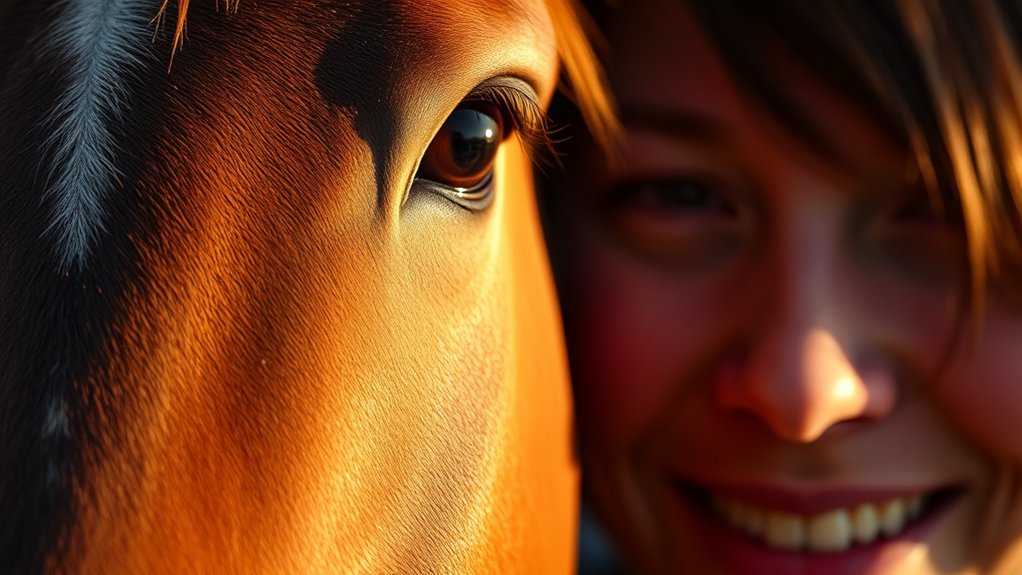
Horses don’t just communicate among themselves; they also read and respond to human facial expressions with remarkable sensitivity. When you communicate with horses, the horse might assess your emotional state by associating certain facial cues with past experiences. They take the time to notice details like the whites of the eyes and lip movements, which reveal intent and mood.
Understanding these subtle signals helps you determine the next step in your interaction.
- Horses increase heart rates and gaze with their left eye when detecting anger.
- They respond differently to happy, neutral, or negative expressions.
- Horses pay more attention to trusted humans’ facial cues, enhancing safety.
How Domestication Changed Horse Communication
You’ll notice that domestication has really sharpened horses’ ability to pick up on human cues. This happens mostly because of selective breeding and the way they adapt socially.
The environments we create for them—whether they’re rich and stimulating or more restrictive—play a big role in how horses express and improve their communication skills.
Plus, horses learn a lot from both humans and other horses, which keeps shaping how they interact as time goes on.
Domestication Enhances Human Cue Recognition
Since domestication began around 4,000 to 3,000 BCE, horses have developed a heightened ability to recognize and respond to human cues. Their social nature and facial recognition skills have made them particularly receptive to human signals.
Over time, individual experiences and domestication have refined how horses interpret body language and vocal cues. You’ll notice they respond more accurately when familiar with you, emphasizing the importance of positive interactions.
Key factors shaping this recognition include:
- Exposure to diverse human gestures and vocal tones.
- Consistent, positive human contact enhancing trust and attentiveness.
- Their innate social skills facilitating nuanced understanding of subtle cues.
Impact of Environment On Behavior
Although domestication has profoundly shaped equine behavior, the environment where horses live continues to play a critical role in their communication patterns. You’ll notice that environmental influence strongly affects how horses express themselves and interact.
Horses confined to stalls or isolated settings often show reduced natural social behaviors, limiting their ability to communicate effectively with peers. Conversely, those in enriched environments with regular social contact maintain more complex communication skills.
This environmental influence also impacts how horses respond to human cues. Positive interactions enhance their sensitivity to human body language and facial expressions. Understanding this dynamic helps you appreciate that domestication’s effects on communication are intertwined with the horse’s surroundings, emphasizing the importance of environment in shaping behavior beyond genetic domestication traits.
Social Learning Shapes Communication
How exactly has domestication transformed the way horses communicate with humans? Social learning plays a key role in this process, enhancing horses’ ability to interpret and respond to human cues. Their social nature and facial recognition skills allow them to read human expressions and body language more effectively.
Over time, individual experiences and positive interactions refine their communication skills. Consider these aspects:
- Younger horses rely on body orientation but improve through social learning.
- Positive human interactions reinforce responsiveness to subtle signals.
- Social environments influence communication, with isolation hindering skill development.
How to Recognize Signs of Stress and Relaxation in Horses
When you observe a horse closely, you can identify stress or relaxation by noting specific physical and behavioral cues. Relaxed horses exhibit soft eyes, relaxed ears, and slow, fluid movements. Stressed horses show pinned-back ears, wide eyes, and tense postures.
Behavioral cues such as lip licking, yawning, and soft blinking often indicate relaxation. On the other hand, rapid movements and frequent pawing usually signal stress. Physiological signs, including heart rate and breathing patterns, also provide insights into the horse’s emotional state.
| Sign | Relaxed | Stressed |
|---|---|---|
| Ears | Forward or floppy | Pinned back |
| Eyes | Soft, partially closed | Wide, showing whites |
| Tail | Low or limp | High |
| Movements | Slow, fluid | Rapid, tense |
| Facial Expression | Relaxed, lip licking, yawning | Tense, rapid responses |
How to Respond to Your Horse’s Communication Cues
Since horses communicate primarily through subtle body language and vocalizations, you need to observe their ears, eyes, tail, and overall posture closely to understand their emotional state. Pay particular attention to ear signals, as they provide immediate clues to your horse’s feelings.
When you notice pinned ears or a tense posture, respond calmly to reduce stress. Use your own body language, like a relaxed stance and slow movements, to reassure your horse.
Here’s how to respond effectively:
- Identify ear signals indicating discomfort or agitation and adjust your approach accordingly.
- Recognize vocal cues like nickers or blows and reply with patience and gentle touch.
- Match your responses consistently to build trust and encourage open communication.
This attentive, responsive behavior fosters mutual understanding and safety.
Why Knowing Horse Signals Builds Strong Partnerships
Although horses communicate primarily through subtle signals, your ability to recognize and interpret these cues directly influences the strength of your partnership.
Understanding subtle horse signals is key to building a strong, trusting partnership.
Ear signals, for example, reveal a horse’s focus and emotional state, guiding your responses to promote trust and mutual understanding.
By observing ear orientation alongside eye and tail movements, you accurately assess your horse’s feelings, reducing misunderstandings.
This detailed awareness enables you to lead with respect rather than dominance, fostering cooperation.
Responding appropriately to these signals encourages your horse’s relaxed, confident behavior, reinforcing your bond.
Consistent, clear communication through horse signals enhances safety and emotional connection, ensuring long-term partnership success.
Ultimately, knowing these signals transforms interactions into a dialogue built on trust and shared understanding.
Frequently Asked Questions
Do Horses Use Scent to Communicate With Each Other?
Yes, horses use scent marking extensively to communicate with each other. When you observe them, you’ll notice they deposit glandular secretions, urine, or feces on objects or areas. This conveys information about territory, reproductive status, and social hierarchy.
You’ll see horses sniffing one another to gather detailed olfactory cues about health and emotions. This scent marking plays a vital role in their social interactions and helps them navigate their environment effectively.
How Do Foals Learn Communication From Their Mothers?
You’ll notice foals learn communication through the mother-infant bond by closely observing their mother’s body language, vocalizations, and facial expressions. They mimic ear, eye, and tail movements, gaining insight into social cues and emotional states.
The mother uses calming signals and nickers to guide them, helping the foal understand boundaries and social hierarchy. This early interaction sharpens their ability to interpret subtle signals essential for social development.
Can Horses Understand Communication Between Different Horse Breeds?
You’d think horses from different breeds speak entirely different languages, but they actually understand each other well despite breed distinctions.
Their communication relies on universal body language, like ear position and tail movement, that transcends breed differences.
Horses adapt their signals during cross-breed interactions, showing that social experience matters more than breed.
How Do Wild Horses Communicate Differently Than Domestic Horses?
You’ll notice wild horses rely more on subtle vocal signals, like specific whinnies or neighs during reunions or warnings. Unlike domestic horses, who vocalize more frequently.
Wild horses emphasize body language for communication to avoid predators, preserving natural behaviors.
Domestic horses, influenced by humans, often develop altered vocal patterns, making their signals less instinctual.
Observing these differences reveals how environment shapes their communication methods scientifically and precisely.
Are There Seasonal Changes in Horse Communication Behaviors?
You’ll notice seasonal signals sharply contrast in horses: vibrant vocalizations and energetic tail flicks dominate spring and fall.
Winter brings subdued gestures and fewer sounds. In breeding season, stallions amplify aggressive body language to assert dominance.
You’ll also see more frequent ear movements and nickers during warmer months, reflecting social engagement.
These seasonal shifts highlight horses’ adaptive communication strategies, balancing energy conservation with social interaction throughout the year.
Conclusion
Imagine standing beside your horse, eyes meeting, ears twitching, tail flicking, a silent conversation flowing between you. By tuning into these subtle signals, you discover a language shaped by evolution and domestication.
Recognizing stress or calm and understanding each ear flick or vocalization lets you respond with empathy and precision. This scientific awareness deepens your bond, transforming interaction into partnership.
Every gesture speaks volumes in the quiet world of horse communication.