Are Horses Prey Animals?
Yes, horses are prey animals with highly developed senses like nearly 360° vision, acute hearing, and a strong sense of smell that help you detect threats early. Their primary survival strategy is flight, triggered by fast hormonal responses, though they may briefly freeze to assess danger.
Living in small herds led by a dominant mare enhances their protection through social bonds and communication. Understanding these behaviors reveals much about their natural instincts and needs.
What Does It Mean That Horses Are Prey Animals?
Because horses evolved as prey animals, they’ve developed acute senses and swift flight responses to survive predators. As prey animals, horses depend on detecting threats early through keen eyesight, hearing, and smell.
Their survival hinges on rapid assessment and immediate reaction, often favoring flight over confrontation.
You’ll notice horses react instinctively to sudden movements or unfamiliar stimuli, reflecting their ingrained alertness. This heightened sensitivity allows them to avoid danger before it escalates.
Furthermore, horses tend to conceal pain or weakness, a behavior rooted in preventing predators from targeting vulnerable individuals.
Understanding that horses are prey animals helps explain their cautious, reactive nature and reliance on flight responses, emphasizing the evolutionary adaptations that prioritize escape and self-preservation in the wild.
How Do Horses Use Fight-Or-Flight to Stay Safe?
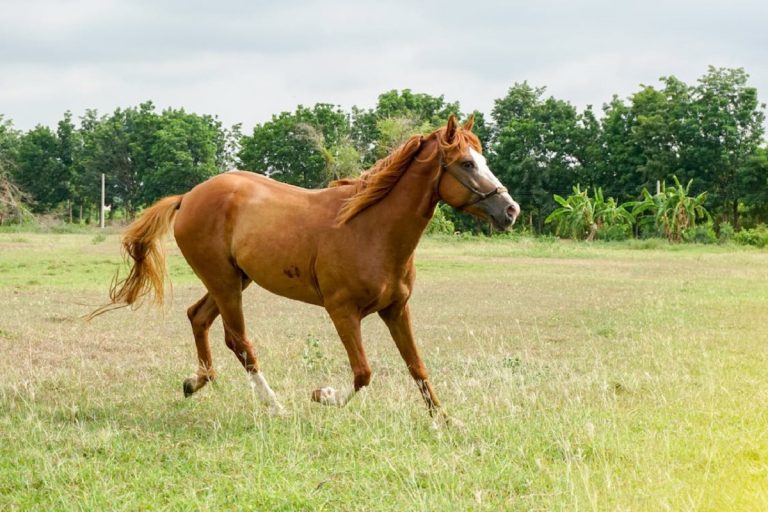
Although horses can choose to confront threats, they mainly rely on their flight response to stay safe. When you observe a horse detecting danger, its amygdala triggers the release of adrenaline and cortisol, priming muscles for rapid escape.
Horses detect danger through their amygdala, releasing adrenaline and cortisol to prepare for swift escape.
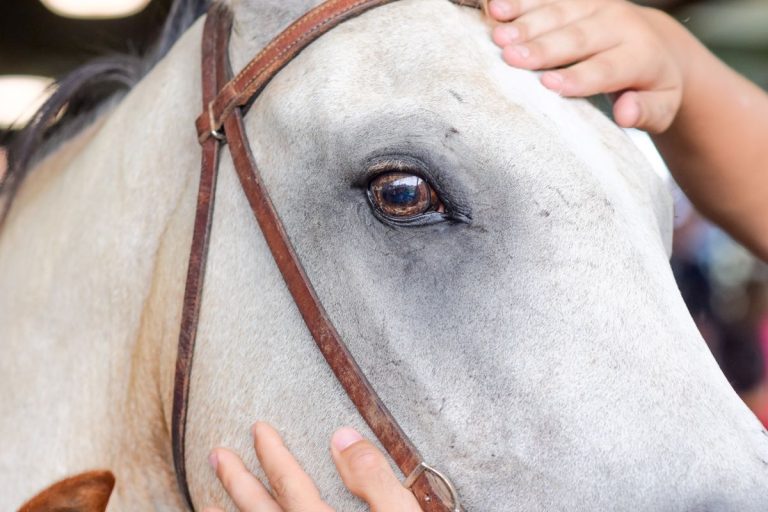
Horses’ vision, which spans nearly 360 degrees, allows you to see how they scan their environment for threats, especially when in a herd. This wide-angle vision, combined with acute hearing, enables early detection of predators.
Once a threat activates the fight-or-flight mechanism, horses prioritize fleeing to increase survival chances.
After escaping, their parasympathetic nervous system lowers adrenaline, restoring calm.
Understanding this process helps you appreciate how horses use physiological and sensory adaptations to respond swiftly and effectively to dangers in their environment.
Why Do Horses Freeze Before They Flee?
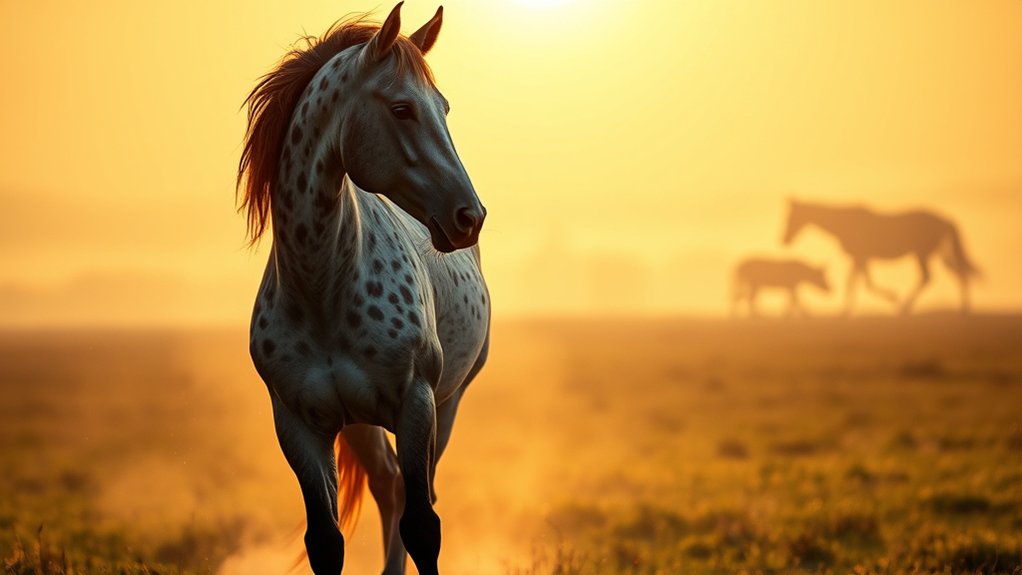
When a horse senses danger, it often freezes first to assess the threat before deciding how to respond. This freeze is an innate survival mechanism triggered by the amygdala, which processes fear and activates the fight-or-flight response.
By freezing, horses minimize movement, making it harder for predators to detect them. Observing horses’ body language during this freeze reveals heightened alertness. Their ears point forward, muscles tense, and eyes widen to gather critical information.
This pause allows the horse to evaluate whether immediate flight or remaining still offers the best chance of survival. The freeze response is a strategic, adaptive behavior that gives horses extra time to choose the safest option.
Understanding this aspect of horses’ body language helps clarify why freezing comes before fleeing in their natural defense repertoire.
How Herd Life Protects Horses in the Wild
You count on the herd’s social structure to keep you safe. Usually, a dominant mare takes the lead, while a stallion stays alert and defends the group from any threats.
The herd is always in communication, using body language and vocal signals to stay connected and aware of what’s going on around them.
Herd Dynamics And Safety
Because wild horses live in small, organized herds led by a dominant mare, their collective behavior substantially enhances safety. Herd dynamics rely on coordinated vigilance, where higher-ranked members initiate movement and alert the group to threats. This structure reduces each individual’s vulnerability by distributing awareness and enabling rapid, collective responses.
The herd’s social bonds and territorial cohesion make it difficult for predators to isolate a single horse. Peripheral stallions and the lead mare coordinate defense and resource gathering, maintaining group integrity.
You can see how these herd dynamics create a natural defense mechanism, markedly increasing survival chances.
In the wild, this organized social system ensures safety through collective action, illustrating how horses depend on group behavior to mitigate predation risks.
Leadership Roles And Protection
The coordinated vigilance and social bonds within a herd set the stage for clearly defined leadership roles that enhance protection. In wild horse herds, a dominant mare leads the group, guiding it to resources and maintaining cohesion.
Her leadership role involves managing daily routines and ensuring safety through social and protective behaviors.
A single stallion complements this by defending the herd from predators and rival males, exhibiting territorial and protective actions.
During threats, both the lead mare and stallion coordinate protective measures, relying on collective vigilance to detect danger early.
This dynamic balance of leadership roles allows the herd to respond effectively to external threats.
Understanding these roles highlights how herd life fundamentally supports the horses’ survival in the wild through structured protection.
Who Leads the Herd and Why It Matters for Survival
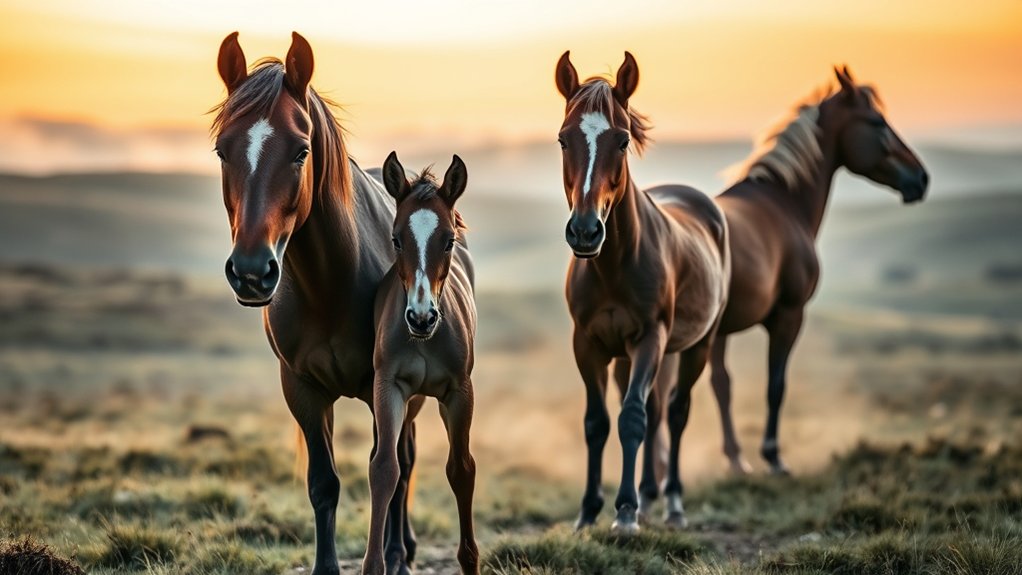
How does a horse herd maintain cohesion and survive in the wild? Herd leadership centers on an experienced alpha mare who guides the group to resources and safety. This social hierarchy depends not on physical dominance but on trust and social bonds.
The lead mare sets the herd’s daily movement and decision-making, ensuring efficient navigation of threats. Her role is essential for maintaining social order, reducing aggression, and fostering group cohesion.
Meanwhile, stallions typically remain on the herd’s periphery, focusing on defense rather than directing activities.
This structured leadership enhances the herd’s chances of survival by promoting coordinated responses to environmental challenges.
Understanding this dynamic shows that survival hinges on cooperation led by the alpha mare, not merely on strength or aggression.
What Stallions Do in the Herd
While alpha mares guide daily herd movements, stallions play a crucial role by defending the group’s boundaries and protecting their mares from predators and rival males. You’ll notice stallions typically position themselves on the herd’s periphery, remaining alert to threats.
During the breeding season, they intensify aggressive behaviors to guard females and uphold their status within the dominance hierarchy. Stallions use scent-marking, like urination and manure placement, to establish territory and attract mares.
Their protective nature often leads to driving off rival males, sometimes engaging in fights to assert dominance.
In domesticated environments, stallions are usually separated or closely monitored to prevent conflict and unwanted breeding.
Understanding these roles helps you appreciate how stallions contribute to herd stability and survival dynamics.
How Horses Communicate Danger and Comfort
Because horses rely heavily on social cohesion for survival, they’ve developed a sophisticated system of communication to signal danger and convey comfort within the herd.
As prey animals, effective horse communication is essential for rapid response to threats and maintaining group calm.
You’ll notice horses use:
- Pinned ears, wide eyes, and tense muscles to indicate danger or alertness.
- Vocalizations like neighs and snorts to warn or seek reassurance.
- Relaxed postures, lowered heads, and gentle tail movements to show comfort.
- Mutual grooming and nuzzling to reinforce social bonds and reassure others.
- Subtle cues such as blinking and ear shifts to communicate emotional states.
Understanding these signals helps you better interpret how horses navigate safety and social comfort.
Why Horses Need Sleep and How They Rest
Horses rely on constant vigilance to stay safe, but they also need regular rest to maintain their health and alertness. They sleep both standing and lying down, using the stay apparatus in their legs to rest while staying ready to flee from threats.
Standing sleep lets horses doze in short intervals, usually around five minutes, cycling through slow-wave sleep.
But horses need to lie down for one to two hours every few days to get REM sleep, which is essential for cognitive function and physical recovery.
Without enough REM sleep, horses can suffer from exhaustion, stress, and even sudden collapse.
Understanding how horses sleep and rest shows their unique adaptations as prey animals needing both safety and restorative sleep.
How Being Prey Shapes Domestic Horse Behavior
You’ll notice that a horse’s flight-or-fight instinct drives a lot of its behavior. It triggers quick stress responses whenever they sense danger. This instinct is all about survival, so horses often react abruptly instead of making careful decisions.
If you understand how horses calm down after getting stressed, it can really help you handle their behavior better at home.
Flight-Or-Flight Instinct
How does the flight-or-fight instinct shape the behavior of domestic horses? Horses exhibit a strong fight-or-flight response, with flight being their dominant survival strategy. When faced with danger, horses initially freeze or become alert before deciding to flee. They rely on rapid hormonal changes triggered by the amygdala.
Their acute senses play a vital role in detecting threats early, enabling a swift flight response rather than confrontation.
Key aspects of the flight-or-flight instinct in horses include:
- Primary instinct to run from perceived threats
- Initial freezing or heightened alertness before fleeing
- Hormonal activation preparing muscles for quick escape
- Dependence on sight and hearing to detect danger
- Preference for flight over fight due to prey animal status
Understanding this instinct explains many domestic horse behaviors.
Stress Responses And Recovery
The rapid activation of the flight-or-fight response sets off a cascade of physiological changes designed to maximize survival. When your horse faces a threat, the amygdala triggers stress responses, releasing adrenaline and cortisol to heighten alertness and prepare muscles for escape.
Once the danger passes, the parasympathetic nervous system initiates recovery by reducing these hormone levels and promoting relaxation. However, stress and sleep deprivation can impair your horse’s ability to recover efficiently, risking exhaustion or health complications.
Because horses are prey animals, they instinctively mask pain and discomfort, making stress responses subtle and sometimes difficult for you to detect. Understanding these mechanisms helps you recognize when your horse needs rest and support to maintain ideal well-being.
What Owners Can Do to Support Their Prey Animal’s Needs
Because horses rely heavily on their flight response, creating a calm and predictable environment is essential to support their well-being. You can foster a sense of security by mimicking aspects of their natural herd dynamics and engaging in consistent trust-building exercises.
This approach reduces their instinct to flee and encourages cooperation.
To support your horse’s prey animal needs, consider:
- Providing a stable routine and predictable interactions
- Avoiding sudden movements and loud noises
- Using gentle, regular handling to build trust
- Recognizing subtle body language indicating stress or pain
- Steering clear of forceful training methods
Frequently Asked Questions
How Do Horses’ Prey Instincts Affect Their Training and Learning?
You’ll notice horses’ flight response considerably impacts their training, as their prey animal perception heightens sensitivity to threats. They may freeze or bolt when scared, making consistent, gentle handling essential.
To train effectively, you must introduce new stimuli gradually, build trust patiently, and read subtle body language cues to prevent anxiety.
Understanding these instincts helps you create a calm environment, promoting better learning and cooperation from your horse.
Can Horses Overcome Their Prey Instincts With Experience?
Oh sure, just toss a horse a salad and expect it to forget millions of years of evolutionary traits! In reality, you can’t erase those deep-rooted prey instincts, no matter the horse diet or experience.
While consistent training helps horses manage their natural alertness, their survival wiring remains intact. You’ll find they adapt, not overcome, their instincts, balancing flight responses with learned trust and routine but never fully outgrowing evolution’s design.
Do Different Horse Breeds Have Varying Levels of Prey Sensitivity?
Yes, different horse breeds have varying levels of prey sensitivity. You’ll notice that breeds like Arabians exhibit heightened flight responses due to their alertness.
While draft breeds tend to be calmer with less pronounced reactions.
Herd dynamics also influence these responses, as social structure affects how horses perceive and react to threats.
How Do Foals Learn Prey Behavior From Their Mothers?
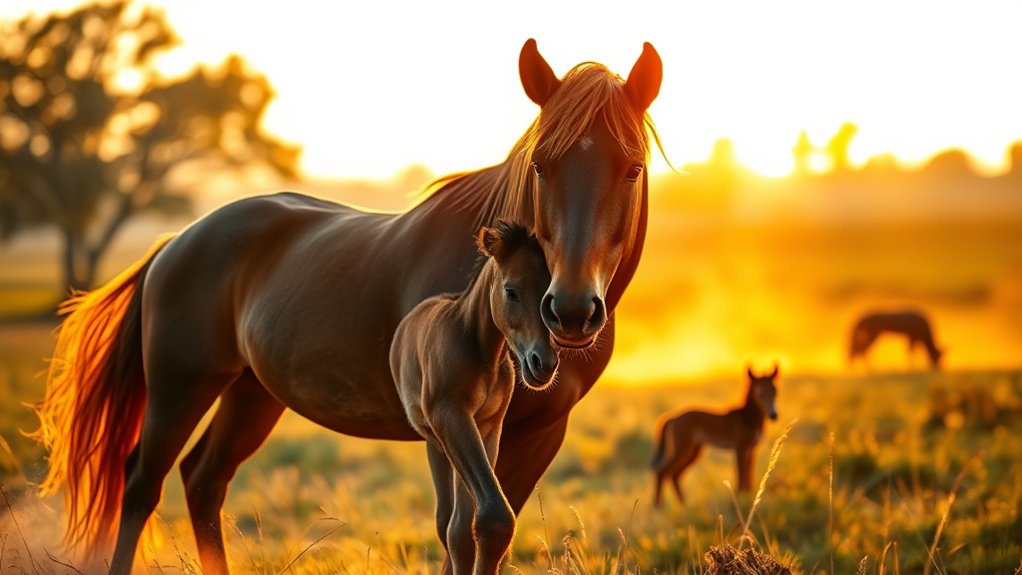
You’ll see foals learn prey behavior primarily through foal communication and maternal bonding. From birth, they closely observe their mother’s body language and vocal signals, which serve as cues for danger or safety.
This strong maternal bond enables foals to quickly associate specific threats with appropriate flight responses.
As a result, they develop innate survival instincts by mimicking their mother’s alertness and reactions to predators or disturbances.
Are Horses’ Prey Responses Similar to Other Prey Animals?
Imagine you’re watching a horse freeze and scan its surroundings before bolting at a sudden noise. This shows how horses’ prey responses mirror other prey animals.
Their prey defenses, like heightened senses and rapid flight, arise from survival instincts triggered by the amygdala.
Just like deer or rabbits, horses rely on these automatic reactions to avoid predators. This emphasizes that their behavior is a precise, instinctive survival strategy common across prey species.
Conclusion
Understanding that horses are prey animals is like holding a key to their world. They are alert, cautious, and deeply social. Their fight-or-flight instincts, herd dynamics, and communication methods are survival tools finely tuned by evolution.
By recognizing these behaviors, you can create an environment where your horse feels safe and understood. Supporting their natural needs isn’t just care; it’s honoring a timeless dance between vulnerability and resilience that shapes every horse’s life.