7 Best Racing Horses of All Time
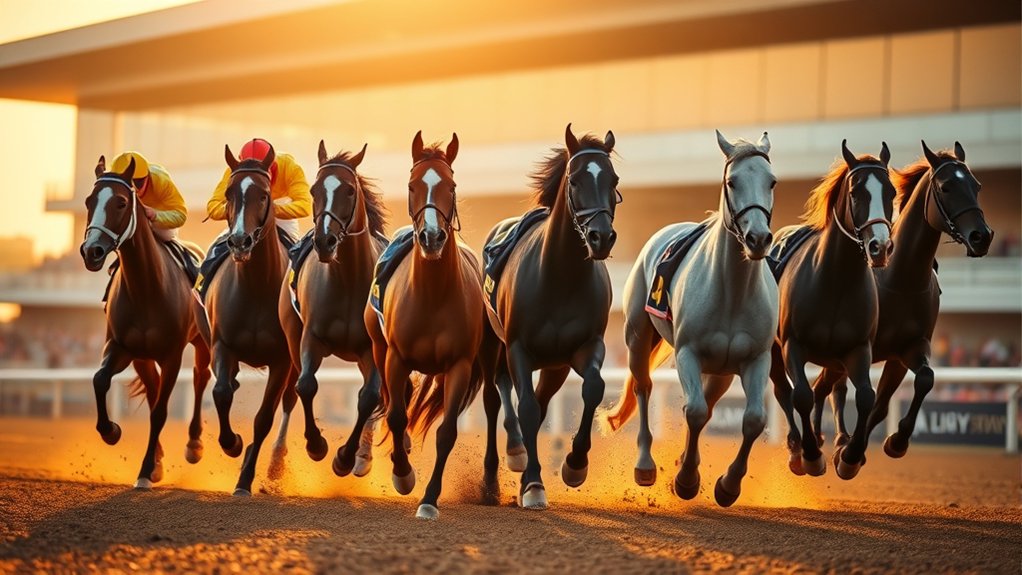
You’ll find the 7 best racing horses of all time have set unmatched records and defined racing excellence. Secretariat dazzled with record-breaking Triple Crown wins, while Kelso’s durability earned five Horse of the Year titles.
Man O’ War’s dominance shaped early 20th-century racing, and the fierce rivalry of Affirmed and Alydar captivated fans. Spectacular Bid showed near-perfect speed, Forego proved tough under heavy weights, and John Henry’s endurance broke records.
Their stories reveal the essence of greatness in horse racing.
Secretariat: The Triple Crown Legend Who Set Records

Secretariat, born in 1970, stands as the definitive benchmark for racing excellence, having shattered records that still hold today. When you study Secretariat’s 1973 Triple Crown victory, you see more than just wins. You witness a transformation in horse racing standards.
He set a blazing 1:59 2/5 record in the Kentucky Derby at 1 1/4 miles, a time no other horse has matched.
Then, at the Belmont Stakes, Secretariat didn’t just win; he demolished the field with a stakes record of 2:24 flat, still the fastest ever run at that distance.
His combination of speed and stamina redefined what a champion could achieve, making Secretariat’s Triple Crown performance an enduring symbol of equine greatness and athletic prowess.
Kelso: Five-Time Horse of the Year and Durability Icon
You just can’t overlook Kelso’s incredible streak of five straight Jockey Club Gold Cup wins. It really shows how tough and talented he was.
And then there’s his Sweep of the Handicap Triple Crown in 1961 — that wasn’t just about power, but also smart racing across some really challenging events.
When you look at his whole career, Kelso’s ability to stay consistent on all kinds of tracks really cements his place as a true durability icon in racing history.
Consecutive Jockey Club Wins
Although few horses have demonstrated such sustained excellence, Kelso’s five consecutive victories in the Jockey Club Gold Cup from 1960 to 1964 remain unparalleled. This remarkable streak highlights not only his competitive edge but also his extraordinary durability and endurance.
You can appreciate how Kelso consistently overcame the grueling demands of high-stakes racing, often carrying significant weights against elite fields. His consecutive wins in this prestigious event cemented his legacy, showcasing his ability to maintain peak performance year after year.
These achievements set a benchmark in thoroughbred racing, illustrating how durability and stamina are as critical as speed. When you examine Kelso’s record, the Jockey Club Gold Cup victories stand out as a testament to his unmatched resilience and class in the sport.
Handicap Triple Crown Sweep
Kelso’s 1961 Handicap Triple Crown sweep, winning the Metropolitan, Suburban, and Brooklyn Handicaps, showcases his unmatched versatility and toughness in handicap racing. This feat highlights Kelso’s exceptional durability and stamina.
It helped him dominate under heavy weights and against elite competition. As a racing legend, Kelso defined what it means to excel in the Handicap Triple Crown. He set a high bar for future champions.
| Race | Weight Carried (lbs) | Result |
|---|---|---|
| Metropolitan | 130+ | Winner |
| Suburban | 130+ | Winner |
| Brooklyn | 130+ | Winner |
| Total Races | 63 | 39 Wins |
| Earnings | – | ~$2 Million |
You witness true stamina and durability in Kelso’s career.
Versatility And Consistency
While many horses shine briefly, few maintain peak performance like Kelso did, earning Horse of the Year honors five times between 1960 and 1964. You’ll appreciate Kelso’s unmatched consistency, showcased through 63 starts and 39 wins across diverse race types and distances.
His versatility allowed him to dominate both sprints and marathon races, a rare trait in racehorses competing at top-level racing.
Kelso’s durability stands out, with repeated victories in the Jockey Club Gold Cup for five consecutive years, proving his ability to perform at the highest level season after season.
When you study Kelso’s career, you see a model of reliability and adaptability, making him a true icon of versatility and consistency in American racing history.
Man O’ War: Early 20TH Century’s Unrivaled Champion
When you examine the legacy of Man O’ War, it’s clear why he’s often hailed as the early 20th century’s unrivaled champion. This Thoroughbred racehorse dominated with an astonishing 20 wins out of 21 races, showcasing unmatched speed and stamina.
Man O’ War shattered records, especially winning the 1919 Belmont Stakes by an incredible 20 lengths and capturing the 1920 Kenilworth Park Gold Cup. His $249,465 earnings were groundbreaking for his time, underscoring his impact on the sport.
You’ll appreciate how his versatility on dirt and turf tracks set new standards. Man O’ War’s influence extends beyond his victories; he reshaped Thoroughbred breeding and remains a benchmark for excellence in racing history, embodying the true essence of a Champion.
Affirmed and Alydar: Racing’s Epic Triple Crown Rivalry
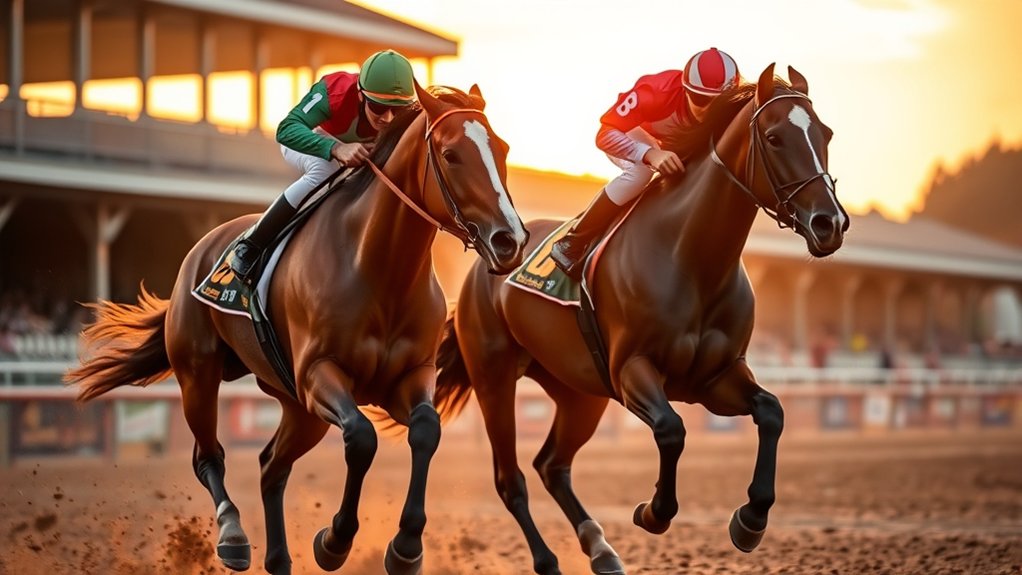
Man O’ War set a high bar for racing greatness in the early 20th century, but the intense rivalry between Affirmed and Alydar in 1978 brought a new level of drama and competition to the sport.
You witnessed a rivalry that defined the Triple Crown’s excitement, with Affirmed narrowly defeating Alydar in all three races.
Their battles were strategic and fiercely contested, culminating in the Belmont Stakes, where Affirmed won by just a nose.
This rivalry showcased not only their physical prowess but also tactical brilliance on the track.
Both horses earned multiple Eclipse Awards, with Affirmed claiming Horse of the Year twice.
When you study their 1978 performances, you see a moment in racing history that epitomizes competitive excellence and the sheer thrill of championship duels.
Spectacular Bid: Near-Perfect Triple Crown Contender
You’ve got to appreciate Spectacular Bid’s dominant early career. He snagged victories in both the Kentucky Derby and the Preakness Stakes, really showing his strength.
His near-perfect streak came to a halt with a third-place finish in the Belmont Stakes, just missing out on the Triple Crown by a whisker.
But that’s not where his story ends. As a four-year-old, he stayed undefeated, proving he’d extraordinary consistency and speed—qualities that still impress folks today.
Triple Crown Near Miss
Few racing stories capture the fine line between triumph and heartbreak like Spectacular Bid’s 1979 Triple Crown campaign. You witness a near-miss that still resonates deeply in racing history.
Spectacular Bid won the Kentucky Derby and Preakness Stakes with commanding performances, setting the stage for a perfect Triple Crown.
Yet in the Belmont Stakes, he finished third, falling short despite his evident talent.
This unexpected outcome remains one of the most talked-about moments in the sport, illustrating just how elusive the Triple Crown can be.
Even without the final jewel, Spectacular Bid’s dominance and record-setting runs cemented his legacy.
His 1979 near-miss highlights the unpredictable nature of racing and the razor-thin margins separating glory from defeat.
Dominant Early Career
Although Spectacular Bid fell just short of the Triple Crown, his early career remains a record of extraordinary talent and dominance on the track. You witness an undefeated streak leading up to the Kentucky Derby and Preakness Stakes, where he showcased remarkable speed and stamina.
His consistency during this period reflects an early career brilliance that few have matched.
| Race | Result |
|---|---|
| Kentucky Derby | Winner |
| Preakness Stakes | Winner |
| Belmont Stakes | Third Place |
| Early Career Record | Dominant, Undefeated until Belmont |
Four-Year-Old Undefeated
Nine flawless wins marked Spectacular Bid’s four-year-old season in 1980, cementing his status as one of racing’s most formidable competitors. You witness an undefeated four-year-old who dominated every challenge, showcasing unmatched speed and agility.
Spectacular Bid conquered multiple Grade 1 races, proving his consistency against elite fields. His ability to shatter track records only highlighted his extraordinary talent.
Consider these highlights:
- Undefeated in all nine starts during his four-year-old campaign
- Victories in prestigious Grade 1 races throughout 1980
- Set multiple track records, reinforcing his speed supremacy
- Displayed versatility across various distances and tracks
- Amassed career earnings exceeding $2.7 million
When you analyze Spectacular Bid’s four-year-old season, you see a near-perfect embodiment of racing excellence.
Forego: The Tough Champion Across Distances and Weights
Carrying over 130 pounds in 24 races, Forego proved himself as one of the toughest and most versatile champions in racing history. You’ll appreciate how he dominated the Handicap Triple Crown, winning the Metropolitan, Suburban, and Brooklyn Handicaps, showcasing his adaptability across distances and conditions.
Forego’s durability shines through with 57 starts and 34 wins, a confirmation of his consistent excellence. His three consecutive Horse of the Year titles from 1974 to 1976 underscore his dominance during that era.
When you examine his victories in major Grade 1 races like the Marlboro Cup, often under heavy weights, it’s clear Forego combined stamina, power, and resilience. You can’t overlook how this toughness across distances and weights cements Forego’s legacy among the all-time greats in racing history.
John Henry: Record-Breaking Career and Enduring Legacy
Forego’s toughness set a high bar for durability and versatility, but John Henry took endurance and consistency to another level. You’ll find his record-breaking career defined by remarkable achievements and a lasting legacy in racing history.
John Henry’s durability allowed him to excel across multiple surfaces and compete at an elite level well into older age. Here’s what makes his career stand out:
- 83 starts with 39 wins, earning over $6.6 million
- Twice named Horse of the Year (1981, 1984)
- Dominated as champion grass male for five consecutive years
- Claimed 16 prestigious Grade 1 races, including the Jockey Club Gold Cup
- Renowned for unmatched endurance and versatility
When you study John Henry, you see a model of resilience and excellence that still inspires today.
Frequently Asked Questions
How Are Racing Horses Trained for Peak Performance?
You train racing horses for peak performance by blending precise horse grooming with tailored breeding strategies that enhance natural abilities.
You create training schedules focusing on track conditioning through endurance and speed drills while incorporating mental conditioning to build focus and resilience.
Balancing intense workouts with rest days keeps horses healthy and sharp.
This all-encompassing approach guarantees their physical strength and psychological readiness, maximizing race-day potential effectively and sustainably.
What Diets Do Top Racehorses Follow?
Think of horse nutrition as a finely tuned symphony. Each part plays a crucial role. You’ll balance feeding schedules with high-forage diets, mainly quality hay, to support metabolic health.
You’ll add grains sparingly for energy and include dietary supplements like electrolytes, vitamins, and minerals to boost performance.
Hydration strategies guarantee your horse stays well-watered, preventing dehydration.
This analytical approach keeps them at peak condition and ready to race.
How Do Jockeys Influence Race Outcomes?
You influence race outcomes through precise riding techniques and effective horse-jockey communication, timing every move to maximize your horse’s potential.
Managing your weight is vital to maintain peak performance without hindering the horse.
Start gate strategies set the pace early, while post-race analysis helps refine tactics for future races.
Your decisions in these areas can make the difference between winning and losing, showcasing how deeply your skill shapes race results.
What Are Common Injuries in Racehorses?
You’ll often see common fractures like stress fractures in the cannon bone from repetitive impact during races.
Overtraining signs include tendon strain and ligament injuries, especially bowed tendons.
Injury prevention means balancing training intensity and proper warm-ups.
Treatment methods involve rest, therapy, and corrective care.
Following strict recovery protocols is essential to guarantee horses fully heal and reduce future risks.
You have to monitor closely to keep them race-ready and healthy.
How Is a Racehorse’s Value Determined?
You might think a racehorse’s value hinges solely on speed, but it’s more complex. Market demand and age valuation weigh heavily alongside racing success.
Breeding strategies and bloodline significance shape future potential, while pedigree analysis reveals inherited traits.
You’ll find that a horse’s worth balances current performance with genetic promise, blending immediate impact and long-term breeding value to determine its true market price.
Conclusion
You’ve just glimpsed the shining stars of racing history, each horse a symbol of speed, endurance, and unyielding spirit. Secretariat’s blazing records, Kelso’s iron will, and Man O’ War’s early dominance remind you that greatness wears many faces.
Affirmed and Alydar’s rivalry embodies fierce competition, while Spectacular Bid and Forego showcase near-perfect resilience. Finally, John Henry’s legacy stands as a tribute to lasting excellence.
Together, they represent the very soul of horse racing’s relentless pursuit of glory.