How To Handicap Horse Racing – Quick Guide
To handicap horse racing quickly, focus on recent form and workout patterns to gauge fitness. Then analyze speed figures and class levels for performance trends. Match race conditions like surface and distance to each horse’s strengths.
Also, assess trainer-jockey combinations for impact and synergy. Compare your calculated win probabilities against odds to find value bets with profitable overlays. Mastering these data-driven steps sharpens your insights.
It also sets you up to uncover deeper strategies that improve your betting edge. Keep practicing, and you’ll get better at spotting those winning opportunities.
Get Started: How to Handicap Horse Racing Quickly

When you want to handicap horse racing quickly, start by analyzing recent form and workout patterns to gauge each horse’s current fitness.
Focus on performances over similar surfaces and distances to make sure the horse suits today’s race conditions. Use speed figures and class ratings to pinpoint contenders with proven ability under comparable circumstances.
Also, evaluate trainer and jockey success rates, noting those with consistent positive outcomes in recent races. Prioritize horses showing competitive recent efforts combined with trainers who maintain strong performance trends.
These indicators boost the likelihood of success.
By concentrating on these measurable data points, you can rapidly filter the field and make informed decisions without sifting through excessive historical details or unrelated stats. This approach keeps your analysis precise and efficient.
It really sets a solid foundation for quick handicapping.
Read Past Performances to Gauge Current Form
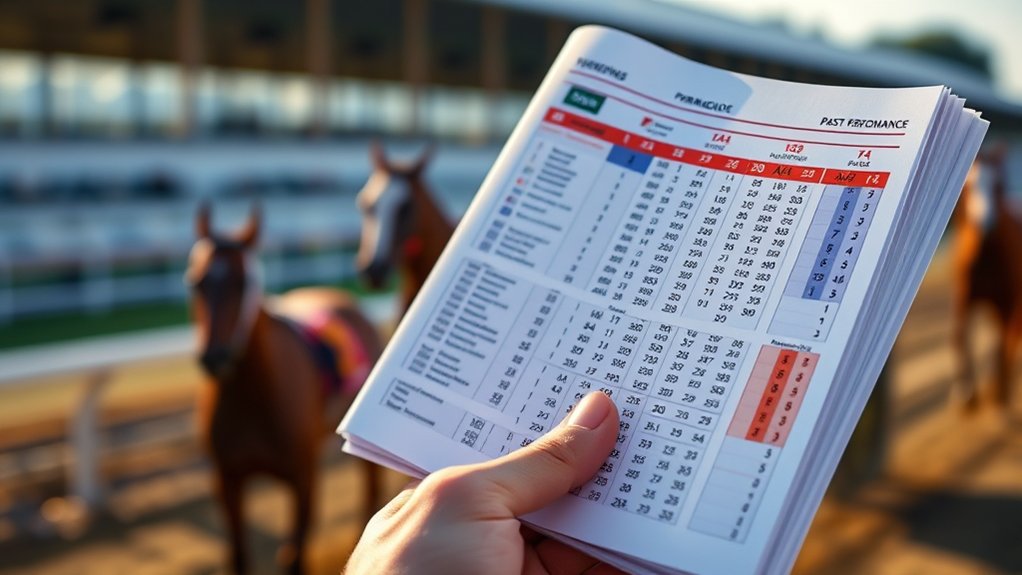
You’ll want to take a good look at recent race finishes to catch any trends in how the horse has been performing.
It’s also a smart move to keep an eye on workout patterns because they can tell you a lot about the horse’s current fitness and how ready it’s to race.
And don’t forget about the trainer’s fitness indicators—if a trainer has been doing well lately, it can really have a positive impact on the horse’s form.
Recent Race Finishes
How can recent race finishes reveal a horse’s current form and fitness? By analyzing the last 3 to 5 races, you get the most up-to-date snapshot of performance trends, highlighting improvement or decline. Focus on finishes at distances and track conditions similar to today’s race to ensure relevance.
Consistent top-three placements indicate a horse’s competitiveness and reliability, signaling strong current form. Also, consider the timing of these races. A horse coming off a short layoff mightn’t be at peak fitness yet and could need workouts to regain sharpness.
Workout Patterns
Although recent race finishes provide valuable insights, workout patterns offer a deeper glimpse into a horse’s current fitness and readiness. Pay close attention to recent “bullet” workouts. Those fastest drills indicate peak conditioning.
When a horse posts quick times consistently after a layoff, it signals improving form and potential for a strong next race. Analyze workout timing and consistency over several weeks to identify performance trends or peaks.
Conversely, sudden drops in workout quality or prolonged inactivity can reveal hidden fitness issues not evident in race results. Incorporating workout data from past performances lets you confirm or question a horse’s current form.
This sharpens your betting decisions with objective, data-driven evidence. It’s a smart approach that moves beyond surface-level results to gauge true readiness.
Trainer Fitness Indicators
Several key indicators in past performances help you assess a trainer’s current effectiveness and fitness level. Start by reviewing recent race entries and outcomes to determine the trainer’s success rate and form trends.
Analyze workout patterns, focusing on consistent “bullet” workouts that signal peak preparation.
Look for the trainer’s track record in improving horses after layoffs or adjustments in race conditions, as this reflects adaptability.
Evaluate their ability to prepare horses effectively for specific surfaces and distances by comparing past performance data.
Additionally, factor in any recent changes in the trainer’s staff or strategies, as these can impact conditioning and results.
Use Speed Figures to Measure Horse Ability

When you analyze horse racing performance, speed figures like Beyer Speed Figures provide an essential, quantifiable measure of a horse’s ability by converting race times into standardized scores.
These figures adjust for track conditions, surface, and distance, so you can compare horses across different races effectively.
Use speed figures to identify performance trends by tracking recent figures to see if a horse is improving or declining.
They also help you evaluate consistency—consistently high figures usually mean a horse is reliable and has top-level ability.
Plus, speed figures let you compare competitors on a standardized scale, making it easier to spot potential frontrunners in any race.
Analyze Class Levels to Assess Competition
To assess a horse’s chances accurately, you need to analyze class levels by comparing its recent race ratings with the competitive level of the current race. Use the Recent Class Level (RCL) system to gauge if the horse’s past performances at similar or higher classes indicate readiness to win today.
Pay attention to horses moving up in class. They’ll likely face tougher competition, which reduces their chances. On the other hand, those dropping in class often hold an edge.
Consistency at a given class level signals reliability. Erratic results, however, warrant caution.
Also, try to identify if the horse shows signs of improvement, decline, or transition between classes.
This insight can uncover hidden value or potential upsets. By focusing on these data-driven factors, you’ll make sharper and more informed handicapping decisions.
Match Race Conditions to Horse Racing Strengths
You need to check if a horse’s ideal distance matches the race length to predict when it’ll perform at its best.
Then, take a look at how the horse has done on different surfaces like dirt, turf, or synthetic tracks to see if it suits the current race conditions.
Assess Distance Suitability
How do you determine if a horse is suited for the race distance? You analyze its past performances and data points carefully to match stamina and speed to the race length.
Start by looking at past races at similar distances. Focus on speed figures and fractional times to see if the horse can sustain competitive speed throughout.
Next, consider pedigree insights. Breeding often reveals natural aptitude for sprinting or endurance, which helps guide distance suitability.
Also, review recent workouts and race history for signs of fitness and success at the target distance. This ensures the horse’s current form supports its potential.
Evaluate Surface Compatibility
Although a horse’s overall talent is essential, its performance often hinges on surface compatibility. It’s all about matching the race conditions to the horse’s proven strengths.
Start by checking the horse’s past performances on similar surfaces like dirt, turf, or synthetic. Then, compare those to today’s track condition.
Look at surface-specific speed figures such as Beyer or Timeform ratings to get a sense of how effective the horse is on that particular surface. Don’t forget to factor in recent workouts and race results on comparable surfaces to gauge current form.
Keep in mind, many horses excel on turf but struggle on dirt because of breed traits and running style. Also, consider weather and track conditions. Moisture or dryness can speed up or slow down the surface, which directly impacts a horse’s ability to perform at its best.
Using this data-driven approach will really sharpen your evaluation of surface compatibility.
Evaluate Trainer and Jockey Influence on Race Results
When evaluating a horse’s chances, considering the trainer and jockey influence is essential because their recent form, win percentages, and synergy can dramatically affect race outcomes.
You should analyze:
- Trainer metrics: Examine recent form, overall win percentage, and track-specific success to gauge preparation quality and adaptability.
- Jockey performance: Look for high win rates, experience, and riding styles that suit the race conditions, such as early positioning or energy conservation.
- Trainer-jockey combinations: Identify patterns of success or failure by reviewing their joint results in similar race types or conditions to predict potential synergy benefits.
Find Betting Value by Comparing Odds and Handicapping
Since successful betting hinges on finding discrepancies between your handicapping and the bookmakers’ odds, you need to calculate the implied probability from the odds and contrast it with your estimated chances.
Identify value bets where your predicted probability exceeds the implied probability. This approach helps you pinpoint overlays, horses priced higher than their true chances, offering profitable wagers.
| Horse | Decimal Odds | Implied Probability (%) | Handicapped Probability (%) | Value Bet? |
|---|---|---|---|---|
| Horse A | 4.0 | 25 | 30 | Yes |
| Horse B | 3.0 | 33.3 | 25 | No |
| Horse C | 5.5 | 18.2 | 22 | Yes |
| Horse D | 2.5 | 40 | 35 | No |
Focus on buying low, selling high using this data-driven process. It’s a smart way to make your betting more profitable over time.
Frequently Asked Questions
What Are the Best Online Resources for Horse Racing Data?
You’ll find Equibase, TimeformUS, and Daily Racing Form invaluable for past performances and speed figures.
Combine these with Brisnet’s analytics and Racing Post’s expert insights to sharpen your horse racing data analysis efficiently.
These resources really help you get a clearer picture of each race and make smarter bets. Give them a try and see how your understanding improves!
How Do Weather Changes Affect Race Outcomes?
Like a telegram signaling change, weather shifts alter track conditions, affecting horse speed and stamina. You must analyze wet track records, temperature impacts, and wind effects closely to adjust your race predictions accurately and seize data-driven advantages.
Paying attention to these factors helps you stay ahead in the game. It’s all about reading the signs nature gives you and using that info smartly. That way, you can make better calls on race day.
What Role Does Horse Nutrition Play in Performance?
You can’t overlook horse nutrition; it directly fuels energy and stamina, maintains muscle condition, and prevents fatigue. Balanced, tailored diets optimize performance data, enhance recovery rates, and sustain consistency across races.
This gives you a critical edge in handicapping. Proper nutrition really makes a difference when it comes to how horses perform day in and day out.
How Can I Identify a Horse’s Running Style Visually?
You identify a horse’s running style by observing its position early in the race. Notice if it leads, stalks, or closes. This gives you a good idea of how it prefers to run.
Next, look at how the horse responds to pace changes. Watching multiple race replays helps a lot with this. You can see if it speeds up or holds back at different points.
Also, check out past performance data. This information can confirm what you’ve seen on the track. Putting all these clues together makes it easier to understand the horse’s style.
What Are the Common Mistakes Beginners Make in Handicapping?
You often overemphasize recent wins, ignore race conditions, and rely solely on speed figures.
You miss key data like pace, track surface, trainer patterns, and jockey changes. This leads to inaccurate predictions and undervaluing longshot potential.
It’s easy to fall into these traps when you’re just starting out, but paying attention to all the details makes a big difference.
Conclusion
Now that you’ve learned how to handicap horse racing, remember: “Don’t put all your eggs in one basket.” Use data from past performances, speed figures, class levels, and race conditions to make informed decisions.
Factor in trainer and jockey stats to spot trends, then compare odds to find value bets. Staying analytical and detail-focused helps you turn information into winning strategies.
This way, you’ll maximize your chances in every race. Keep it smart, and enjoy the process!