How Long Is a Length in Horse Racing?
A length in horse racing is about 8 feet, roughly the average horse’s body length. It’s used to measure the gap between horses at the finish line. This is an approximate, standardized metric that varies with horse size, stride, and race type.
You can also convert time differences into lengths, with one second equaling about six lengths on good flat turf. Understanding this helps you analyze race margins, pacing, and performance.
Explore further, and you’ll uncover how these factors influence strategies and betting.
What Is a Length in Horse Racing?
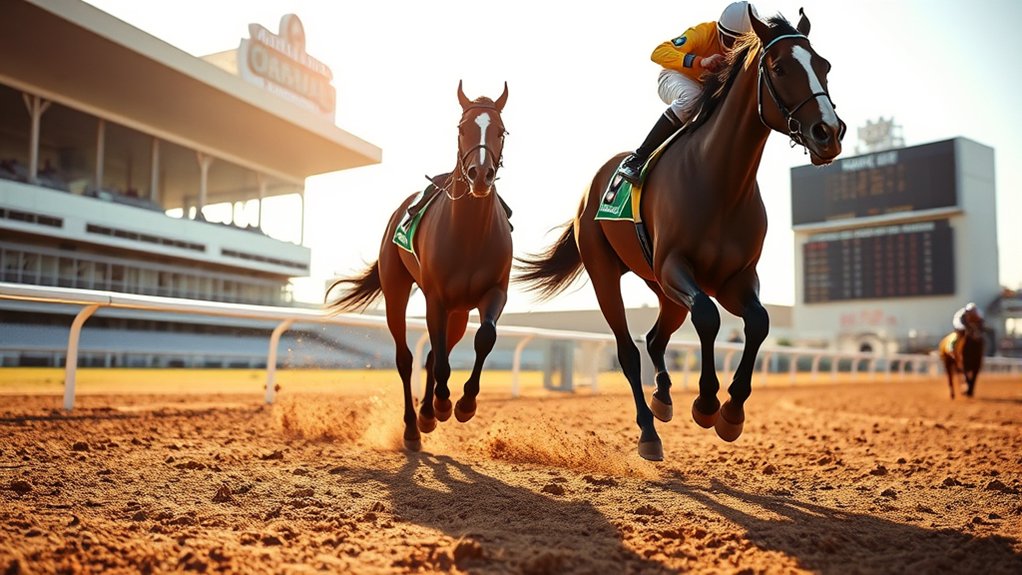
How do race officials and enthusiasts quantify the distances between horses at the finish line? They use a length, an approximate measurement representing the space between horses, typically around 8 to 9 feet.
Race officials measure horse distances at the finish using a length, about 8 to 9 feet apart.
This length isn’t exact; it’s a visual estimate influenced by each horse’s size and stride. Instead of relying solely on stopwatch timings, the length conveys the winning margin or how far behind other horses finish.
In flat racing, one length corresponds roughly to 0.2 to 0.25 seconds in elapsed time. Using length as a unit offers a practical, immediate way to describe race results, capturing both spatial and temporal gaps.
Understanding this helps you grasp how race outcomes are communicated beyond mere numerical timings.
How Is a Length Measured on the Track?
You measure a length on the track by using a standard estimate of about 8 feet, which is based on a horse’s average body length. But keep in mind, this can vary depending on the size and stride of each horse, so it’s more of an approximation than an exact measurement.
When it comes to getting precise distances during a race, officials usually convert the time difference between horses into lengths. They do this by using a calibrated lengths-per-second scale, which helps make those measurements more accurate.
Standard Length Definition
A standard length in horse racing typically measures about 8 to 9 feet, representing the distance from a horse’s nose to its tail. This length serves as a consistent visual benchmark to estimate the margin between horses at the finish line.
When you observe a race, the length isn’t measured by tools but by comparing the relative positions of horses as they cross the finish. Because horses vary in size and stride, the length remains an approximate measure rather than an exact unit.
You rely on this standardized length to interpret race results and margins accurately, even though it’s inherently imprecise due to physical differences among horses. This method balances practicality with the need for a uniform reference in race reporting.
Measurement Variability Factors
While the standard length offers a useful estimate, several factors cause variability in how lengths are measured during a race. Measurement variability arises primarily from differences in individual horse height and stride length, which affect the actual distance covered per stride.
This distance is typically estimated between 8 to 9 feet but isn’t fixed.
You must also consider track conditions. Varying surfaces can alter a horse’s stride pattern, impacting the effective length calculation.
Since measurements are often derived from the approximate distance a horse covers from nose to tail during a stride, this method introduces inherent imprecision.
As a result, lengths serve as general guides rather than exact metrics.
Understanding measurement variability is essential when analyzing race outcomes and interpreting the significance of length margins.
Time-Based Distance Conversion
Since direct measurement of horse lengths on the track can be imprecise, racing officials convert lengths into time intervals to standardize distance margins. Typically, one length corresponds to approximately 0.2 to 0.25 seconds in flat racing, reflecting the time it takes a horse to cover 8 to 9 feet.
This time-based conversion enables more consistent measurement of race margins, regardless of horse size or stride variability.
During a race, the finishing time differences between horses are translated into lengths, providing a clearer, quantifiable margin of victory.
By using time as a unit for distance measurement, analysts and bettors can compare performances accurately across different races and track conditions.
This method guarantees that distance margins remain precise, facilitating objective race analysis and informed decision-making.
Why Horse Size Matters for Length Measurement
Because horses vary considerably in size, their physical length directly impacts how a “length” is measured in races. Horse size, ranging typically from 8 to 9 feet, influences stride length, which in turn affects the standard distance a “length” represents.
Larger horses with longer strides naturally extend the race margin denoted by one length compared to smaller horses. This variability means the conventional estimate of approximately 8 feet is an average, not a fixed measure.
When you interpret race results, understanding horse size becomes essential, as it determines the actual spatial gap between competitors. Without accounting for these differences, the precision of distance margins expressed in lengths diminishes, potentially skewing performance analysis and comparisons in horse racing contexts.
How Do Race Types Influence Length Calculations?

You’ll find that flat racing usually defines a length as about 8 feet. This translates roughly to 6 lengths per second when conditions are ideal on the turf.
Now, National Hunt races bring in some variations. Since hurdle and steeplechase events involve jumps and uneven pacing, they often apply different standards for measuring lengths.
On top of that, the track surface and its condition can really change the lengths-per-second conversion. So, adjustments are needed to accurately estimate distance margins across the different race types.
Flat Racing Lengths
Although a length in flat racing is generally estimated between 8 and 9 feet, the exact calculation depends heavily on the race type and track conditions.
In flat racing, lengths serve as a standardized measurement of margin between horses, translating time gaps into physical distances.
For example, turf races on good going convert roughly 0.2 to 0.25 seconds into about 6 lengths per second, while heavy ground reduces this to approximately 4 lengths per second.
Sprint races, with higher speeds and shorter strides, affect these conversions differently than route races, altering the effective length calculation.
Understanding these nuances allows you to interpret race margins accurately across varying distances and surface conditions, ensuring consistent and precise assessments of horse performance in flat racing contexts.
National Hunt Variations
When analyzing National Hunt racing, you’ll notice that length measurements closely resemble those in flat racing, typically ranging from 8 to 9 feet. But the race type and track conditions introduce greater variability.
National Hunt race distances often affect how lengths translate from time gaps. Heavier ground alters stride length and speed, making time-based estimations more common than fixed length measures.
| Race Type | Typical Length (feet) | Notable Margin Examples |
|---|---|---|
| Hurdle | 8 to 9 | Head, Neck |
| Steeplechase | 8 to 9 | Over 30 lengths (Ireland) |
| Harness Racing* | Varies; meters used | Close finish margins |
*Harness racing uses meters but retains lengths concept in margin calculations.
Track Condition Effects
Since track conditions directly affect a horse’s stride length and speed, they play an essential role in calculating race lengths. On firm or good tracks, horses maintain longer strides, so a length corresponds to a greater distance.
Conversely, soft or heavy track conditions shorten stride length, reducing the actual distance a length represents. This variation impacts the lengths-per-second conversion used to measure winning margins accurately.
You must also consider how race types interact with track conditions. Flat turf races on firm ground differ from National Hunt events on heavy going, requiring distinct length-per-second scales.
Understanding these nuances helps you analyze race outcomes and performance metrics precisely, as track conditions fundamentally influence how lengths translate into physical distances and times across varying race types.
What Are Smaller Winning Margins Called?
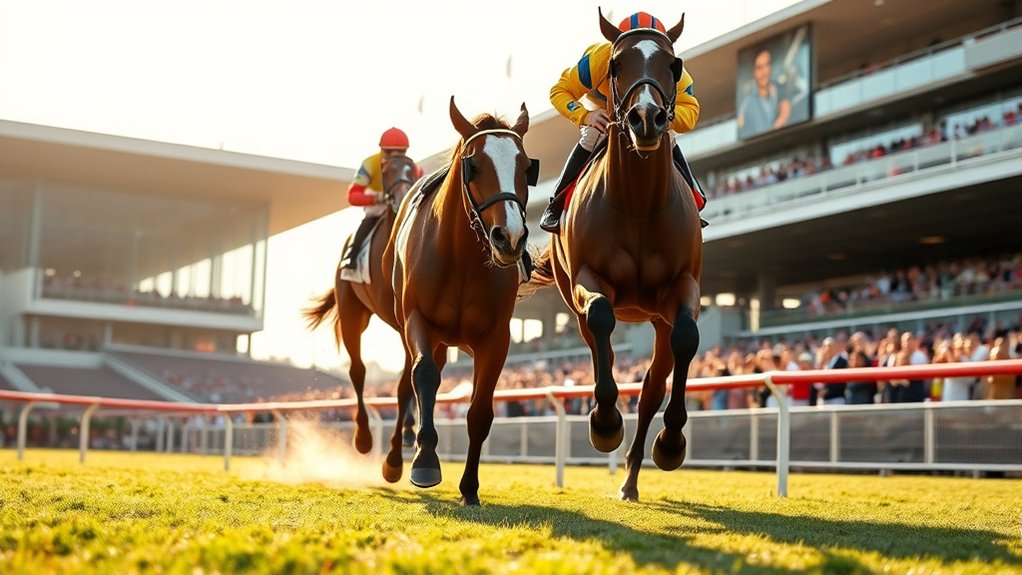
How close can a horse race finish? In horse racing, smaller winning margins have precise terms reflecting minute distances between competitors. These margins are vital for analyzing race outcomes and performance metrics.
The smallest winning margin is a “nose,” often just a few inches apart, roughly 0.05 seconds in flat racing. A “short head” is slightly larger, about one foot. A “head” margin corresponds to the length of a horse’s head, marking a very tight finish.
These terms quantify the winning margin with high resolution, aiding in race analysis.
| Margin | Approximate Distance/Time |
|---|---|
| Nose | Few inches / ~0.05 seconds |
| Short Head | About 1 foot |
| Head | Length of a horse’s head |
| Neck | Larger than head, less than a length |
How Are Time Gaps Converted Into Lengths?
Although time gaps provide a direct measure of the interval between horses at the finish, converting these intervals into lengths requires applying a standardized lengths-per-second scale tailored to specific race conditions.
Time gaps reveal finish intervals, but converting to lengths needs a tailored lengths-per-second scale for accuracy.
In horse racing, you multiply the recorded time gap by a lengths-per-second factor that varies with race type and track condition.
For example, in flat turf races on good going, 1 second typically corresponds to about 6 lengths, while in national hunt races on heavy going, it equates to roughly 4 lengths.
This conversion standardizes winning margins, enabling consistent comparisons regardless of race speed or surface.
To convert time gaps accurately, you must identify the correct lengths-per-second factor for the given context, ensuring precise and meaningful length measurements in horse racing analysis.
How Do Lengths Determine Winning Margins?
Understanding the conversion of time gaps into lengths sets the stage for interpreting how lengths define winning margins in horse racing. You measure winning margins by the distance between horses at the finish line, where one length equals roughly 8 feet (2.4 meters).
When a horse wins “by two lengths,” it means the winner finished about 16 feet ahead. Fractions like half a length or smaller margins such as a head or nose provide precision in close finishes. This standardized measurement allows you to objectively compare performances across different races and track conditions.
Converting lengths into time, approximately 0.2 to 0.25 seconds per length, helps you analytically gauge the significance of a winning margin in racing results.
How Do Lengths Relate to Common Race Distances?
You’ll find that lengths translate directly into measurable distances across furlongs—each length is about 8 feet of separation. It’s pretty straightforward once you get the hang of it.
Knowing how these lengths add up over common race distances can really help you understand just how significant winning margins are.
Plus, it gives you insight into pacing strategies. This kind of precision lets you see how jockeys tweak their tactics depending on how far apart the horses are expected to be over different furlong lengths.
Lengths Across Furlongs
When analyzing race distances like 6 furlongs, converting them into lengths offers a precise way to grasp the scale of competition. Since one furlong equals 660 feet, and a length measures approximately 8 to 9 feet, you can calculate that 6 furlongs span roughly 440 lengths.
This conversion facilitates a detailed examination of race margins, allowing you to quantify how far ahead a horse finishes. Understanding lengths across furlongs also aids in comparing performances across varying distances.
While lengths may slightly vary due to horse size and stride, this standardized metric remains invaluable. By translating furlong distances into lengths, you gain a clearer, more analytical perspective on race dynamics and results, enhancing your ability to assess both the scale and significance of winning margins.
Impact On Race Strategy
Although lengths measure physical distance on the track, they also translate into critical time differentials that shape race strategies across common distances. Since a length equals roughly 8 to 9 feet or 0.2 to 0.25 seconds in flat racing, you can quantify winning margins relative to race distances like 5 furlongs or a mile.
In sprint races, a lead of several lengths signals dominance, prompting jockeys to prioritize early speed and maintain position.
Conversely, for longer race distances, margins in lengths guide trainers in balancing stamina versus speed training.
By understanding how lengths correlate with race distances, you can analytically gauge competitiveness and adjust tactics, ensuring ideal energy distribution and positioning for each specific race length.
This precision enhances strategic decision-making for both trainers and bettors.
Why Lengths Matter for Betting and Race Analysis
Because lengths quantify the margin of victory or defeat, typically measured as about 8 feet per length, they provide critical insight beyond mere finishing positions. When you analyze race results, lengths offer a standardized metric that enables deeper race analysis and more informed betting decisions.
For example, a 2-length margin (about 16 feet) indicates a decisive but not dominant win. This helps you gauge a horse’s competitiveness under varying conditions.
Furthermore, converting lengths to time—approximately 0.2 to 0.25 seconds per length—allows you to assess speed and consistency quantitatively.
By incorporating lengths into your handicapping process, you can compare performances across different tracks and race scenarios.
This helps refine your betting strategy with data-driven precision and minimizes guesswork. Understanding lengths is essential for accurate performance evaluation and effective betting analysis.
How Lengths Help in Other Equestrian Activities
While lengths primarily quantify racing margins, they also play a crucial role in various equestrian activities by providing a standardized measure for spacing and positioning. You use lengths to gauge distances between horses during group riding, training, and competitions, ensuring safety and ideal performance.
Trainers rely on lengths to manage paddock spacing, promoting social comfort. In disciplines like dressage, lengths help maintain formations accurately. This measurement standardizes communication across equestrian contexts, much like in racing.
| Application | Purpose |
|---|---|
| Group Riding | Maintain safe spacing |
| Competitions | Judge positioning and routines |
| Paddock Management | Control distances for comfort |
| Instructional Use | Standardize spacing guidance |
Frequently Asked Questions
How Did the Term “Length” Originate in Horse Racing?
The term “length” originated from historical origins as a practical, visual measure based on a horse’s physical size, roughly 8 feet. You use this term to estimate the distance between horses at the finish line, especially before precise timing existed.
This intuitive measurement helped jockeys, trainers, and commentators communicate race margins clearly. Over time, it became standardized, reflecting an analytical approach rooted in the observable stride and body length of a typical racehorse.
Are Lengths Used in Other Sports Besides Horse Racing?
Lengths largely limit themselves to the landscape of horse racing, leaving little room for cross country comparison in other sports. You won’t find lengths leveraged in swimming, cycling, or track events where time or meters measure margins meticulously.
Instead, these disciplines deploy distinct distance or temporal metrics to quantify performance. So, while lengths lend a unique lens to equestrian analysis, you’re better off relying on sport-specific standards when evaluating athletic achievements elsewhere.
Can Weather Conditions Affect Length Measurements During a Race?
Yes, weather impact can considerably affect length measurements during a race. When you experience rain or fog, visibility decreases, making it harder for you to judge distances accurately.
Wet or slippery tracks alter horses’ strides and speeds, skewing the timing-to-length conversion you rely on.
As a result, you’ll find that poor weather conditions introduce variability and reduce precision in measuring margins, challenging the consistency of length assessments across different races.
How Do Jockeys Perceive and Use Lengths During a Race?
You rely on Perception Dynamics to gauge lengths during a race, blending visual cues with your horse’s stride and speed. Your brain constantly analyzes the spatial relationship between your mount and competitors.
It adjusts for track conditions and momentum.
This dynamic perception helps you estimate margins accurately, enabling strategic decisions, whether to push forward or conserve energy.
Mastering these subtle judgments optimizes your race tactics and enhances communication with your team.
Do Different Countries Have Varying Definitions of a Length?
Like steering a map with shifting landmarks, you’ll find that global standards for a length in horse racing aren’t uniform. Different countries define it between 8 to 9 feet, with the UK and US leaning toward 8 feet, while others may vary slightly.
These subtle differences impact race margin descriptions, so when analyzing results, you must consider local conventions to interpret lengths accurately across international races.
Conclusion
Think of a length in horse racing as the ruler by which you measure a champion’s journey. Each length marks a calculated step in a race’s narrative.
Just like the gears in a finely tuned machine, lengths quantify performance, strategy, and margin with precision.
Understanding lengths sharpens your analytical edge, turning abstract distances into clear data points that inform betting decisions and race insights. This makes every finish line a story you can decode with confidence.