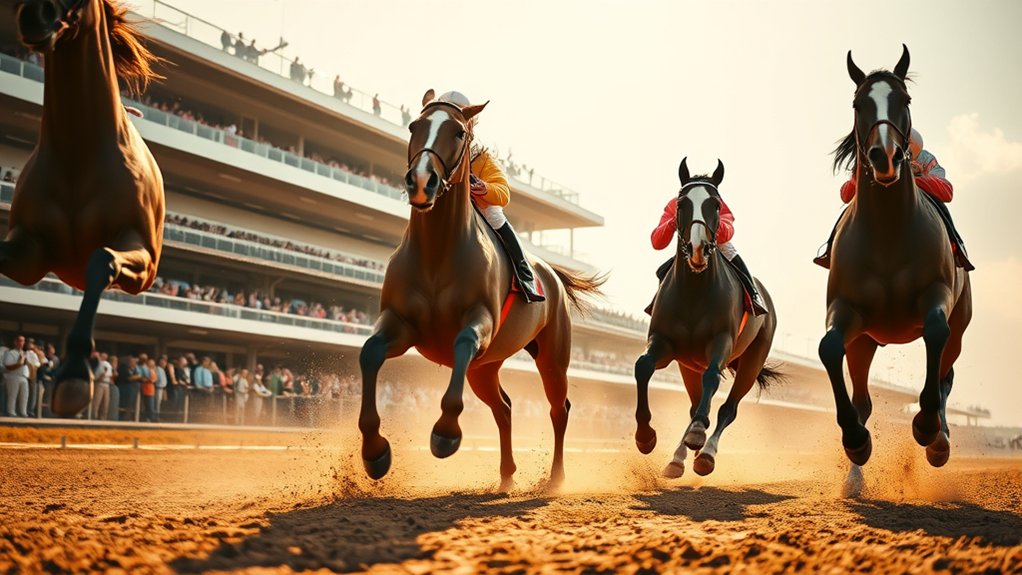
How Does Horse Racing Work?
Horse racing combines speed, strategy, and skill as you watch horses compete on varying tracks, flat or with jumps, over different distances and surfaces. Jockeys play a vital role by guiding horses with precise control and tactics.
Training and health keep horses at peak performance. Betting adds excitement by letting you predict outcomes based on detailed racecards and odds.
Understanding these elements gives you a solid grasp of the sport’s dynamic nature and what influences each race’s result.
How Horse Racing Began
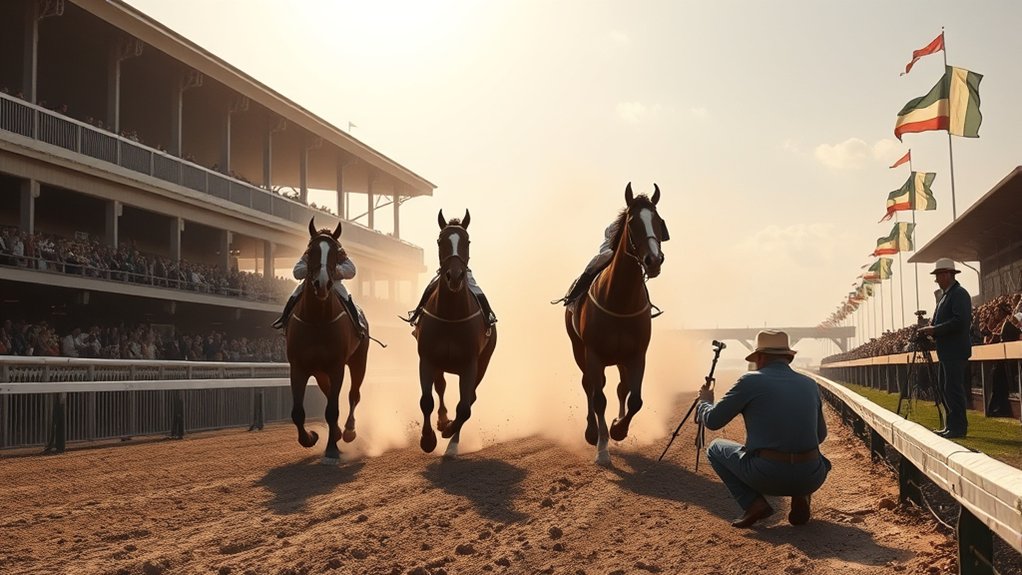
Although horse racing has evolved markedly over time, its roots stretch back to ancient civilizations like Greece, Rome, Egypt, and Babylon. In these cultures, races often carried religious or mythological significance.
Horse racing’s origins trace to ancient civilizations where races held deep religious and mythological meaning.
You can trace horse racing’s origin to these cultures, where it wasn’t just sport but a crucial part of ceremonies and entertainment. The Roman Empire further shaped its history with chariot races, blending competition with grandeur.
When you look at the British aristocracy in the 18th century, you see organized Thoroughbred racing taking form, complete with racecourses and official events. The establishment of the Jockey Club in 1750 was pivotal, setting standards that professionalized the sport.
Understanding this history gives you a clearer view of how horse racing developed from ancient rituals into the structured sport you know today.
Common Types of Horse Races
You’ll find that flat racing, the most common type, challenges horses to run fast over varying distances on a smooth track. It’s all about speed and stamina.
Then there’s jump racing, which adds an extra layer of skill. Horses have to clear hurdles and fences while still keeping up their pace.
Knowing these basics really helps you appreciate the different demands each race type places on both horse and rider.
Flat Racing Overview
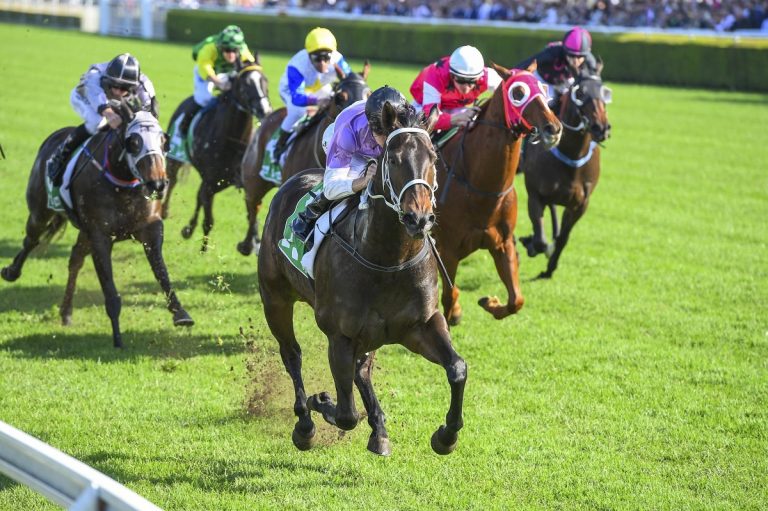
When you watch flat racing, you’ll see horses sprinting over a level track that ranges from short sprints of about 440 yards to endurance-testing runs exceeding four miles. This type of race tests both speed and stamina, with most races covering 5 to 12 furlongs.
The goal is to get horses to finish first, but finishing in the top positions is also essential for prestige and prize money. Flat racing usually features horses carrying equal weights, adjusted slightly for age or gender to keep the competition fair.
Famous events like the Kentucky Derby and Melbourne Cup highlight the sport’s global appeal. You’ll notice races often take place on turf or dirt, emphasizing quick acceleration and sustained speed over obstacles-free courses.
Jump Racing Basics
While flat racing tests a horse’s speed and stamina on a level track, jump racing adds an extra layer of challenge by requiring horses to clear obstacles like hurdles and fences. This discipline, also called National Hunt racing, demands not just speed but exceptional stamina and agility to navigate longer courses filled with jumps.
You’ll notice horses often start their careers in flat races before moving on to jump racing as they mature.
Key features of jump racing include:
- Longer distances, often exceeding two miles, pushing horses’ endurance
- A variety of obstacles, from smaller hurdles to larger, more demanding fences
- Specialized training focused on safe and efficient jumping techniques
Understanding these basics helps you appreciate the skill and strategy behind every jump race.
Racecourse Designs and Track Types
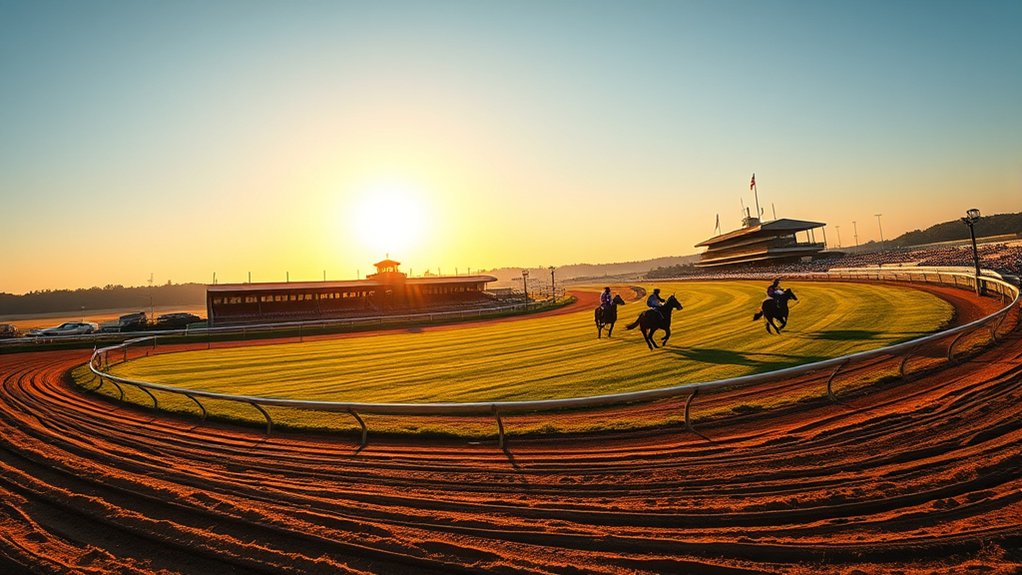
When you watch a race, the track surface can really affect how horses perform. It might be dirt, turf, or synthetic, and each one behaves a little differently.
You’ll probably also notice that racecourses come in various shapes—like ovals, straights, or even figure-eights. Each shape is designed to challenge the horses in its own unique way.
Knowing about these differences makes it easier to appreciate the strategy behind every race.
Track Surfaces Explained
Although racecourse designs vary widely, the type of track surface plays one of the most critical roles in shaping how a race unfolds. You’ll notice three main types of race surfaces that impact speed, safety, and strategy:
- Dirt tracks are common in North America, made from clay and sand to guarantee durability and good drainage.
- Turf surfaces use grass, favored internationally for their softer footing, which affects horse stamina and running style.
- Synthetic tracks like Polytrack or Tapeta offer consistent footing and reduce injury risks, especially in bad weather.
Understanding these surfaces helps you appreciate how track conditions influence race outcomes and horse performance, making each race unique and exciting.
Course Layout Variations
Because racecourses vary widely in design, understanding their layouts can deepen your appreciation of how each race challenges horses and jockeys differently. Racecourse design ranges from oval and circular to straight tracks, with track layout directly influencing race strategy.
Track configuration often involves multiple turns. Shorter tracks feature tighter curves, while longer courses have more gradual bends. Course variations also include distance, from sprinting 5 furlongs to endurance runs over 2 miles.
Some tracks incorporate hurdles or steeples, adding jumps that test agility and stamina. Recognizing these course variations helps you grasp how different track layouts and surfaces impact speed, maneuverability, and tactics.
It makes every race a unique test shaped by its racecourse design and track configuration.
The Role of Jockeys in Horse Racing
While the horse’s speed and stamina are essential, jockeys play an equally important role in determining race outcomes by skillfully guiding and controlling their mounts throughout the competition. You’ll see jockeys making split-second decisions that can mean the difference between winning and losing. Their skills go beyond riding; they manage weight, pace, and positioning in the race.
Key aspects of a jockey’s role include:
- Wearing distinctive silks to represent owners and help identify horses during the race.
- Starting as apprentices, gaining experience and refining their riding skills over time.
- Maintaining strict weight limits to ensure fairness and optimize each horse’s performance.
Understanding jockeys’ expertise helps you appreciate how much they influence a horse’s success on the track.
Training and Preparing Racehorses
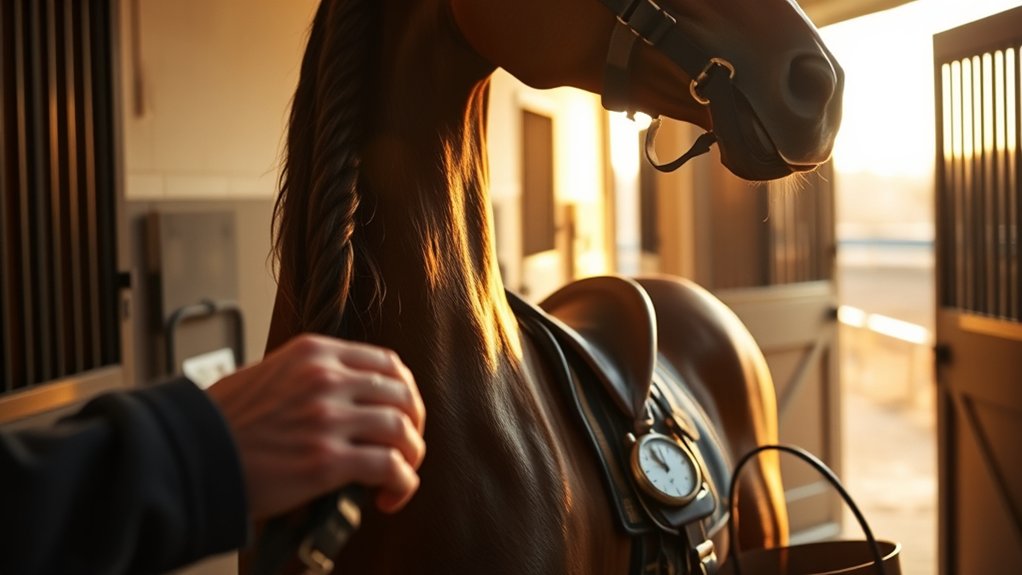
Jockeys rely on well-trained horses to execute their strategies effectively, making the preparation of racehorses a key factor in racing success. Your horse’s training involves rigorous daily routines like jogging, speed work, and strength exercises to build stamina and muscle.
Well-trained horses are essential for jockeys to execute strategies and achieve racing success.
Conditioning is essential, so you gradually increase workloads to avoid injuries, especially since skeletal maturity isn’t reached until around age six. You tailor training programs based on breed, age, and race distance, focusing on speed or endurance as needed.
Nutrition plays a critical role. Feeding balanced diets rich in energy, protein, and electrolytes ensures peak performance and recovery.
Moreover, regular veterinary check-ups and physiotherapy help maintain your horse’s health and address issues early, making preparation both a science and an art in horse racing.
Understanding Racecards and Their Importance
When you look at a racecard, you’ll see important details like horse names, jockeys, and past performance stats. These bits of info help you make smarter bets.
Once you learn how to read these elements, you can size up each horse’s chances more effectively.
Understanding racecards really is key because they give you a clear picture of how the race is set up and what might happen.
Essential Racecard Information
Because a racecard contains detailed information about each horse, jockey, trainer, and race conditions, it acts as your essential guide to understanding the event. The racecard presents everything you need to evaluate the field, including the horse’s recent performance and the odds, which reflect their chance of winning according to bookmakers.
It also outlines race specifics like distance and track surface, helping you gauge how conditions might affect outcomes.
When you review a racecard, focus on:
- Horse numbers and names for easy identification
- Performance stats indicating form and fitness
- Starting prices or odds to assess betting value
Using this information, you can make informed decisions and better appreciate the dynamics of horse racing.
How To Read
Although racecards might seem overwhelming at first, learning to read them opens valuable insights that can greatly improve your understanding of horse racing. A racecard lists essential race details like horse names, jockeys, trainers, race distances, and importantly, betting odds.
By studying a horse’s recent performance, such as finishing positions and times, you can assess its current form and potential. The racecard also highlights race conditions, like track surface and layout, which affect outcomes.
Understanding these elements helps you compare competitors more effectively and spot promising bets. When you grasp how to interpret a racecard, you gain a clearer picture of each horse’s chances and the race’s dynamics, making your experience as a bettor or spectator far more informed and engaging.
Racecard Benefits Explained
Since racecards pack a wealth of information into a concise format, they become your essential tool for making smarter decisions at the track. A racecard provides key race details, including distance, track surface, and class. This helps you assess conditions that impact performance.
It also lists odds or starting prices, allowing you to evaluate potential payouts and risks effectively.
Most importantly, the racecard offers historical performance data, showing recent finishes and form trends. This way, you can gauge a horse’s current potential.
By understanding these elements, you can analyze race details to identify favorable conditions, compare odds to spot value bets, and review historical performance to predict likely outcomes.
Mastering the racecard sharpens your insights and boosts your betting strategy.
How Betting Works in Horse Racing
How exactly does betting work in horse racing? You start by selecting a horse and choosing a specific type of wager before the race begins.
Betting options range from simple bets like Win, Place, and Show to more complex ones like Exacta, Trifecta, and Superfecta, each with different payout possibilities.
You can place your wager at the track via windows or kiosks, or conveniently online through platforms like Twinspires.
The odds you see fluctuate up until post time, reflecting the amount of money wagered by all bettors.
These odds, combined with the total betting pool and your wager amount, determine your potential payout.
Understanding this dynamic helps you make strategic betting decisions and enhances your race-day experience.
Understanding Odds and Payouts
Here’s what you need to know about odds and payouts:
Odds like 4/1 show how much profit you make relative to your stake. For example, a $2 bet at 5/1 pays $12 total.
Odds of 4/1 indicate your profit compared to your stake; a $2 bet at 5/1 pays $12 total.
Odds fluctuate based on betting activity and are displayed on tote boards and online for real-time updates.
Exotic bets pool multiple wagers, with payouts calculated after deducting the house takeout.
Factors Affecting Racehorse Performance
What really shapes a racehorse’s performance? It starts with breed. Thoroughbreds excel in speed and stamina because of their muscle fiber makeup, while Arabians bring endurance to the track.
You’ll find that a horse’s muscle composition, like a higher proportion of Type II-a fibers, directly impacts its ability to sprint and sustain effort.
Training is essential too. Tailored conditioning programs based on age, breed, and race distance help optimize performance and reduce injury risk.
Don’t overlook physical health. Soundness and skeletal maturity play critical roles in race readiness.
Environmental factors also matter a lot. Track surface, weather, and race-day conditions can either enhance or hinder performance.
Understanding these elements helps you appreciate what goes into a winning racehorse.
How to Read Race Results and Confirm Winners
After understanding the factors that shape a racehorse’s performance, you’ll want to know how to interpret the race results accurately. Race results display the finishing order, listing the winner first, followed by second and third place.
To verify winners confidently, rely on official results published shortly after the race, which include margins and sometimes betting payouts.
Here’s how to read and confirm race outcomes:
Check the official race charts or result boards for each horse’s finishing position. Compare the published finishing order with your betting ticket or online platform.
Use track result screens or trusted online sources to verify winners and guarantee accuracy.
Frequently Asked Questions
How Do Veterinarians Monitor Horse Health During Races?
You’ll see veterinarians closely monitor horse health during races through veterinary inspections, checking for signs of distress or injury. They assess racehorse training effects, making sure horses respond well to exertion.
They also watch nutrition’s impact on stamina and alertness. Medication regulations guide their decisions, preventing banned substances from being used.
Using tools like heart rate monitors, vets step in if a horse’s condition worsens, prioritizing safety and peak performance throughout the race.
What Safety Measures Are in Place for Horses and Jockeys?
To prioritize horse welfare and jockey safety, you’ll find strict safety equipment standards like helmets, protective vests, and safety stirrups in place. Tracks feature cushioned surfaces and carefully crafted courses to curb crashes.
Veterinarians continuously monitor horses, ensuring swift risk management.
You’re protected by rigorous regulations that penalize neglect, guaranteeing humane treatment.
These combined measures create a safer, smarter space where both horses and jockeys can race with confidence.
How Are Racehorses Transported to Different Racecourses?
You rely on horse trailer logistics to move racehorses safely between venues, following strict transport regulation standards that protect the animals. Racecourse transportation methods usually involve specialized trailers with secure stalls, minimizing stress and injury risks.
Sometimes, you’ll use air transport for longer distances. Horse transportation safety is paramount, so experienced handlers plan routes and rest stops carefully. This ensures horses arrive calm, healthy, and ready to compete at their best.
What Are the Common Injuries in Horse Racing and Recovery Times?
Imagine your favorite racehorse suffers a suspensory ligament injury, a common racehorse ailment. Recovery duration estimates show such tendon injuries often need months of rest and rehabilitation techniques like controlled exercise.
You can’t overlook horse injury prevention. Proper training and veterinary care reduce risks.
Fractures or ligament tears vary in severity, so your horse’s recovery might take weeks or up to a year, depending on the injury’s complexity.
How Do Environmental Conditions Affect Race Scheduling?
You’ll notice that weather delays often disrupt race scheduling because poor track conditions, like mud or ice, make racing unsafe.
Temperature impacts also play a big role. Extreme heat or cold can force organizers to reschedule or shorten races to protect horses.
Air quality matters too. If pollution or smoke is high, events might be postponed.
Conclusion
Now that you’ve explored the thrilling world of horse racing, picture the thunderous hooves pounding the track, the skilled jockeys guiding with precision, and the crowd’s enthusiastic anticipation. You understand the delicate balance of training, strategy, and chance that shapes every race.
With this knowledge, you’re ready to read race results, grasp betting odds, and appreciate the art behind each exhilarating finish, transforming every race into a vivid, electrifying story you can truly follow.