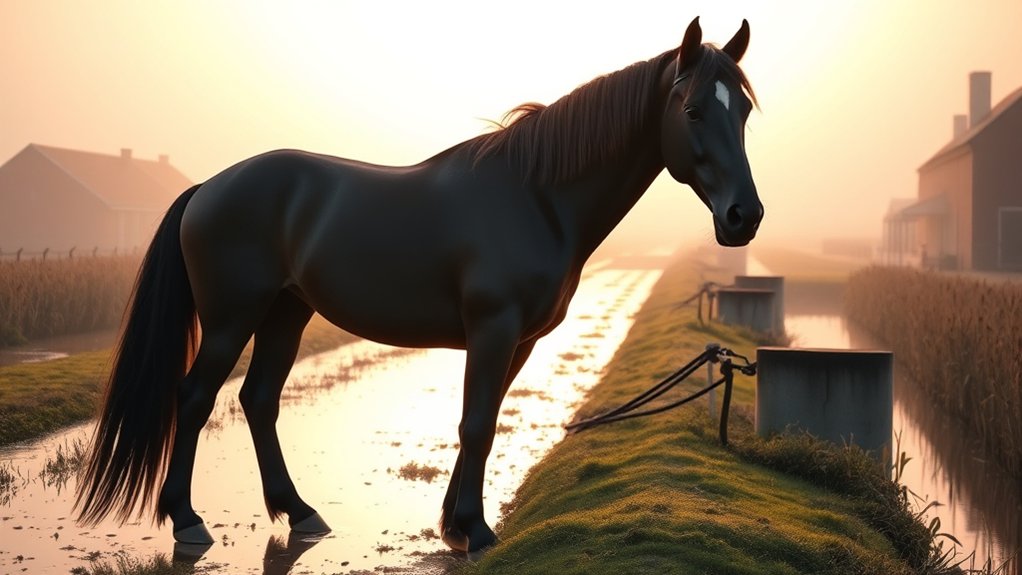
Where Are Friesian Horses From?
You’ll find Friesian horses originating from Friesland, a northern province in the Netherlands, with roots dating back to at least the 13th century. They developed through selective breeding involving native horses and imported Iberian lines, creating a unique blend of strength, agility, and elegance.
Known historically for their role in medieval warfare and aristocratic use, these horses boast a noble presence shaped by environment and crossbreeding influences. Explore further to understand their historical significance and global stature today.
Where Did Friesian Horses Originate in the Netherlands?
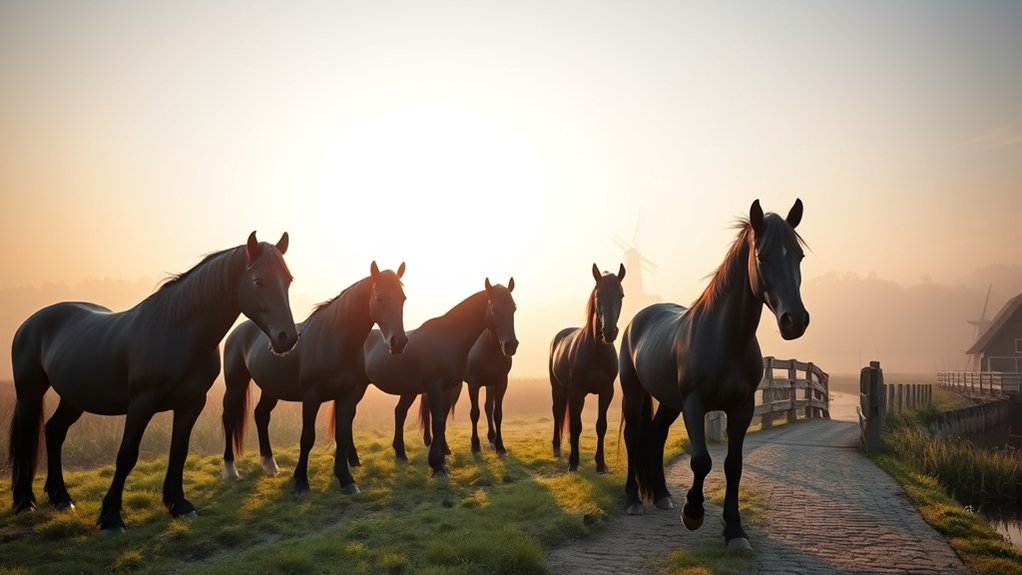
Although Friesian horses are renowned worldwide, their origins trace back specifically to Friesland, a northern region of the Netherlands where breeders have maintained their lineage since the Middle Ages. You’ll find that Friesian horses’ origin is well documented, with archaeological and historical evidence confirming their presence in Friesland from at least the 13th century.
The region’s distinctive environment and dedicated breeding practices shaped the Friesian’s unique traits. The name “Friesian” itself was first recorded in 1544, emphasizing its deep connection to Friesland.
When you study the breed’s development, you see how Friesland’s specific conditions and meticulous breeding fostered their characteristic strength and elegance. This underscores the Netherlands’ pivotal role in preserving this historic equine lineage.
How Were Friesian Horses Used in Medieval Friesland?
When you examine medieval Friesland, you’ll find that Friesian horses played essential roles both on the battlefield and in noble society. These horses served as reliable war horses, valued for their strength and agility, making them ideal mounts for knights riding in armor.
Their robust build allowed them to carry heavily armored riders effectively during combat situations.
Beyond warfare, Friesian horses were also prominent in aristocratic circles, used for transportation and ceremonial purposes.
Historical depictions from medieval Friesland consistently illustrate Friesian horses accompanying nobility, emphasizing their dual function as both war horses and prestigious saddle animals.
Their striking appearance and powerful stature reinforced their status, underscoring how integral Friesian horses were to the military and social fabric of medieval Friesland.
What Role Did Friesian Horses Play in Early European Warfare?
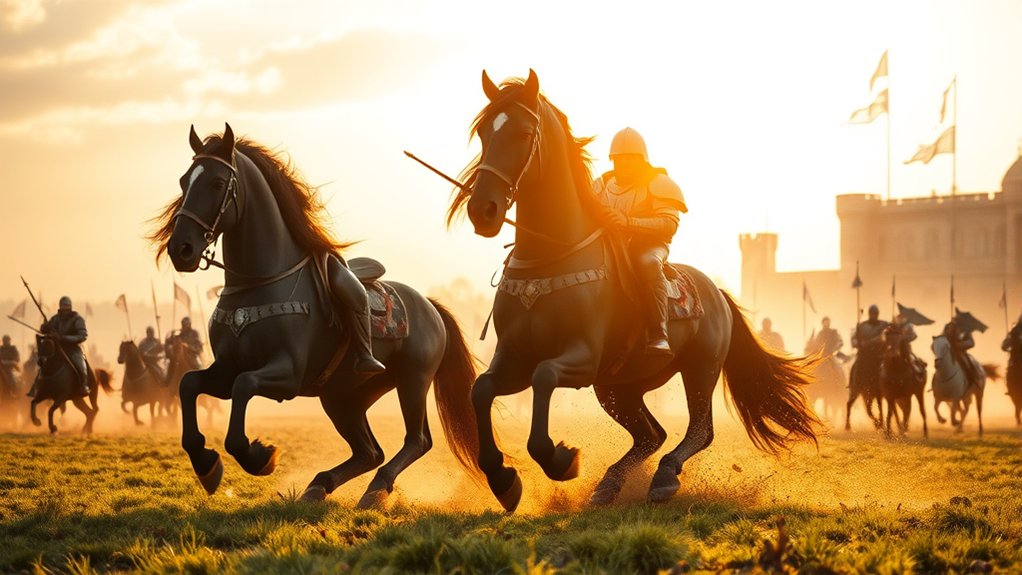
Building on their prominent status in medieval Friesland, Friesian horses also played a significant role across early European warfare. You’ll find they served as essential war horses from the 11th century onward, carrying armored knights and heavy weaponry with ease.
Their strong, compact build paired with agility made them effective on the medieval battlefield, adept at maneuvering in complex combat scenarios. Illustrations from the Middle Ages frequently depict Friesian-like horses, underscoring their martial importance.
| Attribute | Significance in Warfare |
|---|---|
| Build | Strong, compact for armor load |
| Agility | Maneuverable on battlefield |
| Appearance | Noble, intimidating presence |
| Historical Usage | Knights’ mounts since 11th century |
You can appreciate how these qualities cemented Friesians’ legendary war horse status.
How Did Crossbreeding Influence Friesian Horse Development?
You’ll find that crossbreeding with Andalusian, Spanish, and Arabian horses during key historical periods really helped shape the Friesian’s physical and behavioral traits. These influences worked together to refine the breed’s high-stepping trot, aristocratic head, and overall carriage.
And these aren’t just old characteristics—they’re still very much part of the Friesian’s charm today. When you look into these historical partnerships, it becomes clear how selective breeding struck a balance between enhancing the horse’s external qualities and preserving its unique Dutch heritage.
Historical Crossbreeding Partners
Although the Friesian horse originated as a robust draft breed, crossbreeding with Andalusian and Spanish horses during the 16th and 17th centuries markedly enhanced its agility and elegance.
You’ll find that Arabian bloodlines, introduced during the Crusades and the Eighty Years’ War, also played a vital role in refining the breed’s head and high-set neck.
This strategic crossbreeding aimed to create lighter, more stylish carriage horses suited for aristocratic use.
Visualize the impact of these historical partners through:
- The smooth, elevated trot
- Refined, aristocratic head shape
- High-set, graceful neck
- Enhanced agility and elegance
- Stylish carriage suitability
These influences collectively shaped the modern Friesian’s distinctive appearance and movement.
Impact on Breed Characteristics
The influence of Andalusian and Arabian bloodlines on the Friesian horse during the 16th and 17th centuries reshaped key breed characteristics that you can observe today. Crossbreeding introduced lighter, more agile traits that refined the Friesian’s elegant appearance and enhanced its movement.
This strategic infusion shifted the breed from a robust warhorse to a stylish carriage horse suited for urban settings. Selective breeding then emphasized specific traits like a high-stepping trot and noble head carriage, balancing the new influences with preserving the Friesian’s original strength and grace.
Thanks to these practices, you’ll notice a harmonious blend of power and elegance in the modern Friesian, a result of deliberate crossbreeding and meticulous genetic selection that defined its unique breed characteristics.
Influence on Modern Type
When breeders incorporated Andalusian, Spanish, and Arabian bloodlines during the 16th and 17th centuries, they actively shaped the Friesian horse’s modern type by emphasizing elegance, stamina, and spirited movement. This deliberate crossbreeding enhanced the breed development by merging traits from various European breeds.
The result was a refined yet powerful equine. You can appreciate how these influences manifested in the Friesian’s aristocratic head, arched neck, and muscular but graceful physique. Today, the breed’s modern type reflects this historical blending, balancing original characteristics with genetic diversity.
- Noble appearance with a high-stepping gait
- Stamina and spirited movement from Arabian lines
- Muscular yet elegant build
- Light carriage horse qualities
- Distinctive aristocratic head and neck arch
How Are Friesian Horses Linked to British Shire and Fell Ponies?
Since Friesian horses have long been recognized for their strong, muscular build and noble appearance, you can trace many of these traits in the British Shire and Fell pony breeds.
Historical crossbreeding and shared ancestry link Friesians directly to these British breeds.
The Friesian’s prominence as a luxurious carriage horse influenced breeders selecting for strength and elegance in Shires and Fell ponies.
Genetic studies and historical records confirm that Friesian bloodlines contributed to the formation of these Northern European heavy horse and pony breeds during medieval and post-medieval periods.
Scholars like Anthony Dent highlight morphological and genetic similarities among Friesian, British Shire, and Fell pony horses, underscoring a complex, intertwined breeding history that shaped their development through intentional crossbreeding and selective efforts.
How Did Historical Events Shape the Friesian Horse?
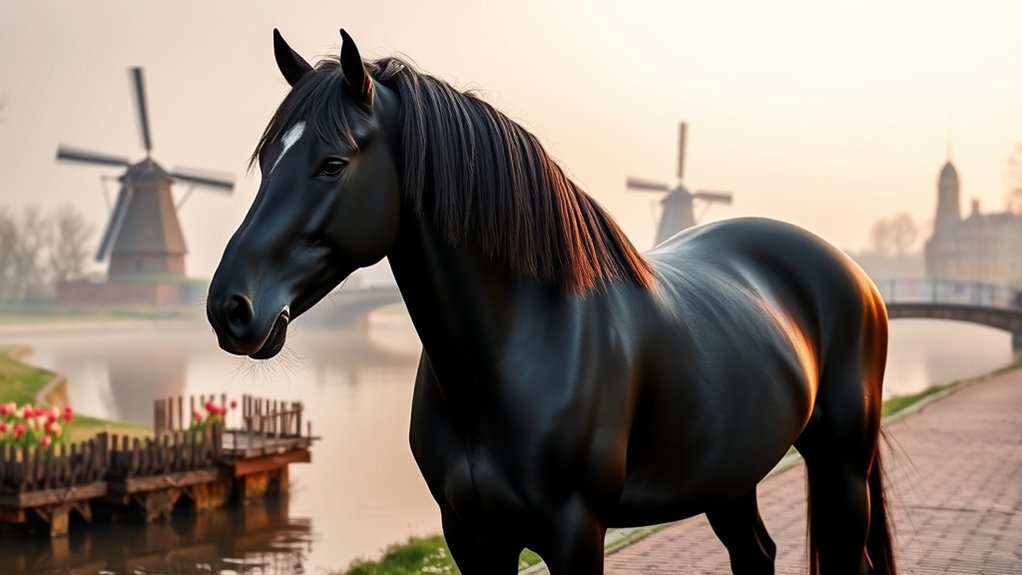
Understanding the Friesian horse’s connections to British breeds like the Shire and Fell ponies provides a foundation for exploring how broader historical events shaped its development. Originating in Friesland, these horses played vital roles in medieval warfare, evident in 11th-century depictions.
The Friesian horse’s ties to British breeds reveal its medieval roots and role in 11th-century warfare.
European conflicts such as the Crusades and the Eighty Years’ War facilitated crossbreeding with Andalusian and Spanish horses, refining the Friesian’s noble, elegant form. These exchanges, driven by military and political dynamics, directly influenced the breed’s characteristics you see today.
Imagine armored knights mounted on powerful Friesians during battlefield charges. Friesland’s marshy landscapes shaped hardy, agile horses.
War spoils introduced Iberian bloodlines into Northern Europe. Crossbreeding forged a blend of strength and grace. Historical illustrations capture their majestic presence in European conflicts.
What Nearly Caused Friesian Horses to Become Extinct?
You know, the Friesian horse almost disappeared in the early 20th century. It was mainly because of crossbreeding, mechanization, and the fact that their traditional uses just weren’t needed as much anymore.
By 1913, there were only three original studbook stallions left, which put the breed in serious danger of vanishing.
Luckily, some passionate breeders and groups like De Oorsprong stepped in to save and bring back this iconic breed.
Breed Decline Factors
Although Friesian horses once thrived across Europe, several critical factors nearly drove the breed to extinction in the early 20th century. You’ll find that the breed nearly vanished due to a sharp decline in population and widespread crossbreeding, which diluted purebred lines.
Mechanization reduced the need for horse-powered labor, while aristocratic carriage use declined. Larger, heavier breeds outcompeted Friesians, and World War I’s disruptions worsened breeding challenges.
By 1913, only three stallions remained, threatening the breed’s unique characteristics.
Consider these decline factors:
- Mechanization replacing horse labor on farms
- Reduced aristocratic carriage demand
- Competition from heavier horse breeds
- Loss of purebred stallions and mares
- Socioeconomic upheavals during and after World War I
Preservation Efforts
Because the Friesian horse population had dwindled to a mere handful of stallions by 1913, urgent preservation efforts became essential to prevent the breed’s extinction. You’ll find that the decline resulted from crossbreeding, mechanization, and shifting transportation demands, which diminished the breed’s role.
Preservation initiatives, led by dedicated breeders and organizations like De Oorsprong, focused on conserving the Friesian’s pure lineage. Post-World War I, the breed’s distinctive appearance suffered, further accelerating decline until structured conservation programs were implemented.
These organizations meticulously maintained breeding records and promoted the Friesian’s unique characteristics. Thanks to these efforts, the breed’s population has rebounded considerably, now exceeding 60,000 worldwide.
Understanding these preservation efforts highlights how targeted conservation can rescue a breed from near extinction and sustain its genetic and cultural heritage.
How Was the Friesian Breed Revived After World War I?
While the aftermath of World War I left the Friesian horse population perilously low, with only about 500 individuals remaining, dedicated breeders and organizations stepped in to reverse this decline. They established systematic breeding programs aimed at restoring the Friesian breed’s original luxurious traits, which had diminished during the early 20th century.
After World War I, dedicated breeders revived the Friesian horse from near extinction through systematic breeding programs.
Breed associations coordinated preservation efforts and promoted breed standards, ensuring quality and consistency. You can visualize this revival through:
- Meticulous selection of stallions and mares
- Collaborative efforts between Royal Stables Borculo and De Oorsprong
- Rigorous record-keeping and pedigree verification
- International interest boosting demand and awareness
- Restoration of the breed’s characteristic elegance and strength
These coordinated efforts structurally revived the Friesian breed, securing its survival and growth by mid-century.
Where Are Friesian Horses Bred and Registered Today?
You’ll find that the primary breeding and registration of Friesian horses are still centered in the Netherlands, under the Koninklijke Vereniging Het Friesch Paarden-Stamboek (KFPS). But it’s not just there—key populations also thrive in places like Germany, North America, Australia, and South Africa.
These regions are supported by dedicated breed societies, such as the Friesian Horse Society (FHS), which help keep things organized. Thanks to this global network, the registered Friesian population has grown to over 60,000.
This wide reach really helps ensure the breed’s preservation and promotion all around the world.
Key Breeding Regions
Although Friesian horses originated in the Netherlands, their breeding and registration have expanded globally. The Friesch Paarden Stamboek (FPS) in the Netherlands remains the central authority, maintaining the official studbook and ensuring breed standards.
However, significant Friesian populations now thrive in diverse breeding regions. North America, with organizations like the Friesian Horse Society of North America, plays a crucial role in local breed promotion.
Furthermore, Germany and other European countries contribute substantially to Friesian horse breeding.
Australia and South Africa also support breed development through specialized associations. These regions collectively sustain and expand the Friesian lineage worldwide.
- The Netherlands, home of the Friesch Paarden Stamboek
- North America’s growing Friesian communities
- Germany’s established breeding programs
- Australia’s dedicated Friesian Horse Society
- South Africa’s Friesian Horse Studbook of Southern Africa
Registration Organizations Worldwide
Because Friesian horses have gained international prominence, their breeding and registration involve a network of organizations dedicated to maintaining breed standards. The primary registration organization is the Koninklijke Vereniging Het Friesch Paarden-Stamboek (KFPS) in the Netherlands. It holds the official studbook for the Friesian horse breed.
Beyond the Netherlands, you’ll find significant breed societies in Germany, North America, Australia, and South Africa. Each oversees local registration while conforming to KFPS standards.
In the United States, organizations like the Friesian Horse Society and the Friesian Horse Association of North America facilitate registration and promote breed integrity.
These registration organizations collectively guarantee that Friesian horses bred worldwide meet the breed’s strict criteria. They preserve its lineage and characteristics across continents.
Global Breed Expansion
Where are Friesian horses bred and registered today, and how do these locations maintain the breed’s integrity? The global expansion of Friesian horses centers on strict adherence to breed standards, upheld by international breed associations.
The Netherlands, Germany, and North America remain primary hubs, with the Koninklijke Vereniging Het Friesch Paarden-Stamboek (KFPS) overseeing registrations in the Netherlands.
North America’s Friesian population has grown markedly since the 1970s, now exceeding 8,000 registered horses.
Other regions like Australia and South Africa have developed their own breed associations to support preservation and recognition.
Rigorous KFPS-led inspections ensure breed purity.
North American breeders follow strict selection criteria.
The Australian Friesian Horse Society promotes local breeding.
The South African studbook maintains pedigree accuracy.
International registries coordinate to sustain global standards.
Why Are Friesian Horses Popular Worldwide Now?
When you consider the Friesian horse’s distinctive appearance and noble lineage, it’s clear why this breed has captivated audiences worldwide, especially in entertainment and ceremonial contexts.
Friesian horses stand out due to their striking black coat, flowing mane, and powerful yet graceful movement, which boosts their breed popularity beyond the Netherlands.
Their versatility in disciplines such as dressage, driving, and saddle seat riding meets diverse equestrian demands, enhancing global appeal.
International promotion through organized breed associations in North America and Australia has facilitated registration and awareness, supporting systematic breeding programs.
These efforts, combined with the breed’s friendly temperament and impressive movement qualities, have expanded the Friesian population globally, solidifying their status as one of the most recognized and sought-after warmblood breeds today.
Frequently Asked Questions
What Is the Average Lifespan of a Friesian Horse?
You can expect the average lifespan of a Friesian horse to be around 16 to 20 years, though some live into their early twenties with excellent care.
Friesian horse history and strict breeding standards emphasize health and longevity, which contribute greatly to their lifespan.
Famous Friesian horses often highlight their cultural significance, reflecting the breed’s resilience.
How Tall Do Friesian Horses Typically Grow?
Imagine a majestic black silhouette rising like a shadowy tower. Friesian horses typically grow between 15 to 16 hands tall, about 60 to 64 inches. This height reflects their Friesian history and breed characteristics, carefully preserved for centuries.
Their stature suits a graceful riding style, blending strength with elegance.
Famous Friesians, often seen in films and shows, embody this uniform height, enhancing their striking presence and fluid, powerful movement.
What Are Common Health Issues in Friesian Horses?
You’ll find Friesian horses face health issues like dwarfism, digestive problems, and skin sensitivities. To manage these, you must prioritize diet considerations and tailor grooming routines to prevent skin disorders.
Responsible breeding practices are vital to minimize genetic risks, reflecting their historical significance as a noble breed.
Regular veterinary care and genetic testing help you maintain their health and uphold the breed’s integrity, ensuring these majestic horses thrive for generations.
How Much Does a Friesian Horse Usually Cost?
You’ll find Friesian horses usually cost between $10,000 and $25,000, reflecting their rich Friesian horse history and strict breeding standards.
Famous Friesians often command prices over $30,000 due to their exceptional lineage and suitability for the elegant riding style they’re celebrated for.
Investing in one signifies appreciating not just their striking appearance but also the rigorous selection that guarantees quality, temperament, and performance in sport or recreation.
What Types of Training Do Friesian Horses Receive?
You’ll train Friesian horses using specialized riding techniques that enhance their natural elegance, rooted deeply in Friesian horse history and breeding standards.
Focus on dressage and harness driving while addressing training challenges like building strength and suppleness.
Consistent, gentle methods optimize their powerful hindquarters and fluid movement.
Understanding their historical breeding guarantees you maintain their characteristic responsiveness and calm temperament, which is essential for both competitive and ceremonial disciplines requiring precision and refined presentation skills.
Conclusion
Now that you know Friesian horses originated in the Netherlands and played crucial roles in medieval society and warfare, you might wonder how they survived near extinction. Their revival after World War I, careful breeding, and connections to British breeds secured their future.
Today, Friesians are bred worldwide and admired for their elegance and versatility. Isn’t it fascinating how a breed so deeply rooted in history continues to captivate and thrive globally?