Why Don’t Wild Horses Need Shoes?
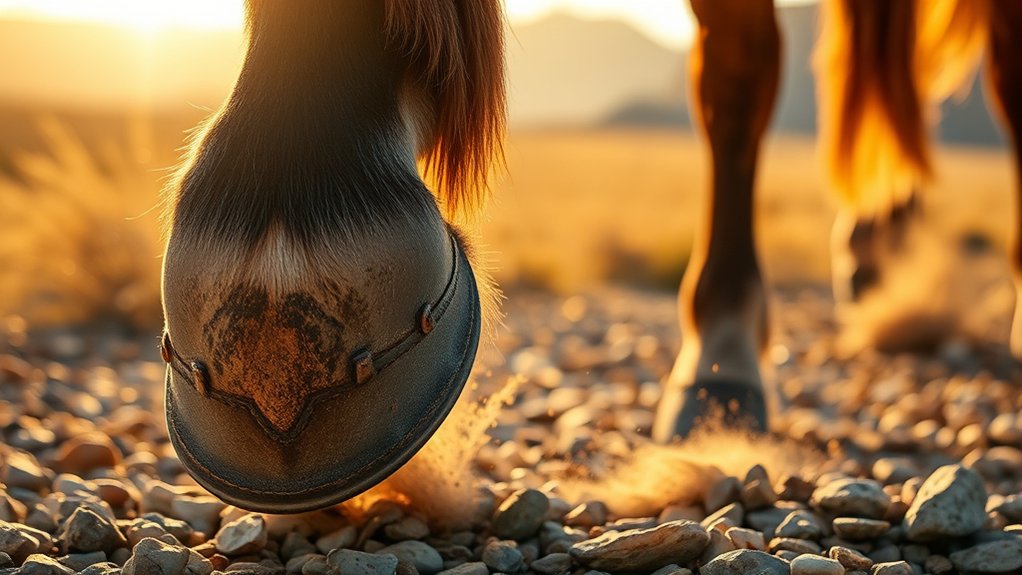
You don’t need to shoe wild horses because their constant movement over rough, abrasive terrain naturally wears down their hooves. This prevents overgrowth and promotes hardness.
Their hooves grow tougher and denser in response to environmental stresses. This is supported by a nutrient-rich natural diet that reinforces keratin development.
This environment-driven abrasion maintains structural integrity and reduces injury. If you explore further, you’ll understand how domestication alters these natural processes and why managed care becomes essential for domestic horses.
Why Wild Horses Don’t Need Shoes

Although domestic horses often require shoes to protect their hooves, wild horses don’t need this artificial support because their constant movement over varied, rough terrain naturally wears down and strengthens their hooves.
Wild horses naturally strengthen their hooves through constant movement on rough terrain, eliminating the need for shoes.
Wild horses traverse hard surfaces like rocky ground and grasslands, which promote consistent natural hoof wear. This environment fosters the development of durable hooves capable of withstanding stress without external protection.
Unlike domestic horses, which often stand on softer ground and face artificial workloads, wild horses maintain hoof health through regular, strenuous activity.
Their hooves adapt and self-regulate wear, eliminating the need for shoes. You’ll notice that wild horses’ hooves remain strong and functional precisely because their environment drives continuous, natural abrasion and structural resilience.
What Makes Wild Horses’ Hooves Naturally Strong
When wild horses constantly move across rough terrains like rocky landscapes and grasslands, their hooves undergo natural abrasion that prevents overgrowth and builds strength. This consistent movement across abrasive surfaces conditions the hoof structure, enhancing its toughness and resilience.
Wild hooves grow at a rate that balances wear with regeneration, ensuring durability without the need for artificial support.
Furthermore, the natural minerals and nutrients from their diet contribute to keratin development, reinforcing hoof hardness and elasticity.
The combination of terrain-induced wear, balanced growth, and nutritional support results in hooves that are naturally strong and capable of enduring the demands of their environment.
Understanding these factors helps you appreciate why wild horses maintain such robust hooves without requiring shoes.
How Wild Terrain Shapes Healthy Hoof Wear
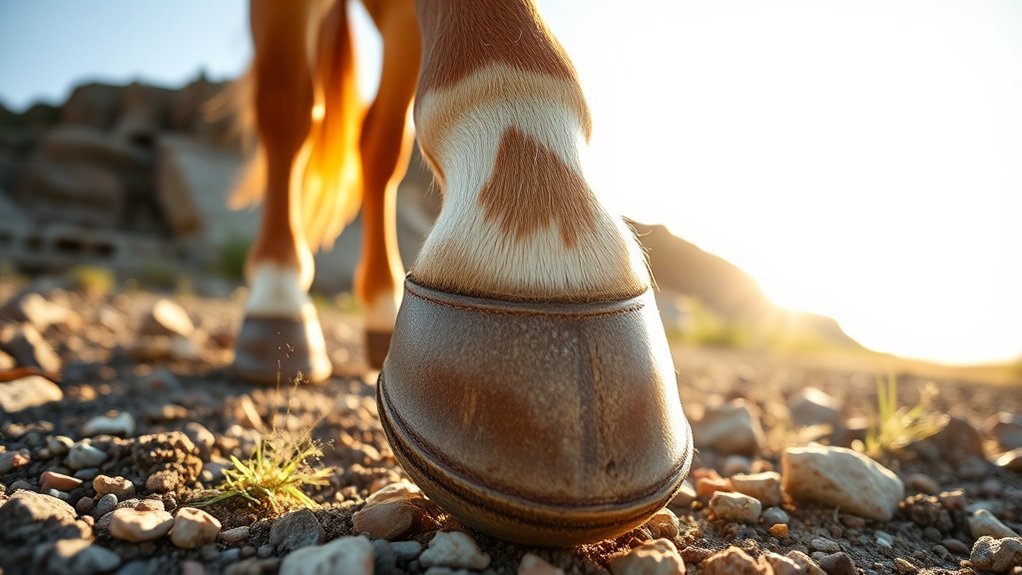
You know, wild horses depend a lot on natural hoof abrasion from rough terrain to keep their hooves healthy. When they walk on abrasive surfaces like rocky paths, it actually shapes their hoof wall over time.
This natural wear helps make their hooves tougher and encourages balanced wear, which is pretty important. Because of this constant contact with the terrain, their hooves don’t grow too long or suffer structural damage.
And the best part? All of this happens without any artificial help.
Natural Hoof Abrasion
How does the natural environment shape the hooves of wild horses? Constant movement over abrasive terrain naturally wears down their hooves, balancing hoof growth and wear. Wild horses travel long distances daily across varied landscapes, causing consistent hoof abrasion.
This natural wear prevents overgrowth and fosters hard, resilient hooves, eliminating the need for artificial shoes.
| Terrain Type | Abrasion Effect | Hoof Adaptation |
|---|---|---|
| Grasslands | Moderate, gradual wear | Balanced hoof growth |
| Rocky Areas | High, intense wear | Tough, durable hoof |
| Sandy Trails | Light wear | Flexible hoof structure |
| Mixed Terrain | Variable wear | Adaptive hoof strength |
| Hard Surfaces | Consistent strong wear | Reinforced hoof walls |
This abrasion mimics shoeing wear, ensuring wild horses maintain ideal hoof condition naturally.
Terrain Impact on Hooves
Although wild horses navigate diverse terrains daily, their hooves adapt efficiently to the constant challenges posed by rough, hard, and uneven surfaces. The natural terrain subjects their hooves to continuous abrasion, especially over rocky grasslands and hard ground, promoting regular wear that prevents excessive growth.
This consistent wear stimulates the hoof wall to shed and renew systematically, maintaining ideal shape and structural integrity. As you observe, the abrasive qualities of the environment ensure the hooves develop toughness and durability necessary for long-distance travel.
Consequently, these conditions foster a self-maintaining hoof system that naturally balances growth and wear without external intervention. Understanding this terrain impact clarifies why wild horses’ hooves remain healthy and resilient, eliminating the need for protective shoes.
Why Constant Movement Prevents Wild Horses’ Hoof Overgrowth
Because wild horses traverse long distances daily over varied terrains, their hooves undergo constant natural wear that prevents overgrowth. This continuous movement creates natural abrasion, stimulating hoof wear and maintaining ideal hoof health.
The hoof keratin sheds and renews regularly, reducing the risk of hoof overgrowth. Diverse terrain types, from rocky to grassy, contribute to balanced hoof shaping and prevent softening often seen in domesticated horses with limited activity.
| Aspect | Effect on Hoof Health | Emotional Connection |
|---|---|---|
| Movement | Ensures constant wear | Freedom and vitality |
| Terrain Variety | Promotes natural abrasion | Balance and strength |
| Hoof Wear | Prevents overgrowth | Natural resilience |
| Hoof Keratin | Regular renewal | Lifelong endurance |
Your horse’s hoof health thrives because of this dynamic interplay.
How Domestication Changes Hoof Structure And Care
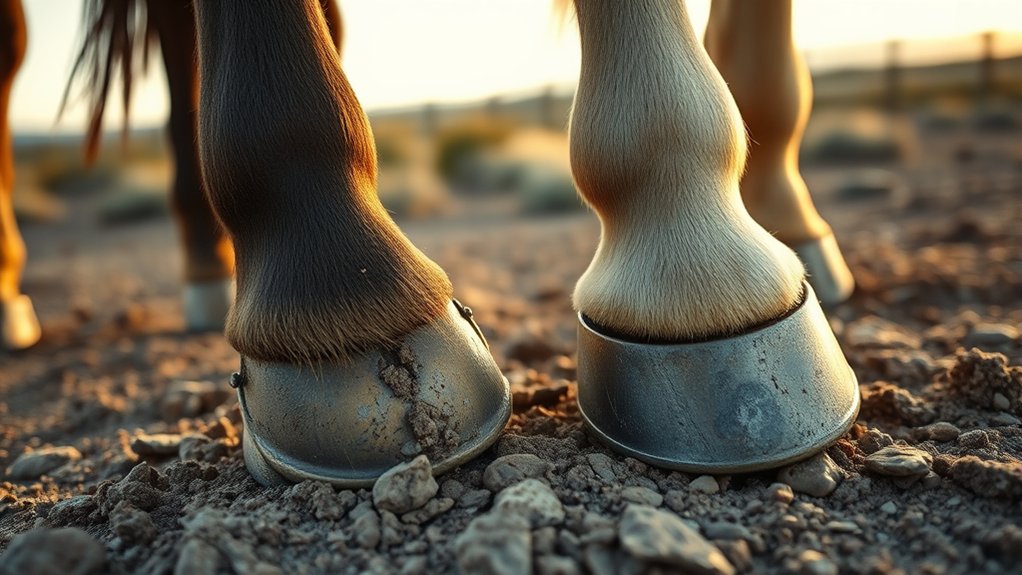
When horses move from wild environments to domesticated settings, their hooves undergo significant structural changes due to altered activity levels, terrain, and nutrition. Unlike wild horses, whose continuous movement over rugged terrain promotes natural hoof wear and robust hoof structure, domestication reduces this abrasive stimulus.
You’ll notice domestic horses often experience diminished hoof wear because softer, managed surfaces limit natural abrasion. Furthermore, their diets frequently lack the mineral diversity found in wild diets, potentially compromising hoof strength.
Selective breeding also changes hoof composition and sometimes reduces resilience.
Because of this, hoof care in domesticated horses must compensate for these changes by addressing weaker hoof walls and promoting proper wear patterns. Understanding these distinctions helps explain why wild horses retain stronger natural hooves, while domestication demands proactive hoof care to maintain hoof health.
When Domestic Horses Need Shoes Vs. Wild Horses
If you observe the daily routines of wild horses, you’ll see their hooves naturally wear down through constant travel over varied, abrasive terrain. This eliminates the need for added protection.
In contrast, domestic horses often require shoes because their environment and hoof wear are different.
Consider these factors:
- Wild horses develop hard, durable hooves by moving long distances across tough grasslands and rocky surfaces.
- Domestic horses frequently have softer hooves due to less strenuous activity and softer ground.
- The lack of natural hoof wear in domestic horses increases the risk of hoof damage and discomfort.
- Shoes provide protection and support to domestic horses that don’t experience the rigorous conditions wild horses do.
Understanding these distinctions helps you appreciate why wild horses thrive without shoes while domestic horses often need them.
How Regular Movement And Terrain Influence Domestic Horse Shoeing
The difference in daily activity and terrain between wild and domestic horses directly affects hoof condition and shoeing needs. Wild horses experience extensive movement over rough, uneven terrain, promoting natural hoof wear that maintains strong, balanced hooves.
This constant activity prevents overgrowth and supports hoof health without artificial intervention. In contrast, domestic horses often move less and primarily on softer, flatter terrain, which limits natural wear and can weaken hooves.
As a result, you’ll find domestic horses more prone to hoof imbalances and damage, necessitating shoeing for protection and support.
Understanding how movement and terrain influence hoof condition helps you manage shoeing practices effectively, ensuring domestic horses maintain *ideal* hoof health despite their less demanding environments compared to wild horses.
Why Wild Horses Rarely Suffer Hoof Injuries Requiring Shoes
You’ve probably noticed that wild horses rarely end up with hoof injuries that require shoes. That’s mainly because they’re always on the move, walking and running over tough, abrasive ground.
This constant activity naturally wears down their hooves, kind of like a natural filing process.
Because of this regular wear, their hoof walls and soles get stronger over time. It helps prevent cracks and keeps the hooves from wearing out too much.
Plus, their hooves actually adapt to these conditions, so they stay tough and durable without needing any artificial support like shoes.
Pretty cool, right?
Natural Hoof Wear
Because wild horses constantly traverse rough and uneven terrains, their hooves naturally wear down at a rate that prevents overgrowth and maintains structural integrity. This natural hoof wear is essential for hoof health and overall hoof development.
You’ll notice that:
- Wild horses’ continuous movement across abrasive terrain promotes natural hoof hardening.
- Their hooves develop thick, durable walls, perfectly adapted to their active lifestyle.
- Regular abrasion prevents excessive growth, minimizing the risk of cracks or injuries.
- This constant natural hoof maintenance reduces the need for artificial protection like shoes.
Constant Movement Benefits
Constant movement over varied and abrasive terrain naturally conditions wild horses’ hooves, preventing overgrowth and minimizing damage. You’ll find that this constant movement promotes natural wear, which balances hoof growth and erosion without external intervention.
As wild horses traverse rough terrain daily, their hooves develop increased density and strength, enhancing overall hoof health. This self-maintenance process results in durable hooves adapted to withstand environmental stresses.
Unlike domesticated horses, whose limited movement often leads to hoof problems, wild horses benefit from continuous, strenuous activity that reduces the risk of cracks, bruises, and soft tissue injuries.
Essentially, their active lifestyle on natural surfaces acts as a natural conditioning mechanism, making artificial shoes unnecessary for maintaining ideal hoof function and integrity.
Tough Terrain Adaptation
Although wild horses face challenging, abrasive terrain daily, their hooves rarely suffer injuries that require shoes. Their hoof durability results from continuous adaptation to tough terrain, including rocky ground and uneven surfaces.
Wild horses travel long distances daily, promoting natural wear that prevents overgrowth and splitting. Constant movement on abrasive surfaces enhances hoof strength by stimulating growth in tougher, denser hoof material.
The natural environment, with grasslands and uneven rocky patches, conditions hooves to resist injury and wear. This active lifestyle shapes hooves ideally, balancing hardness and flexibility to withstand impact without cracking.
You can see how wild horses’ hooves evolve through natural wear and environmental stress, maintaining resilience without artificial support.
How Diet And Environment Affect Wild And Domestic Hoof Toughness
When you examine the hooves of wild horses, you’ll notice their toughness results from both the diet they consume and the environment they inhabit. Wild horses graze on coarse grasses and native plants rich in essential nutrients, promoting resilient hoof tissue development.
Their environment, often dry, rocky, and arid, induces natural hoof wear, preventing overgrowth and conditioning the hoof wall. This constant abrasion, combined with vigorous movement across rugged terrain, enhances hoof toughness.
In contrast, domestic horses usually have softer hooves due to less intense activity and diets lacking the mineral variety found in wild forage. Without the natural environment’s abrasive effects and ideal diet, domestic horses experience reduced hoof wear, which diminishes hoof toughness and necessitates additional hoof care measures.
Understanding these factors clarifies why wild horses maintain healthy hooves without shoes.
What Makes Domestic Hoof Care Different From Wild Hoof Care
You’ll notice that domestic horses experience less natural hoof wear because they move around less and mostly on softer surfaces. Wild horses, on the other hand, travel across abrasive terrains every day.
This difference in environment really affects the strength and shape of their hooves. So, if you’re caring for a domestic horse, you’ll need to be more mindful when it comes to trimming and shoeing.
Plus, domestication changes their diet and exercise habits, which also plays a big role in hoof health.
All these factors mean that keeping a domestic horse’s hooves in good shape requires a bit more attention and care compared to wild horses.
Hoof Wear Differences
Because wild horses constantly traverse rough, uneven terrain, their hooves naturally wear down and maintain an ideal length and hardness. You’ll notice these hoof wear differences when comparing wild horses to domestics:
- Wild horses experience consistent natural wear from continuous movement, shaping durable hooves.
- Their environment promotes hoof health by preventing overgrowth and maintaining hardness without shoes.
- Domestic horses often stand on softer surfaces, limiting natural wear and causing softer, overgrown hooves.
- This lack of natural abrasion means humans have to step in to trim and protect domestic hooves.
Understanding these distinctions helps you appreciate why wild horses sustain healthy hooves on their own, while domestic horses rely on managed care to mimic the natural wear they don’t get in controlled environments.
Environmental Impact Factors
The natural terrain wild horses navigate directly influences their hoof condition, shaping strong, resilient hooves through constant abrasion. In contrast, domestic horses often move on softer, less abrasive terrain like pastures or paved surfaces, which limits natural hoof wear.
This reduced wear affects hoof health by allowing overgrowth and softer hoof material, making shoes or regular trimming necessary.
Wild horses’ environment demands varied, strenuous movement across rough terrain, promoting the development of thick, durable hooves adapted to these conditions.
You’ll notice that this natural selection process fosters hooves capable of withstanding harsh elements without intervention.
Understanding these environmental impact factors clarifies why domestic hoof care differs markedly from wild hoof care, emphasizing the importance of movement and terrain in maintaining ideal hoof health.
Domestication Effects
Although wild horses develop strong, naturally worn hooves through constant movement on abrasive terrain, domestic horses face entirely different conditions that affect their hoof health. Domestication changes the natural wear process, making shoeing necessary. Here’s why:
Domestic hooves experience less natural wear because they live in softer, managed environments without abrasive terrain. Also, reduced movement in artificial settings like paddocks limits natural hoof strengthening.
Diets of domesticated horses often lack nutrients found in wild forage, which can lead to softer hooves. Plus, regular trimming and shoe application take the place of the continuous natural wear that wild horses get on their own.
Understanding these domestication effects helps explain why domestic hooves need shoes for protection and support, while wild horses rely on their environment to keep their hooves strong and naturally worn.
Frequently Asked Questions
How Do Wild Horses’ Hooves Compare to Other Wild Animals’ Hooves?
You’ll notice wild horses’ hoof anatomy shows greater density in hoof mineral content compared to other wild animals, aiding durability. Their evolutionary adaptations focus on continuous natural wear from extensive grazing impact, shaping tougher hooves.
While hoof shape variation exists among species, horses’ hooves are uniquely rounded and robust, designed for endurance.
In contrast, animals like deer have more pointed hooves suited for agility. These differences reflect habitat and lifestyle demands.
Can Wild Horses Survive in Softer, Less Rugged Environments Without Shoes?
Yes, wild horses can survive in softer, less rugged environments without shoes because their hooves naturally adapt through constant movement.
Unlike domesticated horses, which rely on hoof shoe technology and veterinary hoof care due to limited activity and urban horse populations, wild horses maintain hoof health independently.
Their hooves withstand terrain without equine artificial aids or specialized horse training methods, proving their natural resilience and self-sufficiency in varied environments.
What Role Do Genetics Play in the Strength of Wild Horse Hooves?
Genetics play a vital role in your wild horse’s hoof robustness by influencing genetic resilience and hereditary traits. Natural selection favors those with strong hoof structure, enhancing their survival on rugged terrain.
Genetic diversity within populations ensures varying degrees of hoof strength and adaptability. These hereditary traits optimize keratin production, promoting durability and resistance to cracking.
How Do Wild Horses Handle Hoof Infections Without Human Treatment?
You’ll see wild horses manage hoof infections through their hoof resilience and infection defense, relying on evolutionary traits that promote natural healing. Their hoof health benefits from continuous natural wear, which helps prevent severe infections.
Environmental adaptation also plays a key role, as diverse microbes strengthen their immune response. This combination allows wild horses to recover without human treatment, maintaining robust hooves suited to their rugged habitats through intrinsic biological mechanisms.
Are There Seasonal Changes in Wild Horses’ Hoof Growth or Wear?
Yes, you’ll notice seasonal growth and wear considerably influence hoof health in wild horses. During warmer months, increased activity accelerates hoof growth and natural trimming.
Environmental impact, like rough terrain, also enhances hoof wear.
In colder periods, growth slows, and reduced movement lessens wear, promoting hoof resilience. These cyclical patterns maintain balanced hooves year-round, supporting ideal function without artificial intervention.
Conclusion
You don’t need to guess why wild horses thrive without shoes. It’s their constant movement on varied terrain that naturally wears and strengthens hooves.
Imagine a wild mustang traversing rocky trails daily. Its hooves adapt and maintain toughness without human intervention.
Unlike domestic horses, whose limited movement and softer ground demand shoeing, wild horses’ environment and lifestyle create a self-sustaining hoof care system. This highlights the critical role of natural biomechanics in hoof health.