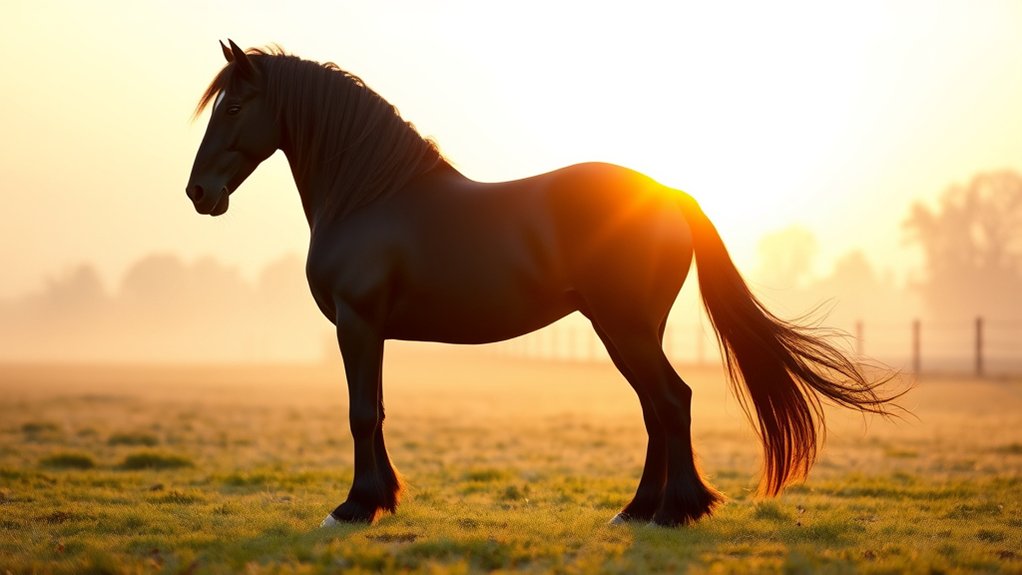
How Tall Is a Friesian Horse?
You’ll find Friesian horses typically stand between 15.2 and 16 hands tall at the withers, with stallions usually measuring 15.3 to 16.2 hands and mares slightly smaller. Their height is measured precisely at the withers to guarantee breed standard compliance, as this range supports their distinctive movement and presence.
Genetics, nutrition, and age influence height development, which generally stabilizes by age four. If you want to understand how these factors affect performance and breed standards, there’s more to explore.
How Tall Is a Friesian Horse on Average
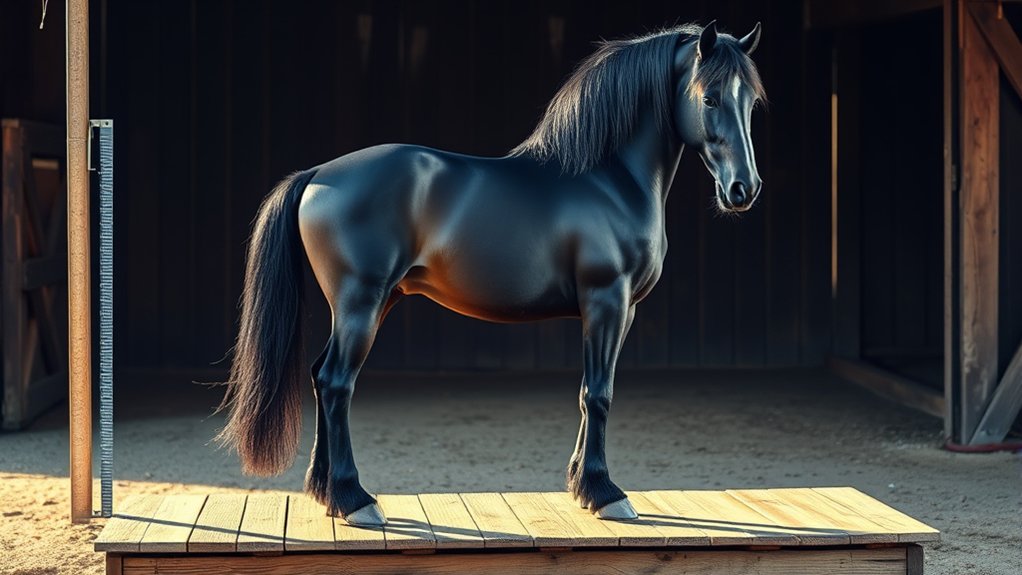
Although individual Friesian horses may vary slightly, you can generally expect them to stand between 15.2 and 16 hands tall at the withers, which translates to about 63 inches or 5 feet 3 inches.
This height range defines the breed’s average stature, positioning Friesians as a tall horse breed.
The breed’s height typically falls within the broader standard range of 14.5 to 17 hands, but most individuals cluster near the 15.2 to 16 hands mark.
This consistency reflects selective breeding focused on maintaining a uniform size.
When evaluating Friesian height, measuring at the withers provides a reliable indicator, as it represents the highest point of the shoulders.
Understanding this average height helps you gauge the breed’s suitability for various equestrian disciplines and confirm breed standards.
Typical Height Ranges for Friesian Horse Stallions and Mares
You’ll find that Friesian stallions typically stand at a minimum of 15.3 hands, which is about 63 inches. That’s their mature height standard.
Mares, on the other hand, usually range between 15.2 and 16 hands—that’s roughly 62 to 64 inches. So, there’s a bit of variation in height within the breed.
It really helps to understand their growth patterns and what factors influence their size to get a clear picture of these typical height ranges.
Stallion Height Standards
When evaluating Friesian stallions, you’ll find that their height typically ranges from 15.3 to 16.2 hands (63 to 66 inches, or 160 to 168 cm) at the withers.
There is a strict minimum requirement of 15.3 hands for breed approval. Stallion height is a critical factor in meeting breed standards, as it directly influences the horse’s overall conformation and suitability for breeding.
The height at withers must be measured precisely during inspections, ensuring that each stallion meets or exceeds the minimum to maintain breed integrity.
These standards help preserve the Friesian’s characteristic elegance and athleticism, setting clear parameters that distinguish approved stallions from those that fall short in height or build.
Maintaining rigorous stallion height criteria supports the breed’s uniformity and functional performance.
Mare Height Variations
While Friesian stallions typically range between 15.3 and 16.3 hands at the withers, mares present a slightly broader variation, generally standing between 15.1 and 16 hands. You’ll find that mare height variations within the breed are normal, but the breed standard sets a minimum height of 15.2 hands for mature mares.
This guarantees mares maintain the breed’s characteristic noble and elegant stature.
When evaluating mare height, you should note that most Friesian mares fall comfortably within the 15.1 to 16 hands range, translating roughly to 61–64 inches (155–163 cm).
Understanding these height variations helps you assess individual mares against the breed standard, ensuring they meet the desired conformation and overall presence typical of Friesians.
Growth Patterns and Factors
Although Friesian horses have established height ranges, their growth patterns depend on various factors that influence their final stature.
Stallions typically measure between 15.3 and 16.3 hands (61-65 inches), with most averaging 15.3 to 16 hands. Mares are slightly shorter, usually ranging from 15.1 to 16 hands (61-64 inches).
Height is consistently measured at the withers, the highest point of the shoulder blade, ensuring precise assessment of physical structure.
Genetic predisposition plays a significant role in determining growth patterns, while environmental factors and nutrition directly impact bone development and muscle mass.
According to breed standards, Friesians over 15.2 hands are considered fully mature, though many stallions exceed 16 hands.
Understanding these variables helps you predict the horse’s ultimate height and physical structure accurately.
The Role of Height in Friesian Breed Standards and Registration
You need to understand that Friesian breed standards specify a height range of 15.2 to 16 hands, measured precisely at the withers for consistency.
Stallions must reach at least 15.3 hands by age four to qualify for registration.
This height criterion directly impacts whether a horse meets the strict registration requirements and maintains breed integrity.
Basically, if a Friesian doesn’t meet these height standards, it can’t be registered as part of the breed.
Height Requirements Overview
How important is height when it comes to Friesian breed standards and registration? Height plays a critical role in maintaining the breed’s characteristic elegance and stature.
The official breed standards specify that Friesians must stand between 15.2 and 16 hands (62 to 64 inches) at the shoulder.
Stallions are required to be at least 15.3 hands (63 inches) by age four.
During inspections, height is a decisive factor in the approval process, ensuring conformity to these strict criteria.
Consistent measurements safeguard the breed’s uniformity and aesthetic appeal.
Key height requirements include:
- Minimum stallion height of 15.3 hands at age four
- Overall height range of 15.2 to 16 hands for all Friesians
- Regular inspections to verify adherence to breed standards
Measurement Methods Explained
Because accurate height measurement directly impacts Friesian breed registration and standards, precise methods are essential. You measure a Friesian horse’s height at the withers, the highest point of the shoulder blade, using a rigid measuring stick or tape.
Position the horse squarely on a flat surface, making sure the measuring device is vertical and contacts the withers without compressing the hair or skin.
Height is recorded in hands, where one hand equals 4 inches. Friesians typically stand between 15.2 and 16 hands.
Consistent, exact measurement at the withers maintains breed uniformity and helps verify conformity with standards during inspections and keuring events.
Impact On Registration
Although height is just one of several factors considered during Friesian breed registration, it plays a critical role in determining eligibility and breeding approval. The breed standards specify that Friesians must stand between 15.2 and 16 hands at the withers for registration.
Stallions are required to be at least 15.3 hands tall by age four to qualify for breeding.
Height is rigorously evaluated during breed inspections and keuring events, directly influencing registration outcomes. Maintaining a consistent height range ensures uniformity and compliance with official breed standards.
Key points regarding height and registration include:
- Horses outside the standard height range may face limited registration options.
- Stallions below 15.3 hands are ineligible for breeding approval.
- Height measurements impact inclusion in the main studbook and breed uniformity.
Comparing Friesian Height to Other Horse Breeds
When comparing the height of Friesian horses to other breeds, you’ll find that they typically stand between 15.2 and 16 hands (62 to 64 inches) at the withers. This height places Friesians above many light riding breeds but below larger draft horses. Understanding this breed comparison helps you appreciate their unique stature within equine categories.
| Breed | Average Height (hands) |
|---|---|
| Arabian | 14.25 – 15.25 |
| Friesian | 15.2 – 16 |
| Percheron | 16 – 18 |
Friesians exceed the height of Arabians and Morgans but remain shorter than draft breeds like the Percheron. Occasionally, Friesians reach 17.3 hands, surpassing many standard riding breeds yet still falling short of some warmbloods. This precise height range defines their niche in breed comparison by hands.
Genetic Influences on Friesian Height
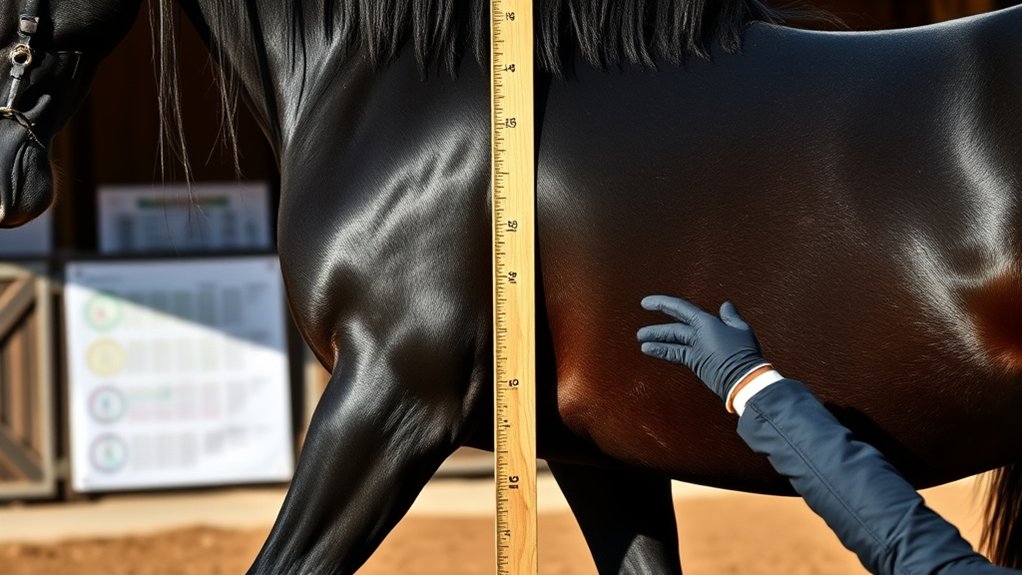
You’ll find that the height differences in Friesian horses come from certain hereditary growth factors passed down through generations. These genetic components control bone length and overall stature, which is why this breed usually has such a tall and consistent frame.
Knowing about these inherited traits makes it easier to understand why Friesians typically stand between 15.2 and 16 hands at the withers.
It’s pretty interesting how genetics play such a key role in their height!
Genetic Height Variation
Since Friesian horses typically stand between 15.2 and 16 hands at the withers, their height variation largely stems from genetic influences. Genetic factors, including specific alleles and inheritance patterns, dictate the range of heights within the breed standard.
When you evaluate height variation, you’ll see it results from heritable traits passed down through generations.
Key points to regard include:
- Selection of stallions and mares with preferred stature directly affects height variation.
- Genetic diversity within the breed causes natural fluctuations in individual height.
- Height variation remains constrained by the established breed standard to maintain uniformity.
Hereditary Growth Factors
Genetic inheritance from Friesian ancestors, including Dutch, Spanish, and Arabian lines, plays a dominant role in determining the horse’s height. You’ll find that specific genetic factors, such as gene variants linked to bone growth and ossification, directly influence the breed’s growth potential.
Heritability of height traits in Friesians is high, meaning these characteristics reliably pass from one generation to the next. Breeders utilize pedigree analysis and genetic testing to stabilize these hereditary growth factors, maintaining the breed’s typical height range of 15.2 to 16 hands.
While nutrition and health impact the expression of genetic height potential, they can’t override the genetic baseline set by the horse’s lineage. Understanding these hereditary growth factors helps you predict and select for desired stature within Friesian breeding programs.
What Affects Friesian Horses’ Height? (Age, Nutrition, Environment)
Although a Friesian horse’s height largely depends on its inherited traits, several factors influence how tall it ultimately grows. You’ll find that growth typically completes by four to five years of age, with full height established by then.
However, nutrition and environment play vital roles during this phase. Proper nutrition, including sufficient protein and minerals, supports ideal skeletal development. Meanwhile, a stable environment with minimal stress and regular exercise promotes healthy growth patterns. Neglecting these can stunt potential height gains.
Key factors affecting Friesian height include:
- Age: Growth phase ends around 4-5 years, determining final stature.
- Nutrition: Adequate protein and minerals ensure optimal bone development.
- Environment: Stress-free living conditions and exercise support healthy growth.
How Friesian Height Impacts Movement and Performance
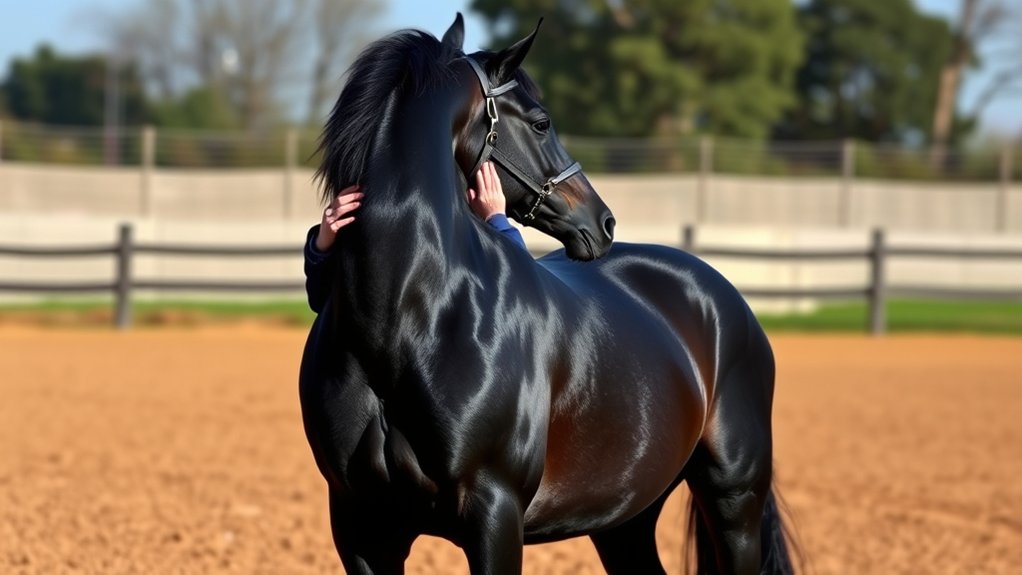
Understanding how a Friesian’s height influences its movement and performance helps you appreciate the breed’s unique capabilities. Standing between 15.2 and 16 hands, their height affords a commanding presence that directly impacts their movement dynamics.
A Friesian’s height, ranging from 15.2 to 16 hands, shapes its commanding presence and dynamic movement.
This stature enables a high, elevated trot, enhancing both elegance and visibility in dressage and driving disciplines. You’ll notice their powerful hindquarters capitalize on this height, producing strong, expressive strides with ideal length.
Taller Friesians tend to excel in performance settings, as their height accentuates noble carriage and a graceful gait, essential for aesthetic appeal and functional agility. The breed’s height balances strength and agility, ensuring versatile movement that supports diverse work and show demands.
Making height a critical factor in Friesian movement and overall performance.
Debunking Friesian Height Myths
While many people assume Friesian horses vary widely in height, the breed actually maintains a consistent range between 15.2 and 16 hands at the withers. This height range is firmly established within the Friesian horse breed’s official breed standards.
Misconceptions about their size often arise, but these usually ignore genetic factors or crossbreeding influences.
To debunk common height myths, consider these points:
- Stallions typically reach a minimum height of 15.3 hands by age four, aligning strictly with breed standards.
- Variations beyond 15.2 to 16 hands are uncommon and often due to age or genetics, not the breed itself.
- Friesians are taller than many European breeds, like Arabians, which average below 15.3 hands.
Understanding these facts helps clarify the precise height range of this elegant breed.
Why Friesian Height Matters to Riders and Disciplines
Because Friesian horses stand between 15.2 and 16 hands at the withers, their height directly impacts their suitability across various riding disciplines. This stature provides you with enhanced stability and a commanding presence, essential for disciplines like dressage, driving, and ceremonial work.
The breed’s height allows for expansive, expressive movement, which is vital for performance and show events. When selecting a Friesian, you’ll find that their consistent height aligns with breed registration standards, ensuring uniformity in competitions.
The Friesian’s stature not only contributes to its elegance but also optimizes rider balance and control, pivotal for technical precision. Understanding the importance of height helps you choose the right horse for your specific discipline, maximizing both performance and aesthetic appeal.
How Friesian Height Develops Over Time
Although Friesian horses reach their full height between 15.2 and 16 hands as adults, their growth follows a distinct timeline. You’ll notice that foals start around 12 to 14 hands at birth and experience rapid height development during their first year.
Friesian foals grow rapidly from 12 to 14 hands at birth to near adult height within their first year.
By age four, most Friesians have achieved their full height, with minimal increase afterward. Monitoring this growth is essential for breeding and maintaining breed standards.
Key stages of Friesian height development include:
- Rapid early growth in the first year, setting the foundation for adult stature
- Gradual slowing of height increase from ages one to four
- Stabilization at full height around age four, influenced by genetics and nutrition
Understanding this timeline helps you manage growth expectations and optimize care.
Frequently Asked Questions
What Colors Do Friesian Horses Come In?
You’ll find Friesian horses come almost exclusively in solid black, which aligns with their breed standards rooted deeply in Friesian history.
Occasionally, a rare chestnut appears, but it’s not accepted officially.
When you handle horse grooming, you’ll notice their glossy black coat reflects proper care and equine diet.
Any other colors or significant markings disqualify them from purebred status, ensuring the breed’s traditional, uniform appearance remains intact.
How Long Do Friesian Horses Live on Average?
You can expect a Friesian horse to live around 25 to 30 years on average. Proper horse grooming and attentive breeding practices considerably contribute to their longevity by preventing health issues.
Their historical origins as robust, versatile horses mean they naturally have a strong constitution.
Are Friesian Horses Good for Beginner Riders?
Yes, Friesian horses suit beginners with proper training techniques, appropriate riding gear essentials, and understanding of breeding practices. You’ll find their calm temperament and balanced gaits help you develop confidence.
However, you must manage their high-maintenance coat and health needs carefully.
What Is the Typical Temperament of a Friesian Horse?
You’ll find Friesian horses have a calm, gentle temperament, making horse training straightforward. Their temperament traits include intelligence and enthusiasm to please, which accelerates learning and builds trust.
They’re relaxed yet attentive, ideal for riders at various skill levels.
Grooming needs are moderate but essential to maintain their coat and mane, reinforcing your bond during care.
How Much Does a Friesian Horse Usually Weigh?
Friesian horses typically tip the scales between 1,250 and 1,450 pounds. You’ll find that a firm feeding regimen, balanced with meticulous horse grooming, supports their sturdy, muscular frame.
Training techniques tailored to their build help maintain ideal weight and performance.
Mature males often carry more mass, so adjusting nutrition and exercise is vital.
Conclusion
When you consider the Friesian horse’s height, you might wonder if their stature truly affects performance. The truth is, their average height of 15.2 to 17 hands precisely balances power and agility. This balance is essential for breed standards and varied disciplines.
Genetic factors guarantee consistent growth patterns, debunking myths about excessive size. Understanding this helps you appreciate how Friesian height influences movement, registration, and rider suitability. It’s a critical aspect of breed evaluation.