How to Identify Appaloosa Horse Coat Patterns
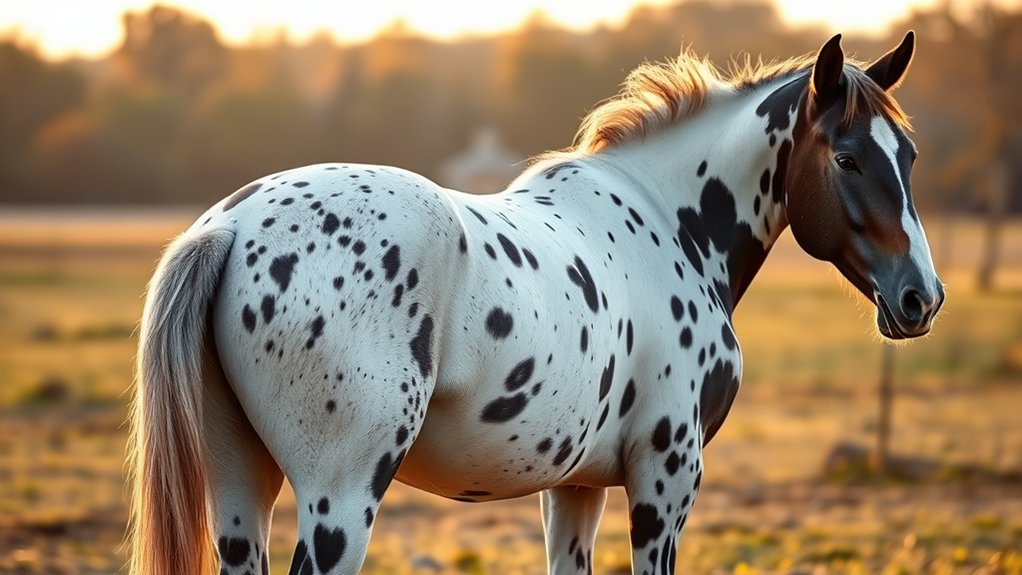
You can identify Appaloosa horse coat patterns by looking for distinct traits linked to the leopard complex gene, such as dense dark spots on white backgrounds (leopard pattern), large white “blankets” on hips, few dark spots on mostly white coats (few-spot leopard), or completely white snowcaps.
Check for mottled skin around the muzzle, eyes, and genitals, white sclera visible around the eyes, and vertically striped hooves. These markers help confirm Appaloosa lineage, while variations and pattern changes reveal deeper genetic influences and age-related effects.
What Defines an Appaloosa Horse Pattern
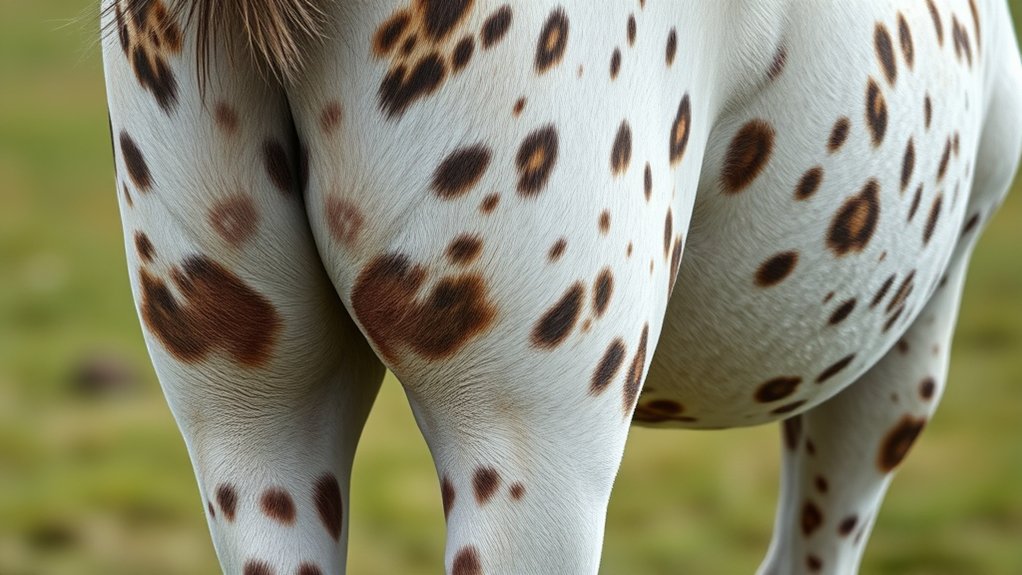
Although you might first notice the striking spots on an Appaloosa horse, what truly defines its pattern is the combination of white areas in the coat and skin where pigmentation shows through as spots or mottling. This is primarily controlled by the dominant LP gene, which dictates the extent of white coat coverage and the presence of spots.
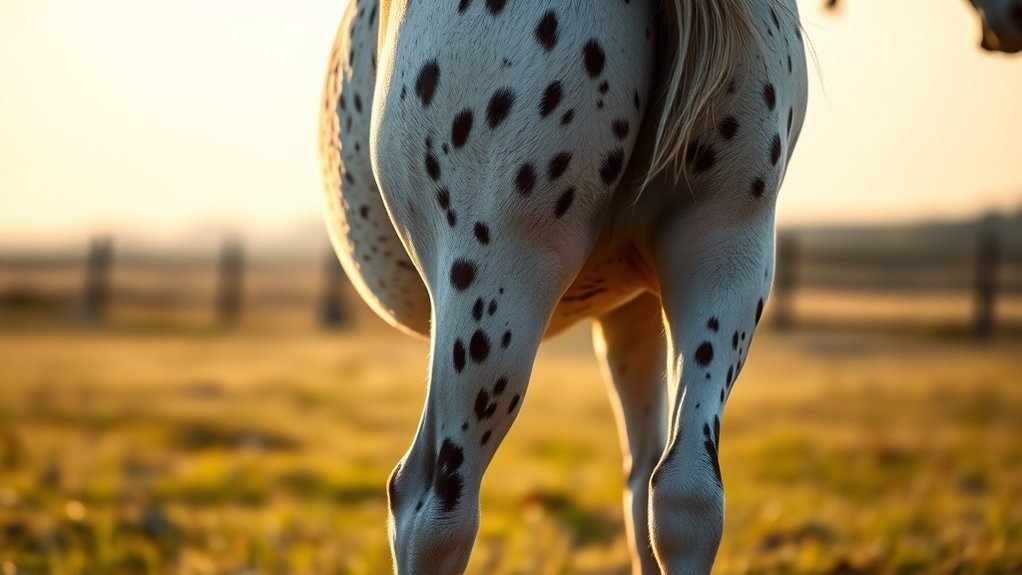
The leopard pattern, the most recognizable, exhibits a white coat densely covered with dark spots uniformly distributed over the body.
In contrast, the blanket pattern features a white “blanket” over the hips, sometimes containing dark spots within this white area or appearing as a spotless snowcap.
Mottled skin beneath these white regions further distinguishes Appaloosa patterns, along with characteristic traits like white sclera and striped hooves, confirming the breed’s unique coat genetics.
Recognizing Major Appaloosa Patterns: Leopard, Few-Spot, Blanket & Snowcap
You’ll recognize the leopard pattern by its white base coat that’s densely covered with dark spots. This look is a hallmark of the leopard complex gene.
On the other hand, the few-spot leopard shows a mostly white coat but with just a few spots around the flank, neck, and head.
Then, there are the blanket and snowcap patterns. These feature solid white areas over the hips or hindquarters.
The snowcap is a bit different because it doesn’t have any spots in those regions.
Knowing these subtle differences really helps when you’re trying to classify the patterns accurately.
Leopard Pattern Characteristics
When you examine the leopard pattern on Appaloosa horses, you’ll notice a distinctive white coat peppered with dark spots distributed across the body, similar to a Dalmatian’s markings. This pattern is genetically controlled by the dominant Lp gene, which governs the extent of white coverage and spot visibility.
Horses with extensive white areas tend to exhibit fewer spots, while others display numerous, variably sized spots. The leopard pattern also includes characteristic mottled skin, especially noticeable around the muzzle, eyes, and genitals, alongside a white sclera surrounding the eyes.
While this pattern is a hallmark of the Appaloosa breed, it appears in other breeds carrying the leopard complex gene. Recognizing these precise traits will help you accurately identify the leopard pattern among Appaloosa coat variations.
Few-Spot Leopard Traits
Because the few-spot leopard pattern expresses the leopard complex gene at a lower level, these Appaloosas have mainly white coats with only a few distinct dark spots, usually located around the flanks, neck, and head.
You’ll notice the few-spot leopard’s chiefly white coat sharply contrasts with the sparse dark spots, making them highly conspicuous.
This reduced expression of the leopard complex results in limited pigmentation areas rather than the dense spotting seen in full leopard patterns.
Furthermore, few-spot leopards exhibit hallmark leopard complex traits such as mottled skin and visible white sclera around the eyes.
When identifying this pattern, focus on the combination of extensive white coverage with isolated, well-defined spots.
This sets the few-spot leopard apart from other Appaloosa coat patterns with heavier or more widespread spotting.
Blanket And Snowcap Variations
Although the blanket and snowcap patterns both involve extensive white areas on the Appaloosa’s coat, they differ markedly in coverage and spotting. The blanket pattern shows a solid white area over the hips, sometimes extending further, with or without dark spots.
In contrast, the snowcap pattern covers the entire body with a pure white coat, lacking any spots. When identifying these patterns, focus on white distribution and the presence or absence of spots within the white area.
| Pattern | White Coverage | Spots Within White Area |
|---|---|---|
| Blanket | Hips, sometimes midsection | Often present |
| Spotted Blanket | Extensive, variable | Dark or white spots present |
| Snowcap | Entire body | None |
Recognizing these distinctions helps you accurately identify Appaloosa coat patterns.
Recognizing Roan and Roan Blanket Patterns
If you want to accurately identify roan patterns on Appaloosa coats, focus on the distinctive mix of white and dark hairs that create a frosted or mottled effect, primarily over the croup and hips.
The roan blanket pattern specifically covers these areas and may extend slightly onto the back.
Within this roaning, you’ll often see spots or mottling, producing a speckled appearance inside the blanket.
Unlike solid-colored coats, the roan areas maintain a stable mixture of white and colored hairs that don’t fade with shedding.
Be aware that varnish and age can alter these patterns, sometimes causing spots to merge into patches or making the roan effect more pronounced over time.
Recognizing these precise traits helps you differentiate roan and roan blanket patterns effectively.
Identifying Solid-Colored Appaloosas
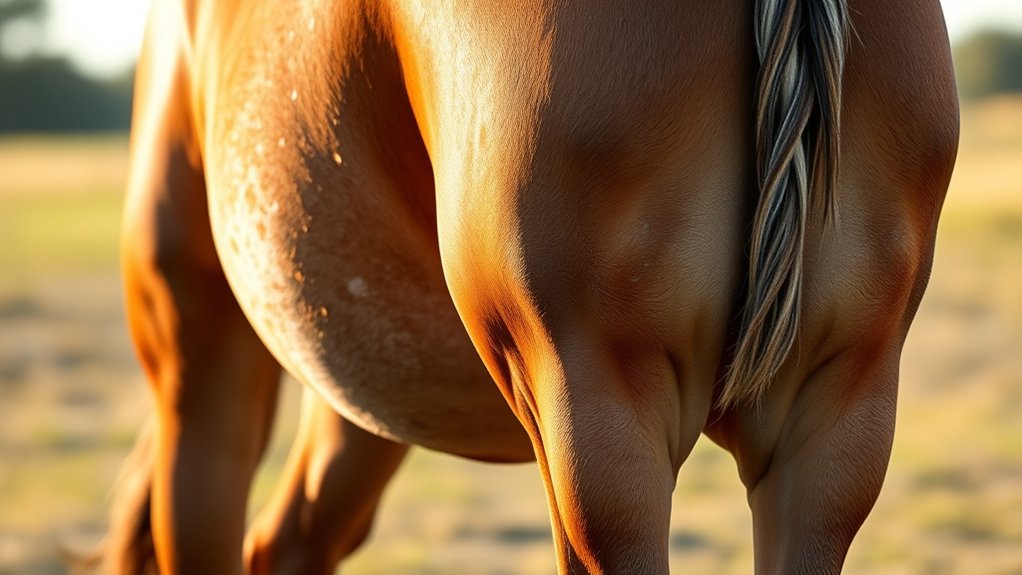
When identifying solid-colored Appaloosas, you’ll need to look beyond visible coat patterns since these horses lack the distinctive spots, blankets, or roaning typical of the breed. A solid coat doesn’t exclude an Appaloosa; instead, focus on subtle breed markers.
Examine the horse for mottled skin, especially around the muzzle and genitals, and check for the characteristic white sclera surrounding the eyes. Solid-colored Appaloosas often have striped hooves, another diagnostic trait.
Their coat colors range from black and bay to chestnut, dun, or palomino, but remain uniformly solid without white or spotted patterns. Despite the absence of visible markings, these horses may carry the leopard complex gene, which can influence coat color changes or pattern emergence over time, confirming their Appaloosa lineage even without distinct coat patterns.
Physical Traits Beyond Coat Patterns
You’ll notice that mottled skin, with its irregular patches of dark and light pigmentation, often shows up around the muzzle, eyes, and genitals of Appaloosas. It’s pretty distinctive.
Also, keep an eye on the white sclera—that’s the white part around the iris—which tends to be more noticeable in this breed compared to others.
These little details give you clear, consistent clues to spot an Appaloosa, even if you’re not just looking at their coat patterns.
Mottled Skin Patterns
How can you accurately identify an Appaloosa beyond its distinctive coat patterns? One key trait is mottled skin, an irregular mix of dark and light pigmentation. This is often most visible around the muzzle, eyes, genitals, and lower legs.
Mottled skin may be present at birth or develop later, making it essential for identification.
| Area | Pigmentation Pattern | Visibility Notes |
|---|---|---|
| Muzzle | Speckled dark and light | Highly visible, even in young horses |
| Eyes | Irregular patches | Common, especially near white coat |
| Genitals | Mixed pigmentation | Distinctive, aids breed recognition |
| Lower Legs | Speckled mottling | More prominent with white patterns |
Mottled skin distinguishes Appaloosas from other breeds, especially when combined with their unique coat patterns.
White Sclera Visibility
Although white sclera is uncommon in most horse breeds, you’ll often see it clearly around an Appaloosa’s eyes, contributing to their distinctive appearance. Unlike typical horses with dark sclera, Appaloosas frequently exhibit a white or pale sclera, especially near the inner eye corner.
This visibility becomes pronounced when the horse is alert or glancing sideways, and under certain lighting conditions. The white sclera serves as a critical physical marker for identifying Appaloosas, particularly when coat patterns are ambiguous or absent.
While white sclera alone isn’t exclusive to the breed, its presence combined with mottled skin and characteristic coat patterns strongly points to Appaloosa lineage.
Hence, evaluating white sclera visibility alongside coat patterns enhances your accuracy in recognizing these unique horses.
How Genetics Influence Appaloosa Patterns
Because the Leopard Complex (LP) gene serves as the primary genetic switch for Appaloosa coat patterns, understanding its role is essential when identifying these distinctive markings. The LP gene operates dominantly; one copy (Lplp) produces spotted patterns, while two copies (LpLp) lead to extensive white with fewer spots.
Modifier genes further refine white coverage and spotting intensity, shaping the final coat pattern.
| Genotype | White Coverage | Spotting Density |
|---|---|---|
| LpLp | Extensive | Sparse |
| Lplp | Moderate | Dense |
| lplp | None | None |
This table highlights how LP gene dosage influences coat pattern expression, emphasizing its critical genetic role in Appaloosas.
Why Appaloosa Coat Patterns Change Over Time
When you observe an Appaloosa horse over several years, you’ll notice its coat patterns can shift in appearance due to natural aging and genetic influences. Age-related changes often cause patterns like snowcap or blanket to expand or fade.
Appaloosa coat patterns evolve over time, influenced by aging and genetics, causing shifts in appearance.
The varnish roan gene plays a pivotal role by transforming smaller spots into larger, more solid patches, considerably altering the coat’s visual texture.
Furthermore, age-related changes affect the visibility of key features such as mottled skin and the white sclera, which may become more pronounced, impacting overall pattern clarity.
Some horses experience a reduction in white areas or spots as they mature, making their patterns less distinct. These dynamic changes result from the interplay between genetics, particularly the varnish gene, and environmental and health factors influencing the horse’s coat over time.
Common Appaloosa Pattern Combinations
You’ll often see Appaloosas with blanket patterns that have all sorts of spot configurations. Basically, the white area over their hips is covered with distinct dark spots.
Then, there are roan coats that often mix with snowflake spotting, which creates this subtle, speckled look all over their bodies.
Knowing how these combinations work really helps when you want to accurately spot and tell apart the more complex Appaloosa patterns.
Blanket And Spot Variations
How do blanket and spot variations define the complexity of Appaloosa horse coats? The blanket pattern features a solid white area typically covering the hips. Sometimes, it extends toward the shoulders or neck. Spots within this white region can either match the horse’s base coat or contrast sharply, creating distinct visual effects. Understanding these variations helps you precisely identify coat patterns.
- The blanket varies in size, from limited hip coverage to larger body areas.
- Spots within the blanket may be dark or white, adding intricate detail.
- Some blankets lack spots entirely, such as the snowcap pattern, which fully covers the hindquarters in solid white.
Roan And Snowflake Mix
Although the roan and snowflake mix pattern presents a complex visual, you can identify it by its combination of a frosted, mottled roan blanket and distinct small white spots scattered across a darker base coat.
Typically, the roan blanket covers the hips and croup, exhibiting the characteristic frosted texture from the roan gene.
Within or along the edges of this roan blanket, you’ll notice snowflake white spots, which contrast sharply against the mottled background.
This interplay creates a variable pattern, as the roaning’s frosted effect softens the base coat while the white spots remain sharply defined.
Be aware that both the roan blanket and white spots can change over time, enlarging or fading with age or seasonal coat shifts.
Tips for Identifying Appaloosas in the Field
When identifying Appaloosas in the field, pay close attention to several distinctive physical traits that differentiate them from other breeds. The Appaloosa pattern often includes a white horse coat with distinctive spotting or mottled skin.
Focus on these key markers:
- Examine the mottled skin around the muzzle, eyes, and genitals; this pigmentation irregularity is diagnostic for Appaloosas.
- Look for the white sclera visible around the eyes, which is a unique characteristic not commonly found in other breeds.
- Check the hooves for vertical striping, even if the legs have a solid color, as this feature is exclusive to Appaloosas.
Conclusion: Confirming Appaloosa Identity With Confidence
Because Appaloosa coat patterns can vary widely and sometimes change over time, you need to rely on a combination of physical markers and genetic indicators to confirm breed identity with confidence. Focus on distinctive traits such as mottled skin, the white sclera surrounding the eye, and striped hooves, which remain consistent regardless of coat pattern changes.
Pay close attention to specific coat patterns like blankets, snowcaps, or leopard spots, knowing that these arise from variations of the leopard complex gene (LP).
Since varnish roan patterns may evolve, ongoing observation is essential.
Frequently Asked Questions
How Long Do Appaloosa Horses Typically Live?
Appaloosa horses typically live between 25 to 30 years, but with excellent care, some reach their early 40s. Their genetic diversity plays an essential role in longevity, influencing overall health and resistance to disease.
While coat patterning doesn’t directly affect lifespan, it reflects underlying genetics that can impact vitality.
To maximize your horse’s lifespan, focus on balanced nutrition, regular veterinary care, and managing environmental stressors effectively.
Are Appaloosa Horses Good for Beginner Riders?
Imagine Sarah, a first-time rider, gaining confidence on her Appaloosa named Blaze. Appaloosa temperament is calm and patient, ideal for beginners like her.
Their consistent, gentle nature reduces anxiety during training.
Using specialized Appaloosa training methods that emphasize positive reinforcement and gradual exposure, you’ll find these horses responsive yet forgiving.
This makes them excellent partners, ensuring you develop riding skills smoothly while enjoying a comfortable, safe learning environment.
What Are Common Health Issues in Appaloosas?
You should watch for genetic mutations in Appaloosas that cause congenital stationary night blindness, impacting their eye health early on. They’re also prone to recurrent uveitis, which can lead to vision loss if untreated.
Moreover, their mottled skin increases risks of photosensitivity, sunburn, and skin cancer in less pigmented areas. Some Appaloosas may develop chondrodystrophy, affecting bone growth, so regular veterinary check-ups are essential to manage these conditions effectively.
How Much Do Appaloosa Horses Usually Cost?
You’ll find Appaloosa pricing typically ranges from $1,500 to $15,000, depending on factors like age, training, and pedigree.
When considering horse purchase considerations, remember foals cost around $1,000 to $5,000, while well-trained adults can exceed $10,000.
Prices spike with champion bloodlines or rare coat patterns, sometimes surpassing $20,000.
Always evaluate training level, health, conformation, and competition history to make an informed investment.
Can Appaloosas Be Used for Specific Riding Disciplines?
Yes, you can definitely use Appaloosas for specific riding disciplines. Their versatile Appaloosa temperament, calm yet alert, allows you to apply varied Appaloosa training techniques effectively in Western pleasure, reining, or trail riding.
Their strong build supports rodeo events like barrel racing.
For English disciplines such as dressage and eventing, their intelligence and stamina enable precise execution.
Tailoring your training to their adaptability ensures ideal performance in any discipline you choose.
Conclusion
Now that you know how to identify Appaloosa coat patterns, you’ll appreciate their diversity even more. Did you know that up to 90% of Appaloosas display some form of spotting or unique pattern?
This high prevalence makes recognizing patterns like Leopard, Blanket, and Roan essential for accurate identification. Remember, combining coat patterns with physical traits and behavioral cues will boost your confidence in confirming an Appaloosa’s identity out in the field.