Can Andalusian Horses Jump – Yes or No?
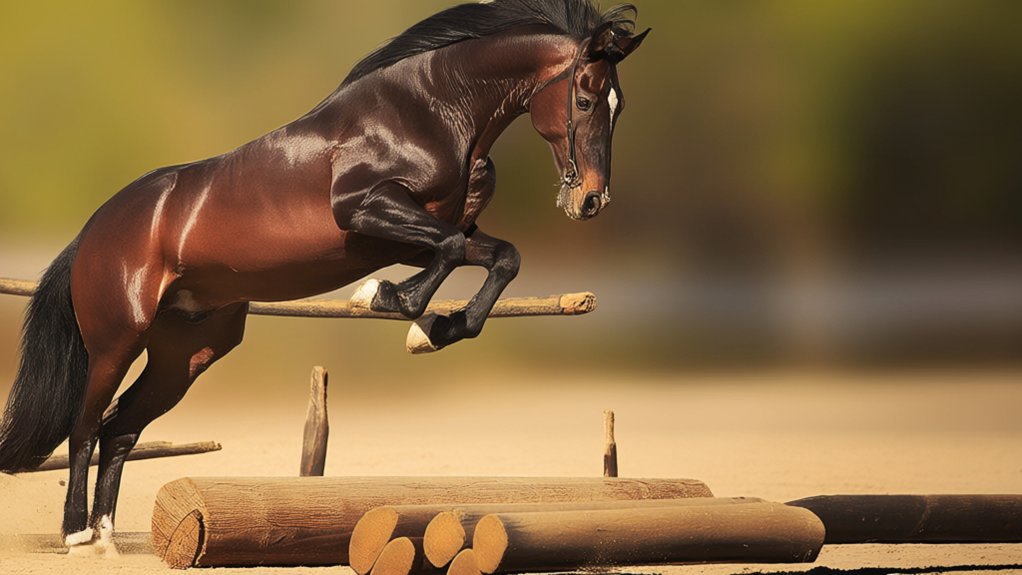
Yes, Andalusian horses can jump effectively, thanks to their natural agility, elegant conformation, and strong hindquarters that provide good propulsion and balance. While they may lack the explosive power or extreme scope of specialized jumpers, their precision, responsiveness, and quick reflexes excel in technical courses and lower to mid-level competitions.
If you want to understand how their physical traits and training enhance their jumping ability or the challenges they face with bigger obstacles, there’s more to explore.
Why Andalusians Make Great Jumpers
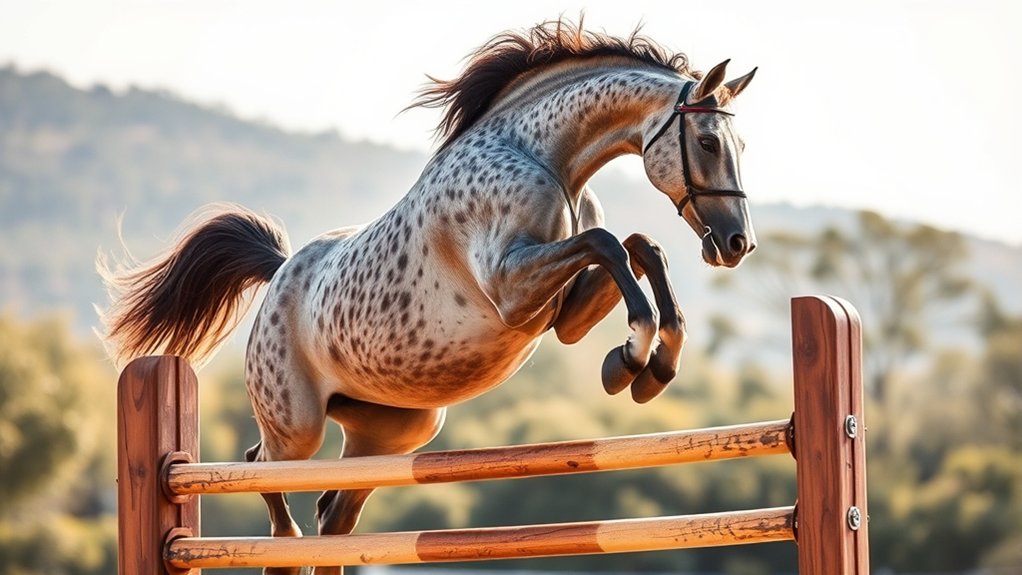
Although Andalusians aren’t traditionally bred as jumpers, their natural agility and quick reflexes make them surprisingly capable in jumping disciplines. You’ll notice their ability to execute neat, precise jumps, supported by an innate carefulness that helps them clear obstacles with adequate height.
Their elegant conformation enhances balance, allowing them to maintain control and style throughout the jump. While they may not match the expansive scope of warmbloods, Andalusians compensate with exceptional technique and responsiveness.
With proper training, many excel in cross-country and show jumping, especially at lower to middle competition levels. Their combination of balance, precision, and quick reaction times makes them a reliable choice for riders aiming for controlled, stylish jumping performance.
Physical Traits Influencing Andalusian Jumping

You’ll find that an Andalusian’s height and conformation give them a balanced frame that’s really well-suited for jumping.
Their muscle structure plays a big role too, boosting agility so they can move quickly and with control when taking off and clearing obstacles.
Plus, their strong, flexible limbs provide crucial support and help absorb shock, which all adds up to better overall jumping performance.
Height And Conformation
When evaluating an Andalusian’s suitability for jumping, you’ll find their typical height of 15.2 to 16.2 hands offers an ideal balance between power and agility. Their sloping shoulder facilitates efficient forelimb extension, while a deep girth provides a stable respiratory capacity during strenuous activity.
Rounded hindquarters contribute to propulsion, and a well-arched neck aids in maintaining balance mid-air. Additionally, sturdy legs with strong bone density support the impact forces during takeoff and landing.
A broad chest enhances stability, distributing weight evenly to prevent imbalance. Though traditionally seen as baroque, Andalusians possess conformation traits that, when properly trained, allow them to perform effectively in jumping disciplines.
They really leverage their structure for both strength and coordination.
Muscle Structure And Agility
Because Andalusian horses possess a strong, muscular build with particularly well-developed hindquarters, they generate the power necessary for effective propulsion during jumps. Their physical traits contribute markedly to their jumping ability by enhancing strength, agility, and endurance.
When you evaluate their muscle structure and agility, consider these key factors:
Long, sloping shoulders provide an extended range of motion for efficient obstacle clearance.
A deep chest and well-sprung ribs support enhanced respiratory capacity during exertion.
Muscular symmetry ensures precise, controlled jumping movements.
Balanced conformation aids in quick adjustments and tight turns on courses.
Well-developed hindquarters deliver the explosive power needed for takeoff.
Together, these elements allow you to appreciate how Andalusians combine power and agility to perform jumps effectively. It’s pretty impressive how all these features work in harmony, isn’t it?
Limb Strength And Flexibility
Although Andalusian horses aren’t primarily bred for jumping, their strong, well-developed limbs with dense bones provide essential support for this activity. You’ll find their hocks and stifles exhibit notable flexibility, granting a wide range of motion vital for powerful take-offs and stable landings.
Their muscular build generates the force needed to clear vertical and lateral obstacles efficiently. Plus, the resilience of their tendons and ligaments ensures they withstand the mechanical stresses involved in quick, agile movements during jumps.
The overall limb conformation in Andalusians, combining strength and flexibility, enhances their jumping capability despite the breed’s traditional focus elsewhere. When you look at their physical traits, you’ll see these attributes collectively enable competent jumping performance.
How Do Andalusians Compare to Classic Jumping Breeds?

While Andalusians aren’t primarily bred for jumping like Thoroughbreds or Warmbloods, they can still perform agile, precise jumps with notable elegance.
Andalusians may not specialize in jumping but excel with agility, precision, and elegant form.
When comparing them to classic jumping breeds, consider these factors:
Andalusians prioritize elegance and agility over the scope and height typical of Warmbloods and Thoroughbreds. Their natural quick turning ability suits close-quarters jumping and cross-country phases well.
They generally lack the extensive jump scope required for wide oxers or high-level competitions. Specific training is essential to optimize their jumping potential, given their different build and movement style.
Their performance emphasizes neat, controlled jumps rather than sheer power or maximum height. So, while they mightn’t clear the biggest fences, they bring a lot of finesse to the ring.
Common Jumping Disciplines for Andalusians
Understanding how Andalusians compare to classic jumping breeds sets the stage for exploring the specific disciplines where they excel. You’ll find Andalusians performing well in show jumping, eventing, and cross-country.
Their neat, precise jumping style allows them to clear significant heights, though they may struggle with the widest oxers favored by warmbloods. Their natural agility and quickness give you an advantage in technical courses requiring tight turns and responsiveness.
In cross-country, their innate balance lets you trust them to handle varied, challenging terrain and jump from the buckle efficiently.
While not bred exclusively for jumping, Andalusians’ versatility and athleticism make them competitive in multiple jumping disciplines when properly trained and conditioned for the demands of each event.
Andalusian Jumping Training Tips
Because Andalusians aren’t primarily bred for jumping, you’ll need to focus on building their confidence and refining their technique through consistent, gradual training.
Their natural agility and carefulness give them an edge, but you must develop their skills progressively. Start with low crossrails to guarantee proper form before advancing.
Key training tips include:
Introduce varied jump types slowly to build adaptability.
Use ground poles to improve stride regulation and rhythm.
Encourage forward, balanced approaches to jumps.
Incorporate flatwork emphasizing impulsion and collection.
Provide positive reinforcement to foster trust and confidence.
Andalusians Winning in Jumping Competitions
With consistent training focusing on confidence and technique, Andalusians can excel beyond expectations in jumping competitions. Though they’re not primarily bred for jumping, many Andalusians show neat, precise techniques over fences, making the most of their natural agility and quick turning ability.
They mightn’t have the same scope as warmbloods for wide oxers, but Andalusians perform really well in lower to mid-level events, keeping their jumps tidy and height-appropriate.
You’ll find top Andalusian jumpers doing great in recognized shows like CIC* and BSJA, which proves they’re competitive.
Their carefulness helps minimize faults, so you can really take advantage of their precision. If you train with attention to detail and tap into their innate athleticism, Andalusians can definitely become strong contenders in jumping competitions.
Challenges Andalusians Face Jumping Big Obstacles
Although Andalusians possess natural agility and strong conformation, you’ll find that their traditional breeding for dressage limits their raw scope needed to clear large obstacles confidently. Their jumping ability depends heavily on training and individual aptitude, especially for wide oxers or high fences.
When facing big jumps, you have to keep a few things in mind. First, there’s limited natural scope because of the emphasis on collected movement. Also, they might lack the explosive power you see in specialized jumpers.
Plus, they need targeted conditioning to build stamina and strength. Their technique tends to favor precision over sheer height or width.
And remember, aptitude can vary a lot—crossbred individuals often outperform purebreds.
Knowing these factors helps you get ready for the challenges when training an Andalusian for big obstacle jumping.
Is an Andalusian Right for Your Jumping Goals?
If your jumping goals prioritize elegance, precision, and versatility over maximum scope, an Andalusian can be an excellent choice. These horses deliver neat, controlled jumps with good height and demonstrate agility and quick reflexes. That makes them suitable for show jumping and cross-country.
Their responsive temperament accelerates learning and enhances performance. Though they may not clear very wide oxers like specialized warmbloods, they bring a lot to the table.
| Aspect | Benefit |
|---|---|
| Precision | Consistent, clean jumping technique |
| Temperament | Eager, responsive, and trainable |
| Versatility | Effective in multiple jumping arenas |
Frequently Asked Questions
How Long Does It Take to Train an Andalusian for Jumping?
It takes you between 6 months to 2 years to train an Andalusian for jumping, depending on its age, temperament, and experience. You’ll need consistent, gradual training, early small jumps, and professional guidance for best results.
Training isn’t something you rush. Starting with small jumps early helps build confidence and technique. Plus, having a pro guide you can make a big difference in how smoothly your horse learns.
Are Andalusians Prone to Injuries When Jumping?
You should know that 30% of Andalusian jumping injuries stem from tendon strains. They are prone to injuries without proper conditioning, warm-up, and technique, so you must manage training carefully to minimize risks and guarantee soundness.
It’s really important to pay attention to how you prepare and train. Taking the time for warm-ups and focusing on good technique can make all the difference in keeping them safe. So, always keep an eye on their conditioning to help prevent injuries.
What Is the Average Jump Height for an Andalusian Horse?
You’ll find the average jump height for an Andalusian horse ranges between 2 to 3 feet (60 to 90 centimeters). With proper training, some can reach up to 3.5 feet, excelling in controlled, moderate jumps.
They’re not typically known for extreme jumping, but they do well with steady practice and guidance. So, if you’re working with one, patience and consistency will go a long way.
Can Andalusians Be Used for Eventing as Well as Jumping?
Yes, you can use Andalusians for eventing and jumping. Their agility, balance, and responsiveness enable precise technical jumps and quick turns. This makes them suitable for cross-country and show jumping with proper training and conditioning.
They’re pretty versatile and can adapt well to different riding styles. Just keep in mind that, like any horse, they’ll need consistent work to keep them in top shape for these demanding sports. But overall, they’re definitely up for the challenge!
Do Andalusians Require Special Equipment for Jumping?
You don’t need special equipment for Andalusian jumping; standard tack like a well-fitted saddle, bridle, and protective boots will do just fine.
Just make sure the gear is lightweight and comfortable. This helps accommodate their sensitive skin and keeps them happy.
It also makes control and responsiveness during jumps much easier. So, no fancy extras—just good quality basics that fit well!
Conclusion
If you’re considering a jumper, Andalusians can indeed soar over fences with grace and power. Their muscular build and agile movement give them a solid foundation. Though they may not clear the highest bars like specialized jumpers, they still have a lot to offer.
With tailored training, your Andalusian can become a reliable partner, steering courses like a skilled dancer leaping through a finely choreographed performance. Choose wisely, and you’ll harness both beauty and strength in your jumping journey.