What Are Andalusian Horses – Meaning & More
You’re looking at Andalusian horses, a Spanish breed originating from the 15th century Iberian Peninsula. They’re known for their muscular build, expressive eyes, and flowing manes. These horses served as noble war horses and still stand as symbols of Spanish heritage tied to royalty and classical dressage.
Andalusians excel in advanced maneuvers like the levade, with training that emphasizes sensitivity and balance. Their elegance also makes them favorites in art and photography. If you dig a little deeper, you’ll find they have an enduring cultural and performance significance that’s pretty impressive.
What Is an Andalusian Horse and Where Does It Originate?
Although you mightn’t be familiar with every horse breed, the Andalusian horse, also called the Pure Spanish Horse, is a distinct breed that originated on the Iberian Peninsula, specifically in Spain. Developed during the 15th century, this breed is renowned for its blend of elegance and strength.
You’ll notice its muscular build and slender limbs supporting a high-stepping gait that reflects both agility and power. Its head features a distinctive convex profile, which sets it apart visually.
Historically, Andalusians served as war horses and were prized symbols of nobility in European royal courts.
As you study this breed, you’ll see how its physical traits and historical roles have contributed to its reputation. It’s pretty clear why it has influenced many other horse breeds globally.
Why Are Andalusian Horses a Symbol of Spanish Heritage?
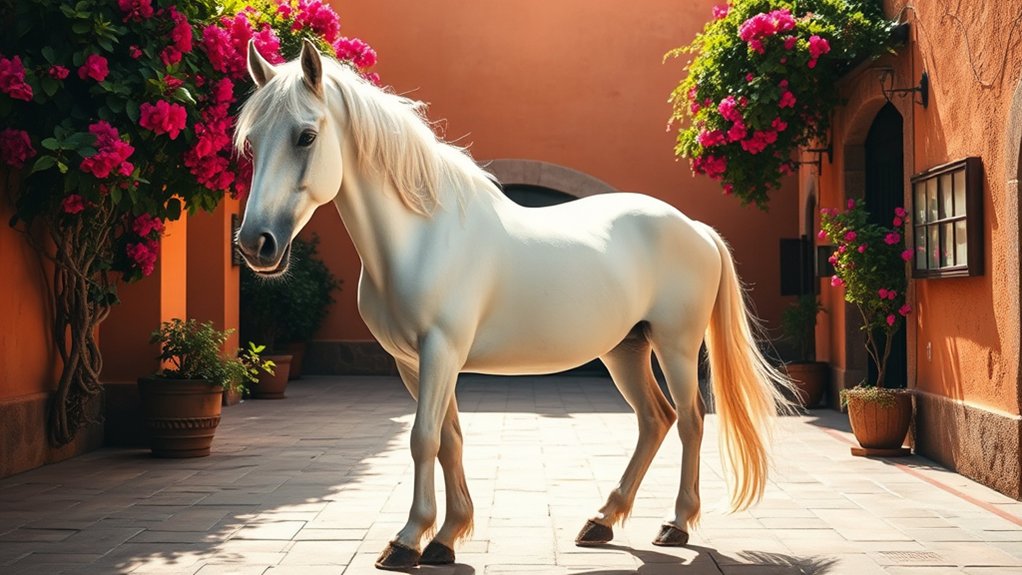
You probably recognize Andalusian horses as symbols of Spanish heritage because they’ve been linked with royalty and military elites for centuries. This long history really highlights their prestige and noble status.
Plus, these horses play a big part in traditional Spanish arts, like flamenco and bullfighting. That connection ties them closely to Spain’s culture and customs.
When you look at all these links together, it’s easy to see how the breed represents both aristocratic history and Spain’s lasting national traditions.
Historical Prestige And Nobility
Since their emergence on the Iberian Peninsula in the 15th century, Andalusian horses have embodied the essence of Spanish nobility and prestige. You’ll find that these horses were integral to Spanish royalty and aristocracy, primarily serving as war horses. This role really solidified their association with power and elite status.
Their presence in royal portraits and historical artworks further underlines their regal standing. You can recognize their reputation for strength, elegance, and intelligence as key factors that elevated them to cultural icon status.
Their extensive involvement in military, ceremonial, and aristocratic contexts throughout Spanish history cements their role as a symbol of noble heritage. Understanding this historical prestige helps you appreciate why Andalusians remain emblematic of Spain’s distinguished equestrian legacy.
Cultural Identity And Tradition
When exploring Spanish heritage, Andalusian horses stand out as living symbols that intertwine history, culture, and tradition. You’ll find their origins dating back to the 15th century, where they served royalty and military units, embodying prestige and power.
Their presence in iconic Spanish traditions like bullfighting, flamenco, and classical dressage reflects a deep connection to the nation’s equestrian and artistic practices.
You’ll also see Andalusians depicted in noble portraits, emphasizing elegance and status. Their physical traits—slender limbs, muscular build—and sensitive temperament perfectly represent Spanish horsemanship ideals.
Recognized as reliable war horses and diplomatic gifts, Andalusians symbolize Spain’s historical influence and artistic identity.
All in all, they make an essential cultural emblem within the country’s enduring heritage. It’s pretty amazing how much history and pride one horse breed can carry, right?
What Do Andalusian Horses Look Like? Key Physical Traits
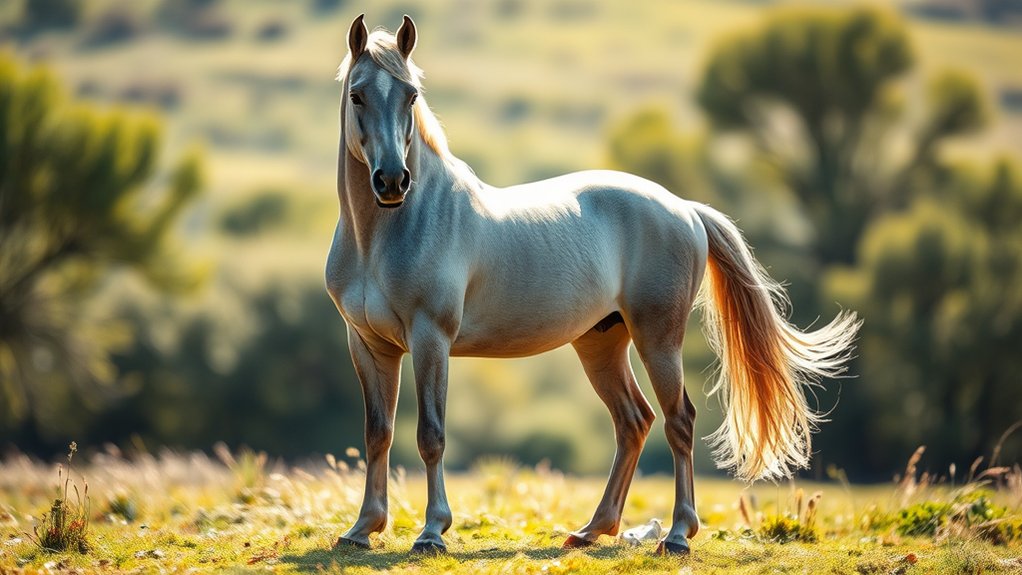
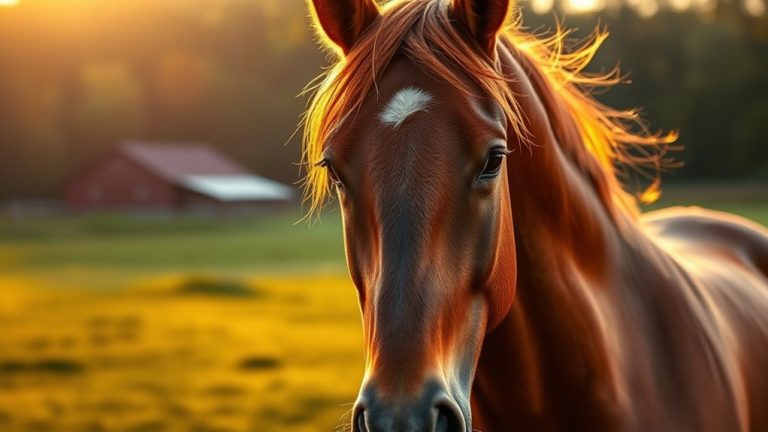
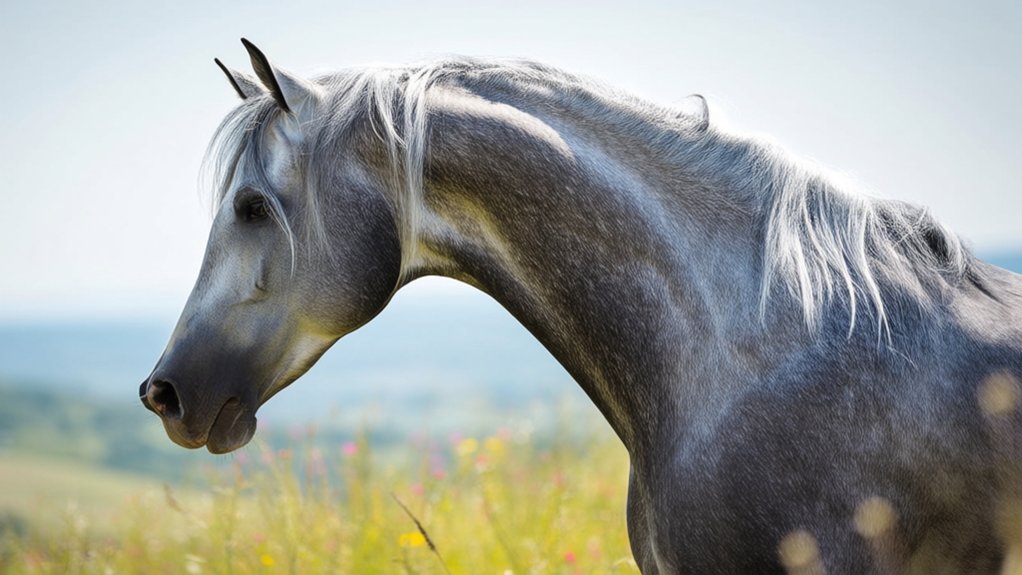
You’ll notice Andalusian horses have a strong, muscular build with a well-arched neck and a broad forehead, which gives them a really distinctive silhouette.
Their heads are quite refined, featuring a straight or slightly convex profile, along with large eyes and small ears.
Their bodies are compact and end in a slightly rounded croup, making them look both sturdy and graceful.
If you’ve seen photos of these horses, you’ve probably noticed their high-set tail and elegant coat colors.
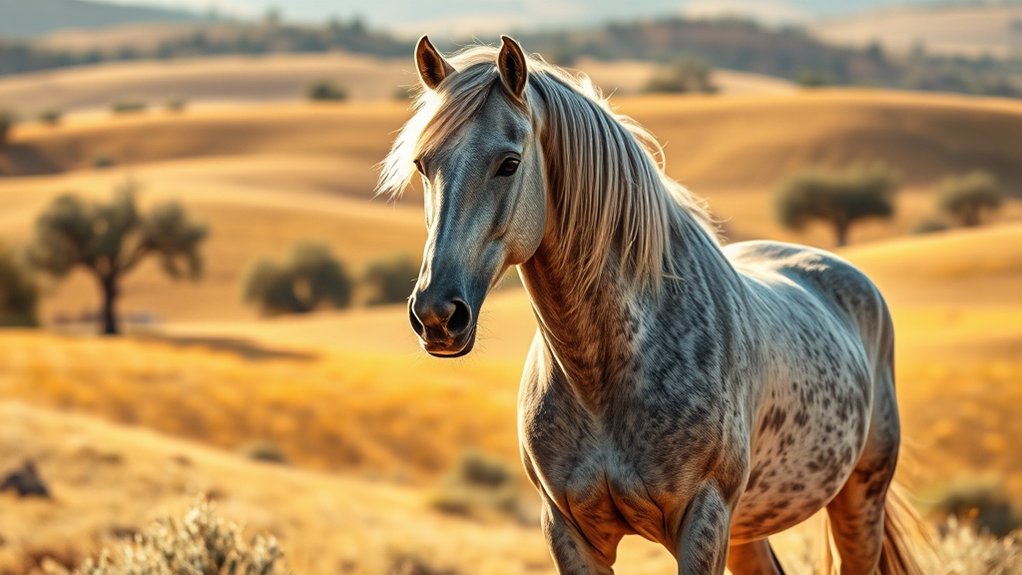
They’re usually gray, but sometimes you’ll spot them in black, bay, or chestnut.
All of these traits come together to highlight their noble presence.
Distinctive Physical Features
Although Andalusian horses vary slightly in appearance, they consistently display a strong, muscular build characterized by a well-arched neck and an elevated, proud head.
You’ll notice their compact bodies feature a broad chest and deep girth supported by a short, straight back, optimizing balance and strength.
Their legs are slender yet sturdy, with well-defined tendons and expressive, feathered hooves that enhance agility and endurance.
The head profile ranges from slightly convex to straight, framed by large, expressive eyes conveying alertness.
A thick, flowing mane and tail complete their regal silhouette, contributing both to aesthetics and protection.
These distinctive physical features combine to create the breed’s characteristic elegance and functionality.
That’s what makes Andalusians so recognizable and highly valued in equine circles.
Common Photographic Depictions
Because Andalusian horses possess a noble, muscular build combined with a distinctive arched neck, photographers often capture them to highlight these defining traits.
You’ll notice images emphasize their smooth, shiny coats, which range from gray and white to black, bay, or chestnut.
Photographic portraits focus on their refined head with a convex profile and large, expressive eyes that convey alertness.
In controlled studio environments, dramatic lighting accentuates their powerful physique and fluid movements.
Photographers frequently showcase their flowing mane and tail, framing the horse’s proud posture.
These visual elements combine to present the Andalusian as both elegant and robust, underscoring its unique physical characteristics with technical precision and artistic clarity.
It’s really about capturing both strength and grace in every shot.
How Were Andalusian Horses Used in History and War?
When you examine the role of Andalusian horses in history and war, their strength, agility, and intelligence stand out as key factors that made them ideal cavalry mounts. Originating in the Iberian Peninsula, these horses were extensively employed by Spanish armies during medieval campaigns across Europe and against the Moors.
Their exceptional stamina enabled them to sustain prolonged combat activities, including charging enemy lines, fording rivers, and executing complex battlefield formations with precision.
European royalty valued Andalusians not only for warfare but also as prestigious gifts, reinforcing their status in military and ceremonial contexts. Their ability to respond to intricate commands under pressure really showed how tactically important they were.
This cemented their reputation as noble and powerful war horses that were integral to historical European military operations.
Why Are Andalusians Famous in Dressage and Performance?
Beyond their historical role in warfare, Andalusian horses have earned lasting acclaim in the domain of dressage and performance due to their exceptional agility and refined movement.
Andalusian horses transcend their martial past, celebrated for agility and elegance in dressage and performance.
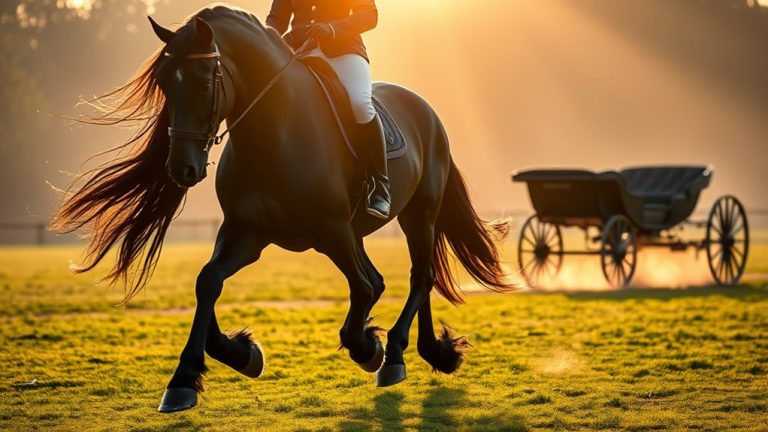
You’ll find these horses excel in executing advanced maneuvers like the levade and Spanish walk, showcasing strength and balance essential in classical dressage.
Their muscular build supports collected movements, while their natural sensitivity and intelligence make them highly responsive to your precise cues.
This responsiveness enables expressive, fluid performances demanding subtle communication between horse and rider.
Rooted in centuries of Spanish royal court tradition, Andalusians possess a graceful carriage and poise that elevate artistic displays.
When you work with an Andalusian, you engage a breed perfected for high-level performance, merging power, elegance, and technical skill seamlessly.
How Are Andalusian Horses Used in Modern Riding Activities?
How do Andalusian horses fit into modern riding disciplines? You’ll find them excelling in dressage, classical riding, and high school movements because of their agility, strength, and trainability. Their ability to perform advanced maneuvers like the levade and Spanish walk makes them favorites in equestrian performances and competitions.
Whether you’re an amateur or a professional rider, their responsiveness and elegance really enhance your riding experience.
Beyond competition, Andalusians also contribute to therapeutic riding programs thanks to their gentle temperament and sensitivity.
Their versatility lets you engage in both traditional cultural events and contemporary equestrian sports worldwide.
In short, Andalusians offer a precise blend of power, grace, and adaptability, making them invaluable across a range of modern riding activities.
How to Care for and Train Your Andalusian Horse
Although Andalusian horses possess natural elegance and intelligence, effective care and training require consistent, gentle handling to nurture their sensitivity and responsiveness. You should emphasize balance, coordination, and subtle aids to develop high school movements such as the levade and Spanish walk.
Incorporate regular groundwork sessions using positive reinforcement to build trust and clear communication. Address any incorrect training promptly to prevent behavioral problems and safeguard the horse’s mental and physical health.
Additionally, expose your Andalusian to varied terrains and exercises consistently to enhance strength, flexibility, and overall performance. This structured approach guarantees the horse remains supple, attentive, and capable, maintaining the breed’s hallmark elegance while optimizing its athletic potential throughout training and everyday care.
Why Are Andalusians Popular Subjects in Photography and Art?
Caring for and training your Andalusian sharpens its natural elegance and expressive movements. These are qualities that photographers and artists love to capture. Their distinctive flowing manes and muscular build make them visually compelling subjects. This is especially true when showcasing high school dressage movements.
Training your Andalusian enhances its elegance and expressive movements, capturing the beauty artists and photographers admire.
Professionals use studio lighting and advanced equipment to highlight the breed’s glossy coat, defined musculature, and emotive expressions.
Plus, Andalusians’ historical ties to nobility and Spanish tradition add to their symbolic presence in art.
So, why do Andalusians dominate photography and art? Well, it’s because of a few key reasons. Their dynamic, graceful motion is perfect for capturing majestic poses. The breed’s timeless nobility evokes strength and cultural heritage. And artists use controlled lighting to emphasize coat sheen and anatomical precision.
All these combined make Andalusians consistently evoke admiration across visual media. They really stand out because of these special attributes.
Frequently Asked Questions
What Is the Average Lifespan of an Andalusian Horse?
You can expect an Andalusian horse to live about 25 to 30 years on average. With excellent care and ideal conditions, they might reach their early to mid-thirties. Genetics and health play vital roles in how long they actually live.
How Much Does an Andalusian Horse Typically Cost?
You’ll typically pay between €5,000 and €24,000 for an Andalusian horse, depending on age, training, bloodlines, and health.
Imported horses may cost less initially, but be sure to factor in transport and veterinary expenses before purchasing. It’s always a good idea to consider these extra costs upfront so you’re not caught off guard later.
Are Andalusian Horses Good for Beginner Riders?
Andalusian horses aren’t ideal for beginners. Their intelligence and spirited nature require calm, experienced handling.
Without skilled control, you risk safety. Their strong build and sensitivity demand precise, patient training to avoid unpredictable behavior.
What Common Health Issues Affect Andalusian Horses?
You’ll encounter congenital laryngeal hemiplegia, joint issues like osteoarthritis and tendinitis, dental malocclusions, dermatitis, fungal infections, and genetic risks such as progressive retinal atrophy when managing Andalusian horses’ health.
These conditions can be challenging, but knowing what to watch for helps a lot. It’s important to keep an eye on their breathing and joint movement. Dental check-ups are also a must to avoid complications.
Skin problems like dermatitis or fungal infections can pop up, especially in humid conditions. And because some issues are genetic, regular vet visits can catch problems early. Taking good care of your Andalusian goes a long way in keeping them healthy and happy.
Can Andalusian Horses Be Kept With Other Horse Breeds?
Yes, you can keep Andalusian horses with other breeds, but you’ll need gradual integration, close supervision, and proper herd management to guarantee compatibility. This is especially important considering their sensitive nature and preference for calm, well-behaved companions.
Taking it slow helps everyone get used to each other without stress. Keeping an eye on their interactions ensures they get along well. With the right approach, they can happily share space with other horses.
Conclusion
Now that you’ve explored the rich history, distinctive traits, and versatile uses of Andalusian horses, you understand why they embody Spanish heritage and excel in modern equestrian disciplines. Their strong yet elegant build, combined with intelligent trainability, makes them ideal for both performance and leisure riding.
As you consider caring for or training one, remember their unique needs demand precision and expertise. This thorough insight equips you to appreciate and responsibly engage with this remarkable breed.