Do Horses Know They’re Racing?
You won’t find that horses understand racing as competition the way humans do. Instead, they recognize familiar cues and routines linked to the race environment, adjusting their behavior accordingly.
Their actions are guided more by training, instinct, and responses to jockey signals than by an internal drive to win. Horses focus on safety and social needs rather than competing, but their awareness and reactions can vary widely.
Exploring how jockeys influence their performance reveals much more about their race-day behavior.
Do Horses Know They Are Racing?
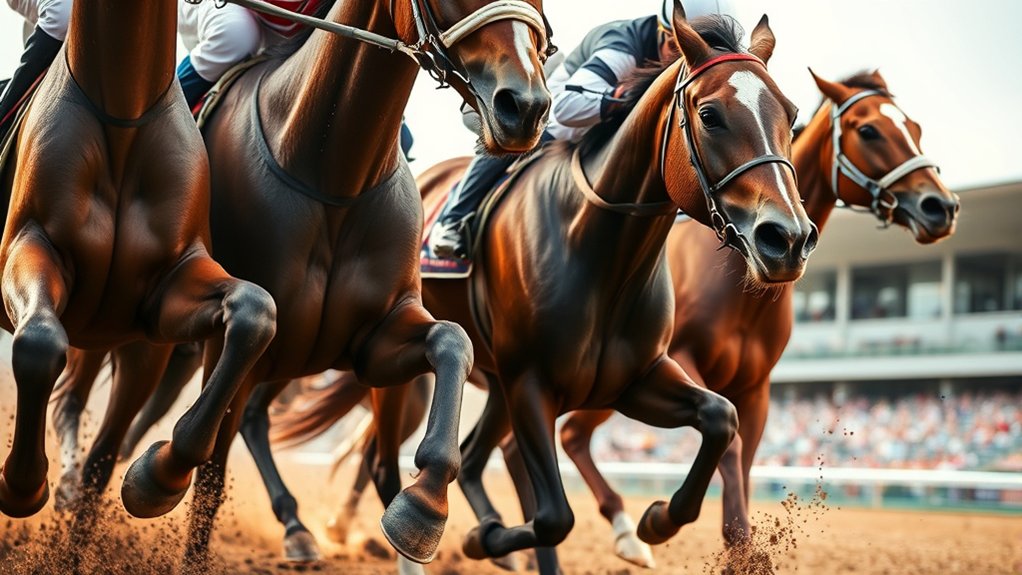
How do horses perceive the moment before a race? Horses often show behaviors like excitement or alertness before the start, which suggests they’re aware of the racing situation. You might notice some horses go through familiar routines on their own, hinting they recognize what’s about to happen.
This awareness isn’t the same for every horse. Some clearly seem to understand they’re about to race, while others mainly respond to the environment or signals from their handlers.
Studies show horses process these cues differently than humans but still reach a certain level of situational awareness related to racing.
When you watch horses before a race, their behavior reflects a mix of instinct, training, and the environment. All these factors come together to shape how aware they’re of the upcoming event.
How Horses Perceive Running and Movement
When you watch horses running, you notice behaviors that come straight from their natural instincts. They’re quick to respond to things happening around them.
And it’s interesting—they often move together in sync with the group. It’s more about being social than trying to compete.
Knowing this helps us see that horses perceive movement as something immediate and reflexive.
Natural Movement Tendencies
Although horses often appear to race competitively, their natural movement tendencies are rooted in social cohesion and safety rather than winning. You’ll notice horses rely on innate instincts to synchronize their movements, which reduces individual predation risk.
This synchronization is a key part of their group behavior, helping maintain steady speed and formation within the herd. Unlike humans, horses don’t see running as a competition to be won. Instead, their focus stays on cohesion and coordinated movement.
Leading or arriving first doesn’t offer a clear survival advantage in natural settings, so horses don’t speed up just to outpace others. Understanding these natural tendencies shows that horses view running through a lens of social and safety needs—not the competitive goals humans usually associate with racing.
Social Running Behavior
Why do horses run together in such coordinated ways? Horses naturally move in groups to maintain cohesion and safety, rather than to compete or win. Their running behavior reflects an instinctual synchronization of speed and movement, which helps them avoid predators in the wild.
You’ll notice that horses maintain similar speeds and alertness levels within the group, emphasizing social bonding over individual achievement. Some horses instinctively prefer to lead or stay within the herd, demonstrating innate social preferences rather than competitive motivations.
When you observe their voluntary movement, it’s clear their running is driven by social and environmental cues, not by any understanding of racing. This group cohesion and synchronization shape how horses perceive running and movement in natural and racing contexts.
Reaction To External Cues
Because horses rely heavily on their senses, they detect and respond quickly to external cues like the start of a race, crowd noise, and rider commands. You’ll notice their behaviour changes. They become alert or excited when they recognize racing preparations or observe other horses moving.
This shows their recognition of specific stimuli linked to running and movement. Horses interpret body language, sounds, and visual signals from humans and peers, which shapes their behaviour during race events.
Their responses come from learned associations and natural instincts rather than an explicit understanding of competition.
Social Behavior and Group Synchronization in Racehorses
When horses run together, they naturally synchronize their movements to maintain group cohesion and reduce risk from predators. This group synchronization comes from innate instincts that emphasize collective movement rather than individual competition.
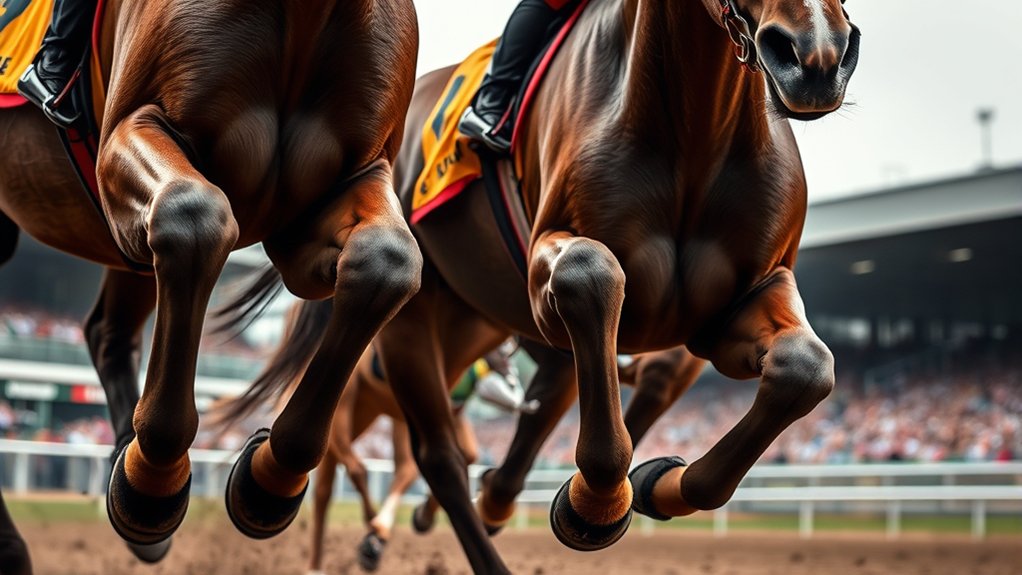
In races, you’ll notice horses adjust speed and position to stay with the pack, which reflects their social behavior. However, jockeys sometimes disrupt this synchronization to create strategic spacing or bunching.
| Aspect | Description | Race Example |
|---|---|---|
| Social Behavior | Preference for group cohesion | Staying close to other horses |
| Group Synchronization | Coordinated movement patterns | Matching pace with the pack |
| Innate Instincts | Risk reduction in the wild | Maintaining position in race |
Your understanding of these dynamics shows how deeply social behavior influences racehorses.
Why Racehorses Lack an Intrinsic Desire to Win
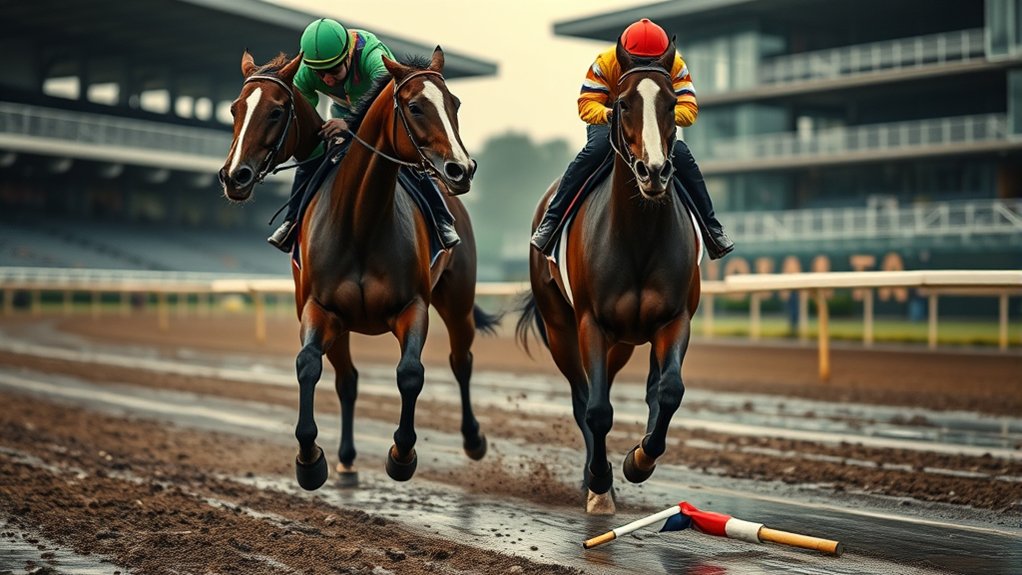
You might’ve noticed that racehorses care more about staying safe and sticking with the group than they do about competing.
When they run in races, it’s not because they’ve a burning desire to win. Instead, their actions are shaped by the training they’ve gone through.
See, horses don’t really have the mental setup for competitive ambition, so winning doesn’t carry any natural meaning or reward for them.
Natural Behavior Over Competition
Although racehorses appear driven to win on the track, their natural behavior doesn’t include an intrinsic desire for competition. As social animals, horses prioritize group cohesion and safety over individual dominance.
Their innate tendencies lead them to synchronize movement with the herd, avoiding risks associated with breaking away to win. In the wild, arriving first could increase predation risk, so horses maintain a consistent pace rather than aiming to outpace others.
| Behavior Aspect | Wild Horses | Racehorses (Learned) |
|---|---|---|
| Social Structure | Herd-based for protection | Trained individually |
| Movement Motivation | Group cohesion | Performance and conditioning |
| Competitive Drive | Absent | Conditioned response |
You’ll notice their natural instincts focus on social bonding, not competition.
Lack Of Winning Motivation
Since horses lack the cognitive structures required to grasp abstract concepts like winning or losing, they don’t possess an intrinsic desire to win races.
Their motivation during races stems primarily from external factors, such as training, fitness, and jockey cues, rather than an internal drive to succeed.
Horses naturally prioritize group cohesion and safety, which opposes competitive motivations seen in humans.
You’ll notice that rather than aiming for victory, horses respond more to immediate stimuli, like relief from pressure or whip strikes, as their primary motivators.
Understanding this helps clarify why racehorses lack the psychological framework for competition-based motivation.
Their behavior revolves around survival and social bonding, not abstract goals like winning.
Why Horses Don’t Naturally Understand Racing Competition
Because horses lack a prefrontal cortex, they don’t naturally grasp racing as a competitive contest with goals like winning. Their innate behavior emphasizes social cohesion and predator avoidance rather than individual achievement.
You’ll notice that horses respond primarily to environmental cues, such as sounds, sights, and handler signals, rather than understanding competition itself.
While training teaches them to associate race procedures with specific stimuli, this learning doesn’t translate into an inherent comprehension of racing’s competitive nature.
Instead, horses react to these cues without recognizing the broader context of winning or losing.
This indicates that their behavior during races is shaped more by conditioned responses than by any natural insight into the sport’s objectives.
How Training Changes Horses’ Natural Race Behavior
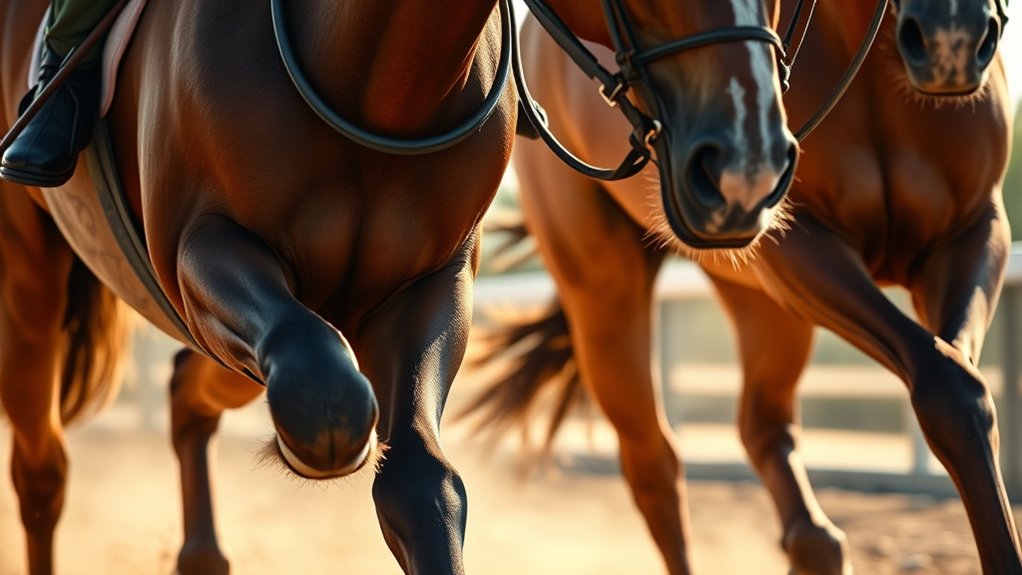
You’ll notice that training changes a horse’s natural tendencies by using cues and pressure to shape how they race. Jockeys actively control the horse’s speed, direction, and spacing, which interrupts the horse’s instinct to stay in sync with the group.
Basically, this means the horse learns to respond to outside signals instead of just following its natural urge to run freely.
Overriding Natural Tendencies
While horses naturally run in groups and maintain their own pace, trainers and jockeys actively intervene to modify these instincts during races. Through targeted training, they condition horses to respond to specific cues that override natural tendencies, such as staying with the herd or regulating their speed independently.
Interventions include directing horses closer together and using pressure on the mouth or whips to encourage faster galloping and disrupt their innate synchronization. These methods suppress instinctual social and movement behaviors, prioritizing race strategies over survival-driven impulses.
Jockeys’ Behavioral Influence
Although horses possess innate behaviors that guide their movement and social interactions during races, jockeys actively modify these patterns through targeted cues and physical signals. You observe how jockeys use reins, voice commands, and body language to override horses’ natural tendencies, guiding their behavior on the track.
Through training, horses learn to respond consistently to these signals, altering their instinctual social and movement patterns. Jockeys apply pressure, including whip use, to encourage faster galloping beyond natural inclinations. They also position horses strategically to control pacing and maintain ideal racing lines.
Subtle emotional cues and physical touches further motivate horses to perform according to racing objectives. This behavioral influence demonstrates how jockeys shape race dynamics by conditioning horses to act beyond their innate instincts.
How Jockeys Influence Horse Race Performance
How exactly do jockeys shape a horse’s performance during a race? Jockeys apply pressure, cues, and whip actions to intentionally override a horse’s natural behavior. This intervention allows you to influence race positioning and pacing effectively.
Jockeys use pressure, cues, and whip actions to strategically override a horse’s natural instincts during a race.
Early in the race, horses tend to rely on herd instincts to stay grouped, but jockeys modify this behavior by directing horses closer or managing their speed. You adjust course and velocity based on real-time assessment of the race, often counteracting the horse’s innate tendencies.
These deliberate strategies optimize performance by positioning the horse advantageously, rather than reflecting the horse’s inherent motivation or understanding of winning.
In essence, jockeys exert control through behavioral influence to shape race outcomes, demonstrating a scientific approach to managing equine performance under competitive conditions.
Variations in Horses’ Race Awareness
Because horses differ in experience and temperament, their awareness of racing conditions varies considerably.
Your observations of horse behaviour reveal that some horses, particularly seasoned racers, show heightened race awareness by responding distinctly to environmental cues.
These variations manifest as experienced horses independently completing pre-race routines, indicating familiarity with race procedures.
You might notice differential reactions to race preparations, such as signs of alertness or excitement.
There’s also varied sensitivity to environmental cues, where some horses recognize the racing context more acutely than others.
This variability suggests that race awareness isn’t uniform across individuals.
While some horses comprehend the racing situation as a familiar event, others may engage without fully understanding its competitive nature.
Recognizing these differences helps you interpret horse behaviour more accurately and tailor training approaches accordingly.
Emotional Responses to Racing and Rider Cues
Understanding a horse’s awareness of racing conditions sets the stage for examining how their emotional responses intertwine with rider cues. You observe that horses mirror rider emotions like tension or excitement, influencing their behavior and alertness during races.
Subtle rider cues such as body language and muscle tension shape horse behavior by either calming or energizing them. This emotional mirroring shows that a horse’s performance depends partly on the rider’s psychological state.
Furthermore, horses sense the broader emotional atmosphere, which affects their motivation and effort.
| Rider Emotional State | Horse Emotional Response |
|---|---|
| Calm | Relaxed, steady pace |
| Tense | Heightened alertness |
| Excited | Increased energy and focus |
| Anxious | Erratic movements |
| Confident | Controlled, ideal behavior |
Ethical Implications of Horse Cognition in Racing
When you consider that horses may grasp the concept of racing, it raises important ethical questions about using their instincts for human entertainment.
Recognizing horse cognition challenges us to examine how training and racing practices affect animal welfare.
If horses are aware of competition, overriding their natural behaviors might compromise their psychological well-being.
Ethical considerations urge the racing industry to balance performance goals with respect for horses’ mental health.
You should reflect on whether training methods align with horses’ natural instincts, the impact of racing stress on animal welfare, and how acknowledging horse cognition informs ethical racing practices.
Frequently Asked Questions
How Long Do Racehorses Typically Train Before Their First Race?
You typically train racehorses for about six months to a year before their first race, adjusting based on horse temperament and developmental readiness.
Effective training techniques start with groundwork and fitness, gradually increasing intensity to match racing schedules.
You’ll observe how each horse responds, tailoring sessions to build stamina and familiarity with tack and rider cues.
This approach guarantees they’re physically and mentally prepared for competitive racing environments.
What Breeds Are Most Commonly Used in Horse Racing?
You’ll find Thoroughbreds dominate horse racing due to their origins in selective breeding for speed, stamina, and agility. These are key racing breed traits.
Standardbreds excel in harness racing, reflecting breeding selection for controlled pacing.
Arabian horses, with endurance-focused origins, suit long-distance races.
Quarter Horses, bred for explosive speed, thrive in sprints.
Understanding these horse breed origins helps you appreciate how specific racing breed traits result from intentional breeding selection tailored to different race types.
How Do Track Conditions Affect Horse Racing Outcomes?
You’ll notice track surface impact considerably alters race outcomes; for example, a horse trained on firm turf may struggle on muddy dirt after heavy rain, showing weather influence.
Course familiarity also matters. Horses accustomed to a specific track handle turns better under varying conditions.
These factors collectively affect traction and speed, making some horses more adaptable.
Understanding these variables helps trainers tailor strategies for ideal performance on race day.
What Safety Measures Are in Place for Racehorses?
You’ll find extensive safety measures protecting horse welfare in racing. Safety equipment like padded helmets and protective vests minimize injury risks.
Veterinary care is rigorous, with pre- and post-race health assessments ensuring horses are fit and promptly treated if needed.
Tracks undergo regular maintenance to provide cushioning, reducing falls.
Emergency protocols include on-site medical teams ready to handle accidents quickly, all designed to prioritize horse welfare throughout the racing event.
How Is a Racehorse’s Diet Managed During Training and Racing?
Imagine fueling a high-performance car. You can’t just pour gas randomly. Similarly, you manage a racehorse’s diet with precise feeding schedules, balancing oats, hay, and dietary restrictions to maintain peak condition.
Nutritional supplements like vitamins and electrolytes replace what’s lost during intense exercise. This careful regimen ensures the horse stays strong and hydrated, optimizing muscle function and stamina throughout training and racing seasons.
Conclusion
As you watch the thunder of hooves on the track, imagine the horse’s mind. It’s not focused on winning but responding to rhythm, rider cues, and group movement. They don’t grasp the concept of racing like you do; instead, they sync with the pace and energy around them.
Understanding this shifts your perspective, revealing the intricate dance between instinct and training that shapes their performance. It reminds you of the delicate ethics behind every race.