What Is Dressage Horse Riding?
Dressage horse riding is a precise discipline where you and your horse perform carefully controlled movements like piaffe and passage within a marked arena. It focuses on harmony, balance, and athleticism, requiring exact timing and communication.
You follow structured training that builds your horse’s responsiveness and skill, progressing through levels with increasing complexity. Understanding the arena layout, scoring, and essential equipment will deepen your grasp of how dressage blends tradition with modern competition challenges.
What Is Dressage Horse Riding?
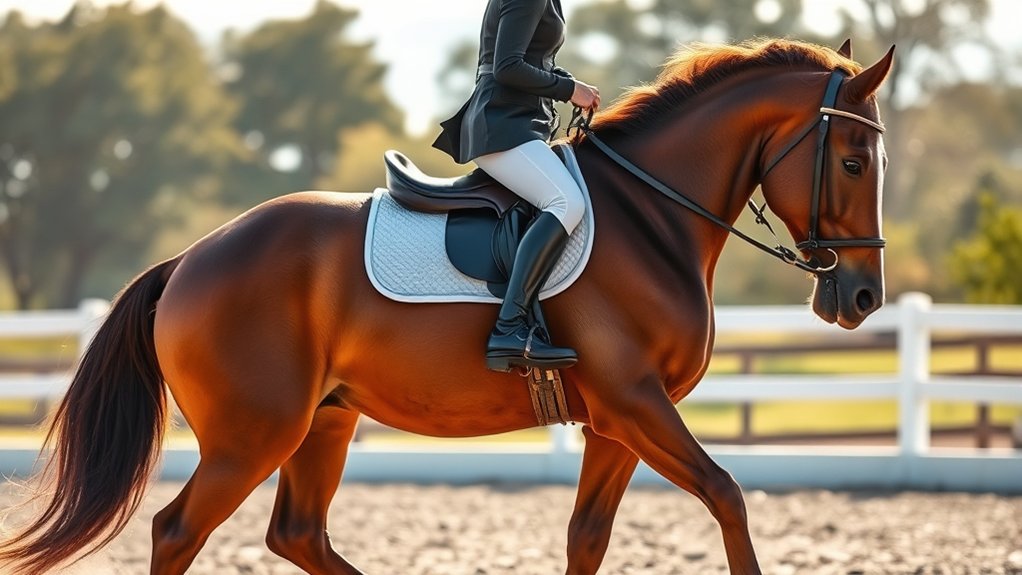
Although dressage horse riding may appear as a graceful performance, it’s a highly technical discipline where you and your horse execute a series of precise, coordinated movements within a defined arena.
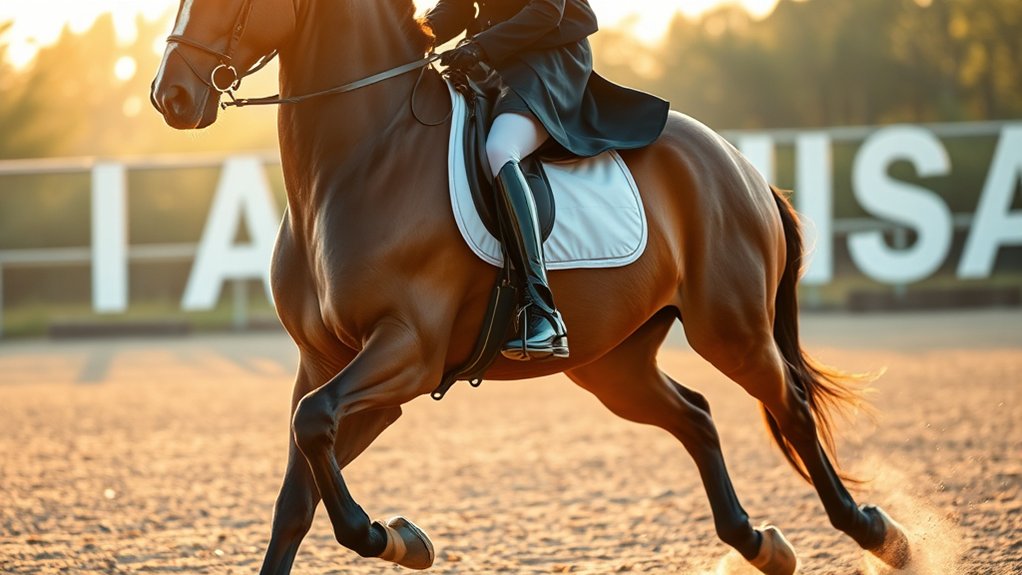
In dressage, the rider guides the horse through predetermined movements like piaffe, passage, and flying changes, each demanding exact timing and control.
You’ll perform these within a 20m by 60m arena marked by lettered guides, ensuring accuracy in progression and positioning.
The training behind dressage builds your horse’s natural athleticism, responsiveness, and willingness, following a structured progression known as the training pyramid.
This discipline showcases the highest level of horse training, emphasizing harmony and athleticism between horse and rider while demonstrating control and elegance in every movement.
Origins and Development of Dressage
Where did dressage originate, and how did it develop into the refined discipline you see today? Dressage traces its origins to classical horsemanship, with foundational training principles documented in ancient horsemanship manuals from Greece and Renaissance Europe. These texts emphasized agility, obedience, and harmony between horse and rider.
Over time, dressage evolved into a formalized system, particularly through military riding schools like the Spanish Riding School of Vienna in the 18th and 19th centuries. These schools standardized training methods and performance criteria.
The term “dressage,” derived from the French word for training, reflects this focus on systematic preparation.
By the early 20th century, dressage had established clear standards for competitive performance. This development culminated in its inclusion as an Olympic discipline in 1912.
Today, dressage remains grounded in classical horsemanship traditions while adhering to rigorous training and judging standards.
Best Horses for Dressage?
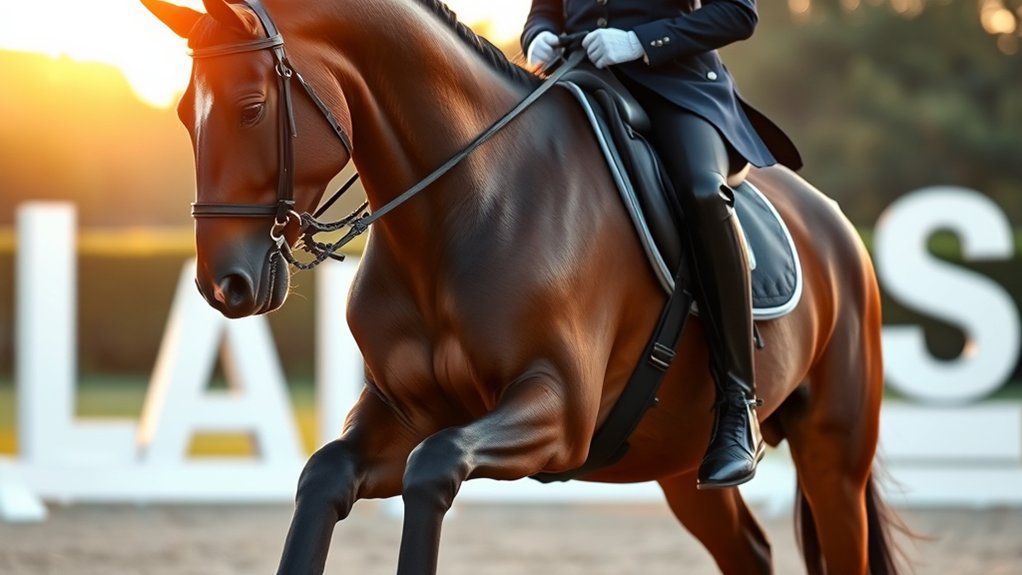
Three key horse breeds dominate the dressage world due to their superior athleticism, trainability, and movement qualities: Hanoverians, Dutch Warmbloods, and Oldenburgs. These warmbloods excel as dressage horses, especially at high-level competition, because their conformation supports collection, elevated gaits, and expressive movement essential in classical dressage.
Furthermore, Iberian breeds like Andalusians, Pura Raza Espanol, and Lusitanos offer natural elasticity and an iconic classical appearance. This makes them valuable for riders seeking expressive movement and collection.
While any breed can learn dressage, you’ll find that those with a strong topline, well-arched neck, and balanced shoulder angles facilitate advanced movements such as piaffe and passage more effectively.
Ultimately, selecting a dressage horse hinges on athleticism, trainability, and the capacity to perform precise, classical dressage maneuvers.
Dressage Arena Layout and Rules
You’ll be working within a standard 20×60 meter arena, which is marked by precise letters that guide your movements and transitions.
Judges place themselves strategically at points like C, E, and B. This way, they can evaluate your performance from different angles.
Knowing these zones and sticking to the layout helps you perform each movement accurately.
Plus, it ensures you meet the competition standards without any hassle.
Arena Dimensions and Markings
Although dressage arenas come in different sizes, the standard competition arena measures 20 meters by 60 meters. Smaller 20 by 40 meter arenas are commonly used for training or lower-level tests. The arena dimensions are defined precisely, with boundary lines marking the perimeter and quarter lines aiding spatial awareness.
Letters positioned around the arena—A, K, E, H, C, M, B, and F—serve as essential reference points for riders to perform specific movements. The centerline runs straight from A to C, dividing the arena into two halves.
Key arena features include boundary lines outlining the long and short sides of the arena, letter markers placed strategically along the perimeter, the centerline guiding straight-line movements and shifts, and quarter lines helping riders maintain alignment during complex figures.
These markings guarantee precise execution and consistency in dressage tests.
Judge Positions and Roles
When evaluating a dressage test, judges position themselves strategically around the arena at designated points such as C, E, B, K, F, M, and H. This setup guarantees thorough observation from multiple angles. The primary judge at C leads the performance assessment, while judges at E and B focus on supplementary movement evaluation.
Each judge uses scoring sheets to record precise marks, ensuring fairness. This arena layout minimizes visual bias, allowing consistent feedback on the horse’s gait, movements, and execution from all viewpoints.
| Judge Position | Role | Focus Area |
|---|---|---|
| C | Chief Judge | Overall performance |
| E | Supporting Judge | Side movement details |
| B | Supporting Judge | Opposite side details |
| K, F, M, H | Auxiliary Observers | Additional angles |
Proper judge positions ensure comprehensive, unbiased scoring.
Movement Execution Zones
Judges rely on the dressage arena’s layout to evaluate each movement accurately, making the letter markers and zones integral to performance assessment. The standard 20×60 meter arena features specific letter markers placed along the perimeter, defining precise execution zones for movements.
You perform complex maneuvers, like circles, lateral work, and progressions, between or around these markers to ensure consistent positioning. Judges stationed at C, E, B, K, F, M, and H assess movements from multiple viewpoints, which enhances scoring accuracy.
Key elements include defined execution zones between letter markers like A, C, and M, movements aligned precisely along the centerline and perimeter, judges’ positions to observe from all critical angles, and strict adherence to the arena layout for consistent dressage performance.
Understanding these zones is essential to mastering dressage movements and meeting judging criteria.
Key Movements in Dressage Tests
What makes dressage truly mesmerizing are the key movements that test both horse and rider with exacting demands. You’ll master piaffe and passage to showcase collection and impulsion. Flying changes demonstrate seamless lead shifts at the canter, while pirouettes and half-pass require precise lateral control and engagement.
Each movement demands balance, rhythm, and coordination.
| Movement | Primary Focus | Key Requirement |
|---|---|---|
| Piaffe | Elevated trot in place | Collection, impulsion |
| Passage | Collected, elevated trot | Rhythm, suspension |
| Flying Changes | Lead shifts at canter | Smoothness, control |
| Pirouettes | Tight turns | Straightness, bend |
You’ll appreciate how these movements highlight athleticism and harmony in dressage tests.
Dressage Competition Structure and Judging
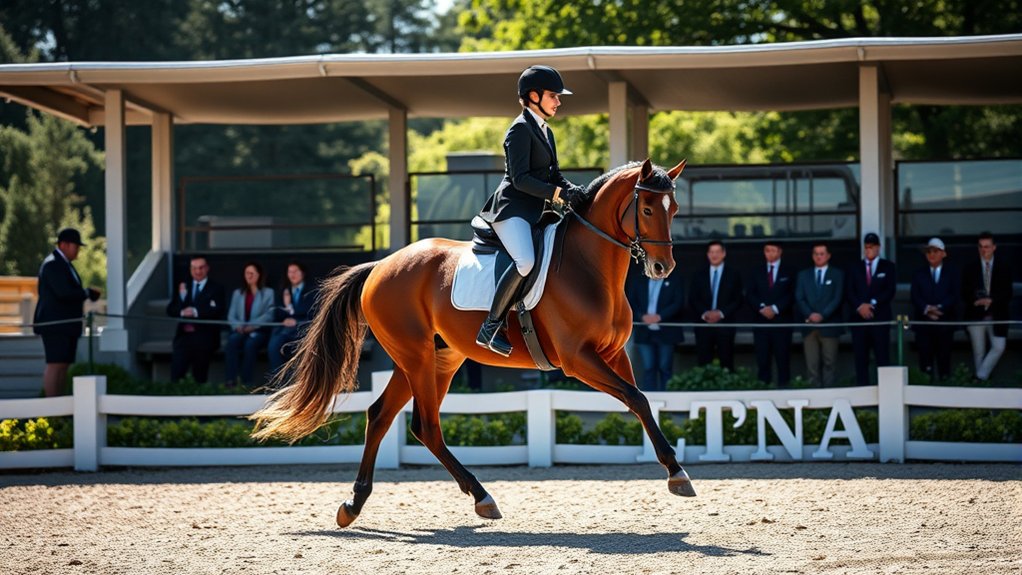
You’ll spot judges placed all around the arena, so they can see each movement from different angles. This way, the scoring stays fair and objective.
Each movement gets a score between zero and ten, and then general impression marks come into play to shape the overall percentage.
Knowing the different competition levels really helps. As you move from beginner to elite tests, the difficulty ramps up, and the judging criteria get more detailed.
It’s a great way to understand how the sport challenges both horse and rider at every stage.
Judge Positions Explained
Because accurate assessment is vital in dressage, officials position themselves strategically around the arena at designated points such as C, E, B, and others to capture every angle of the horse and rider’s performance. The judge positions guarantee a thorough evaluation of each movement for precise scoring.
The primary judge sits at C, directly facing the rider, overseeing the entire performance.
Judges at E and B observe movements along the arena’s long sides, offering alternative perspectives.
Additional judges at K, F, M, and H supplement evaluations, minimizing blind spots.
Each judge scores individual movements from 0 to 10, emphasizing precision, harmony, and execution.
This multi-angle observation system maintains scoring consistency and fairness across judges during dressage competitions.
Scoring Criteria Overview
Although dressage judges observe from multiple angles, they focus primarily on scoring each movement on a scale from 0 to 10. Here, 10 represents flawless execution and 0 denotes an unperformed or incorrect action.
Each movement carries a coefficient reflecting its importance, especially in advanced tests like the FEI Grand Prix, impacting the overall marks. Judges positioned at strategic points around the arena assess the rider’s performance from diverse perspectives to guarantee fairness and accuracy.
After scoring individual movements, judges combine these marks with general impression scores to calculate the final result. This cumulative score is then expressed as a percentage, with performances exceeding 65% generally recognized as successful and indicative of readiness for higher competition levels.
Understanding this scoring system is vital for interpreting dressage results accurately.
Competition Levels Breakdown
As you progress through dressage competitions, you’ll encounter distinct levels: Intro, Training, First, Second, Third, Fourth, and Fifth. Each level is designed to challenge you with increasingly complex movements and skills.
At every level, judges positioned around the arena score your performance on a scale of 0 to 10, factoring in both individual movements and overall impression.
The scoring system includes coefficients to weight critical movements, so precision really matters in your final percentage score. Higher levels, like FEI Grand Prix, demand mastery of advanced exercises.
Key competition aspects include clear progression through defined levels that increase in difficulty.
Multiple judges at arena points C, E, and B provide an all-encompassing evaluation.
Scoring is based on weighted movements and overall presentation. Precision in executing complex movements is critical for competitive success.
Understanding the Dressage Training Scale
When you begin mastering dressage, understanding the Dressage Training Scale is essential because it provides a structured, step-by-step framework that guides the development of both horse and rider.
This training scale comprises six progressive steps: rhythm and regularity, relaxation and contact, impulsion and straightness, collection, and airs above the ground.
You start by establishing a consistent rhythm, which forms the foundation for subsequent relaxation and suppleness.
Once relaxation is achieved, you focus on impulsion to generate controlled energy, enabling precise movements.
Collection then refines balance and engagement, preparing the horse for advanced maneuvers.
Originating from the German National Equestrian Foundation, this scale is pivotal in evaluating progress and ensuring each phase builds the necessary qualities for higher-level dressage performance.
Preparing for Dressage Tests
Before stepping into the competition arena, you’ll need to practice dressage test movements repeatedly to guarantee precision and fluidity. As a rider, focus on memorizing the sequence of dressage tests and their corresponding arena letters to execute each movement flawlessly.
Practice dressage movements repeatedly and memorize test sequences with arena letters for flawless execution.
Consistent training enhances your horse’s responsiveness to subtle aids, ensuring smooth progressions and accurate performance.
Key preparation steps include:
- Studying and memorizing test patterns and arena markers
- Practicing specific movements with attention to precision
- Ensuring the arena setup replicates competition conditions
- Reviewing video recordings to identify and correct errors
This disciplined approach sharpens your timing and communication with the horse, making your training sessions effective and your test performances confident and precise.
Dressage Equipment and Attire
You’ll want a close-contact saddle and a bridle with either a double bit or snaffle to ensure clear communication with your horse. It really helps you stay connected and precise during your ride.
When it comes to what you wear, there are some strict standards to follow. Think tailored black tailcoat or show jacket, paired with white breeches and tall black boots. This keeps everything traditional and professional-looking.
Accessories should be kept to a minimum. Gloves, spurs, and a whip are all you need to give subtle aids without distracting your horse. It’s all about keeping things simple and effective.
Essential Dressage Tack
Although dressage demands subtle communication between horse and rider, the essential tack plays a crucial role in making this connection smoother. You rely on a dressage saddle designed with a deep seat and long, straight flaps to provide close contact and freedom of leg movement.
The bridle, usually black or dark brown leather, features a snaffle bit and a flash noseband to ensure clear, precise cues.
Underneath the saddle, a white or light-colored saddle pad cushions and protects the horse’s back while often showing your stable’s emblem.
Your riding boots, tall and black, offer support and stability. The reins let you maintain delicate control.
Key items include:
- Dressage saddle with deep seat
- Leather bridle with snaffle bit
- White saddle pad
- Tall black riding boots and reins
Rider Attire Standards
When competing in dressage, you must adhere to strict rider attire standards that balance tradition, functionality, and safety. Your dressage clothing typically includes a fitted black or navy show jacket paired with white breeches, ensuring a clean, professional appearance.
Tall black riding boots provide essential support and grip, while your helmet or top hat must fit properly and comply with safety regulations at higher competition levels. White or light-colored gloves enhance communication by making your aids visible to judges.
Governing bodies like the FEI regulate rider attire meticulously, emphasizing neatness and functional design. This precise dress code promotes both rider safety and horse comfort, reflecting dressage’s commitment to elegance and discipline through every element of your attire.
Para-Dressage: Expanding Dressage Accessibility
Because para-dressage adapts traditional dressage for riders with physical disabilities, it opens the sport to a broader range of athletes without compromising technical standards. This discipline enhances accessibility and inclusivity in equestrian sport by integrating rider adaptations that align with each individual’s functional abilities.
Governed by the same rules as able-bodied dressage, para-dressage incorporates classifications to ensure fair competition and maintains rigorous horse training protocols.
You’ll notice para-dressage involves:
- Specialized aids and equipment, such as modified reins or seat adjustments
- Classifications based on riders’ physical capabilities
- Competitions ranging from regional events to the Paralympics
- Demonstrations of harmony and precision between horse and rider
This inclusivity proves that expert horse training transcends physical limitations, expanding the sport’s reach effectively.
Frequently Asked Questions
How Often Should a Dressage Horse Receive Veterinary Check-Ups?
You should schedule veterinary check-ups for your dressage horse at least every six months. Increasing the frequency to quarterly or monthly during intense training or competition can be beneficial.
Combine these exams with grooming routines, saddle fitting assessments, hoof care, and equipment maintenance to optimize performance.
Maintain a consistent turnout schedule and hydration strategies to support health.
Regular vet visits help detect early issues, ensuring your horse stays sound and ready for high-level dressage demands.
What Are Common Injuries in Dressage Horses and Their Treatments?
You’ll commonly see joint inflammation, ligament tears, muscle strains, back pain, hoof injuries, and respiratory issues in dressage horses. These often arise from repetitive strain or improper training.
Treatment includes rest, anti-inflammatory meds, physiotherapy, and sometimes regenerative therapies. Managing these injuries requires precise diagnosis and tailored rehab plans.
Preventing them means balancing workloads, ensuring correct biomechanics, and monitoring respiratory health to keep your horse performing at its best and injury-free.
How Do Riders Develop a Strong Bond With Their Dressage Horses?
You develop a strong bond with your dressage horse through consistent rider consistency and clear horse communication. By attentively reading and responding to your horse’s body language, you foster mutual understanding and trust building.
Regular, systematic training deepens your emotional connection, allowing you both to synchronize movements and intentions precisely. This technical approach guarantees your partnership thrives on respect and responsiveness, essential for advanced dressage performance and long-term harmony.
What Dietary Needs Support a Dressage Horse’s Performance?
You might be surprised how vital nutrition planning is for your dressage horse’s edge. Prioritize forage quality for steady energy and digestive health.
Then, balance nutrients with dietary supplements rich in amino acids and vitamins.
Stick to a consistent feeding schedule to optimize muscle tone and recovery.
Don’t overlook hydration strategies. Proper fluid intake prevents cramps and boosts performance.
Achieving the right nutrient balance keeps your horse focused, strong, and ready to excel.
How Does Mental Training Affect a Dressage Horse’s Success?
Mental training directly boosts your dressage horse’s success by enhancing mental focus and emotional regulation. When you use visualization techniques and concentration exercises, your horse learns to anticipate movements and stay calm under pressure.
Confidence building through positive reinforcement strengthens responsiveness.
Stress management helps your horse recover quickly from mistakes.
These methods improve consistency and precision, leading to smoother performances and higher scores in competitions.
Conclusion
Now that you’ve uncovered dressage’s intricate blend of discipline, grace, and precision, you might think you’ve seen all there is. But the true mastery lies beyond the visible movements. It’s in the subtle partnership between rider and horse, the silent communication that transforms training into art.
As you step into this world, be ready. Every test you ride will reveal new layers of complexity, challenging you to refine both skill and connection in ways you never imagined.