Where Did The Tennessee Walking Horse Originated – History
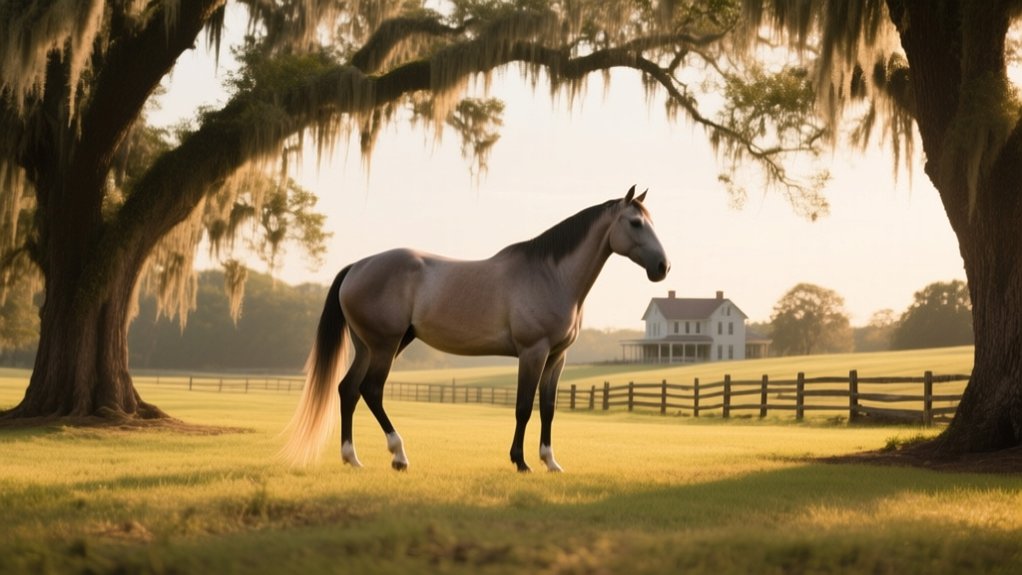
You’ll find the Tennessee Walking Horse originated in late 18th-century Middle Tennessee. Settlers crossbred breeds like Standardbred, Morgan, and Thoroughbred to create a strong, smooth-gaited horse. This horse was ideal for rugged terrain and long-distance travel.
Black Allan, born in 1886, is the foundation sire. He passed down the breed’s signature running walk gait. The breed was developed for plantation work and endurance.
The history of the Tennessee Walking Horse is rich with cultural significance. There are ongoing efforts to preserve its legacy and welfare. There’s plenty more to explore about its evolution and impact.
Origins of the Tennessee Walking Horse in Middle Tennessee

Although many horse breeds influenced its development, the Tennessee Walking Horse originated in late 18th-century Middle Tennessee. Settlers and farmers actively crossbred various breeds to meet their practical needs. These pioneers prioritized creating a horse with stamina, strength, and a smooth gait, which was essential for long-distance travel across rugged terrain.
The Tennessee Walking Horse was bred in 18th-century Middle Tennessee for stamina, strength, and a smooth gait.
Black Allan, born in 1886, emerged as the foundational sire. His lineage was rooted in Morgan, Standardbred, and Thoroughbred bloodlines.
This regional effort in Middle Tennessee shaped what we now recognize as the modern Tennessee Walking Horse.
It’s celebrated for its versatility and unique gait. Understanding this origin shows how practical demands and selective breeding in a specific environment forged a distinct and enduring horse breed.
Crossbreeding’s Role in Tennessee Walking Horse Traits

You’ll notice that the Tennessee Walking Horse’s smooth gait and endurance come from its diverse ancestral breeds like the Standardbred, Morgan, Thoroughbred, and Canadian Pacer. These crossbreeds brought in specific genetic traits that boosted speed, stamina, and a natural, easy gait.
Influential Ancestral Breeds
When you examine the Tennessee Walking Horse’s traits, you’ll see how crossbreeding among several influential breeds shaped its distinctive qualities. This breed’s development pulled from diverse bloodlines, each adding key characteristics that formed the horse you recognize today.
Consider these ancestral contributions:
- Narragansett Pacer: supplied natural gait and stamina
- Standardbred: provided speed and strength
- Morgan: enhanced refinement and agility
- Thoroughbred: improved appearance and agility
- American Saddlebred: brought elegance and smooth gait
These breeds combined to create a versatile horse known for its easy, comfortable gait and balanced physique. Understanding these ancestral influences helps you appreciate how deliberate crossbreeding crafted the Tennessee Walking Horse’s unique blend of endurance, style, and performance.
Genetic Impact on Gait
Because crossbreeding infused diverse genetic traits, the Tennessee Walking Horse developed its signature smooth gait and remarkable athleticism. When you trace its lineage, you’ll find breeds like Standardbred, Morgan, and Thoroughbred played vital roles.
The foundation sire, Black Allan, a Morgan and Standardbred cross, passed down the smooth running walk, a hallmark of the breed. This genetic infusion created the distinctive four-beat gait and stamina essential for long-distance travel.
By combining different bloodlines, breeders enhanced the breed’s versatility, strength, and natural ability to perform this smooth gait.
Understanding this genetic blend helps you appreciate how crossbreeding established the foundation for the Tennessee Walking Horse’s unique movement and physical traits that continue to define the breed today.
Role of Southern Plantations in Developing the Tennessee Walking Horse
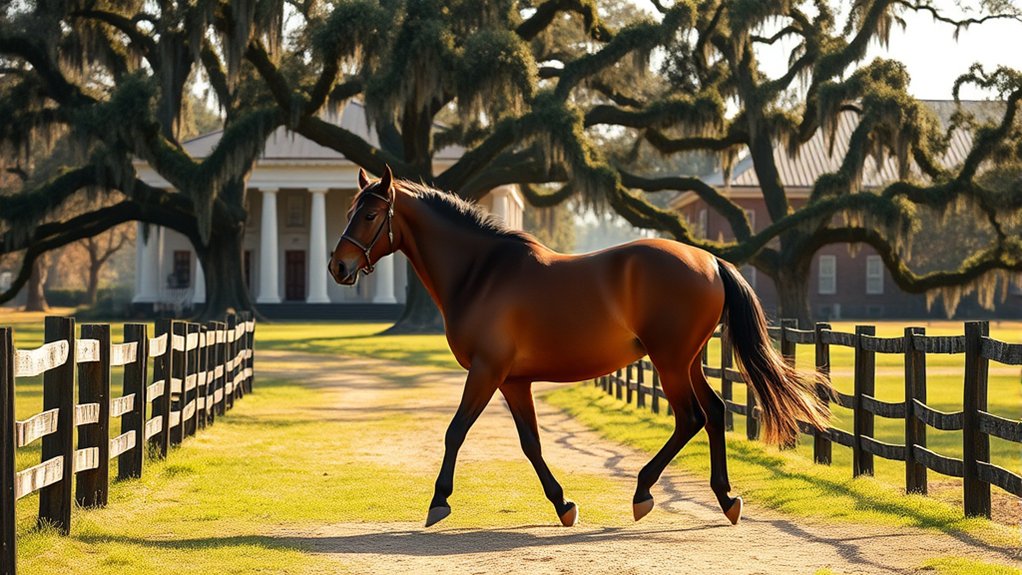
You’ll see that Southern plantations played a vital role in shaping the Tennessee Walking Horse. They really valued its utility and versatility, especially for those long hours spent over vast and rugged terrain.
The breed’s smooth running walk made a huge difference, providing unmatched comfort on extended rides. That made these horses absolutely indispensable for plantation work.
But it wasn’t just about practicality. These horses also became symbols of status.
Owners would often proudly show them off at social events, highlighting both their usefulness and their prestige.
Plantation Utility And Versatility
A Tennessee Walking Horse quickly proved itself indispensable on Southern plantations. It was valued for its exceptional strength, stamina, and a uniquely smooth running walk. You’d find it handling all sorts of tasks, making daily plantation operations more efficient and reliable.
Its running walk let owners cover large, rugged lands comfortably, which really showed off its practical utility.
On plantations, this breed excelled in riding across extensive acreage with ease, hauling supplies and farm equipment, and performing general farm labor effectively.
It also served as a symbol of wealth and status and was often showcased at local social and agricultural events.
Comfort For Long Rides
When Southern plantation owners needed a horse that could carry them comfortably for hours across vast and uneven terrain, they turned to the Tennessee Walking Horse. You’ll appreciate how its unique running walk, a smooth four-beat gait, minimized rider fatigue. This made long rides less exhausting.
This breed’s durability and sure-footedness ensured safe navigation through rough Southern landscapes. It met the demands of both work and leisure.
| Feature | Benefit |
|---|---|
| Running Walk Gait | Smooth, comfortable ride |
| Durability | Reliable for extended use |
| Sure-footedness | Safe over uneven terrain |
| Endurance | Handles hours of continuous riding |
| Plantation Origin | Developed for large estate needs |
Understanding these traits helps you see why the Tennessee Walking Horse became essential on Southern plantations.
Symbol Of Status
Beyond its practical strengths, the Tennessee Walking Horse quickly grew into a symbol of status among Southern plantation owners. You’ll find that owning one wasn’t just about utility; it was a public declaration of wealth and refinement.
This breed’s smooth gait and elegant presence made it a prized showpiece, especially at social events where prestige mattered. Plantation owners valued it for:
- Comfortable long-distance rides across vast estates
- Distinctive, smooth gait that stood out visually
- Demonstrating wealth and social standing in the community
- Serving as a centerpiece at local gatherings and competitions
- Reinforcing the owners’ image of success and sophistication
Black Allan: Foundation Sire of the Tennessee Walking Horse
Although Black Allan was initially unsuccessful as a trotter, he became the cornerstone of the Tennessee Walking Horse breed by passing on a smooth, four-beat gait that defines the breed today.
Born in 1886, Black Allan descended from the Hambletonian Standardbreds and was sired by Allan F-1. His dam was a Morgan mare, blending two distinct bloodlines. Despite his trotting failure, he excelled as a sire, influencing most modern Tennessee Walking Horses.
| Year Born | Sire | Dam |
|---|---|---|
| 1886 | Allan F-1 | Morgan Mare |
Black Allan’s genetic legacy is pivotal, ensuring the breed’s signature gait and versatility. You’ll see his impact in every Tennessee Walking Horse’s lineage.
Running Walk: The Tennessee Walking Horse’s Signature Gait
Because the running walk sets the Tennessee Walking Horse apart from other breeds, understanding its mechanics is essential to appreciating the horse’s unique appeal. This natural, four-beat gait features smooth, long oversteps that create a striking visual and comfortable ride.
When you watch a Tennessee Walking Horse, you’ll notice its rhythmic head nod and steady pace that can reach 10-20 mph without tiring the rider.
The gait is a product of selective breeding, emphasizing effortless, flashy movement. Key characteristics include:
- Four-beat gait with smooth, long oversteps
- Rear feet stepping 6-18 inches beyond front footprints
- Rhythmic head nod synchronized with each stride
- Speed range of 10-20 mph maintaining rider comfort
- Enables long-distance travel with minimal fatigue
This gait truly defines the breed’s elegance and utility. It’s what makes watching and riding these horses such a joy.
How the Tennessee Walking Horse Breeders Association Helped the Breed
When you explore the history of the Tennessee Walking Horse, you’ll find that the Tennessee Walking Horse Breeders Association (TWHBEA) played a crucial role in shaping the breed’s identity and reputation. Founded in 1935, TWHBEA established clear breed standards and created a formal pedigree registry.
The Tennessee Walking Horse Breeders Association, founded in 1935, set breed standards and formalized the pedigree registry.
They closed the stud book in 1947 to protect breed purity.
By organizing events like the first Tennessee Walking Horse National Celebration in 1939, the association boosted the breed’s visibility and prestige. TWHBEA has consistently emphasized elegance, gait, and temperament, guiding breeders toward responsible practices.
Additionally, the organization has actively opposed unethical treatments such as soring, prioritizing the breed’s welfare. Through these efforts, TWHBEA has guaranteed the Tennessee Walking Horse remains a distinct, respected breed.
Rise of the Tennessee Walking Horse in 20th Century Shows and Culture
As the 20th century progressed, the Tennessee Walking Horse gained widespread national recognition largely through its prominent role at the Tennessee Walking Horse National Celebration, which started in 1939. This annual event showcased the breed’s unique running walk and refined appearance, drawing large audiences and breeders alike.
You’ll notice how the Celebration became central to promoting the breed’s versatility and elegance. Beyond the show ring, the horse’s presence in movies and TV enhanced its cultural appeal.
Key factors in the breed’s rise include:
- Annual Celebration as a breeding and training hub
- Showcasing the distinctive gait to national audiences
- Increasing media exposure through entertainment
- Establishing the horse as a symbol of Southern culture
- Sparking early conversations about industry ethics and welfare
This growth shaped the Tennessee Walking Horse’s legacy in American equestrian culture.
Challenges: Soring and Animal Welfare
How does a practice like soring continue to cast a shadow over the Tennessee Walking Horse industry despite decades of legal prohibition? Soring involves inflicting pain on a horse’s legs or hooves to exaggerate its gait, particularly the “Big Lick” style. Although the Horse Protection Act of 1970 outlawed this cruel practice, it still persists.
Trainers use illegal devices, chemicals, and methods to cause inflammation and injury, often disguising the abuse with anesthetics or by punishing horses to manipulate inspection results. Inspectors rely on gait observation and palpation, but deception makes enforcement really tough.
You should know that ongoing legislative efforts, such as the PAST Act, aim to strengthen oversight and eradicate soring entirely. This reflects a growing commitment to animal welfare within the industry.
The Tennessee Walking Horse’s Legacy Today
Although the Tennessee Walking Horse has faced significant challenges, its legacy remains strong and influential today. You’ll find this breed continues to symbolize Tennessee’s cultural heritage as its official state horse.
The Tennessee Walking Horse endures as a proud symbol of Tennessee’s rich cultural heritage.
You can witness its prominence at the annual Tennessee Walking Horse National Celebration, which attracts thousands.
The breed thrives in diverse riding disciplines, showcasing its versatility and smooth gait. Breeders prioritize preserving its gentle temperament while enforcing ethical training methods.
Furthermore, legislation and inspection programs actively work to maintain the breed’s welfare and reputation.
Key aspects of the Tennessee Walking Horse’s legacy today include:
- Symbolizing Tennessee’s heritage as the state horse
- Celebrated through major annual events
- Popular in trail riding, shows, and therapy
- Focus on ethical breeding and training
- Supported by laws ensuring humane treatment
Frequently Asked Questions
What Is the Average Lifespan of a Tennessee Walking Horse?
The average lifespan of a Tennessee Walking Horse is between 28 to 33 years.
If you provide proper care, nutrition, and regular vet checkups, your horse can often live well into its early to mid-thirties.
With the right attention, these horses can be wonderful companions for a long time!
How Much Does a Tennessee Walking Horse Typically Cost?
You’ll typically pay $5,000 to $15,000 for a well-trained Tennessee Walking Horse. Prices can range quite a bit, though.
For example, older horses might go for around $1,000, while show-quality young horses can cost $10,000 or more. Keep in mind, there are extra costs too, like training and ongoing care.
What Are Common Health Issues in Tennessee Walking Horses?
You’ll find Tennessee Walking Horses face shadows like night blindness, joint strain from intense training, and hoof damage from improper shoeing.
Watch for respiratory issues in dusty stalls and manage weight carefully to avoid metabolic troubles. Taking good care of their environment and diet really makes a difference.
Can Tennessee Walking Horses Be Used for Trail Riding?
You can definitely use Tennessee Walking Horses for trail riding. Their smooth gait, sure-footedness, gentle temperament, and stamina make them ideal for traversing rough terrain comfortably and safely during long outdoor rides without tiring easily.
They’re really great companions on the trail because they keep things steady and comfortable, even when the path gets a bit tricky. Plus, their calm nature means they’re easy to handle, which is a big plus for riders of all experience levels. So, if you’re looking for a reliable horse to take on your next adventure, a Tennessee Walking Horse is a solid choice.
How Do Tennessee Walking Horses Compare to Other Gaited Breeds?
You’ll find Tennessee Walking Horses offer a smoother, four-beat running walk with a distinctive head nod. This makes rides more comfortable compared to the Missouri Fox Trotter’s diagonal gait or the American Saddlebred’s rack.
The difference is pretty noticeable once you’ve ridden more than one gaited breed. It’s all about that unique rhythm and style that Tennessee Walkers bring to the trail.
Conclusion
You’ve seen how the Tennessee Walking Horse’s tale twists through time, tracing its roots to Middle Tennessee’s plantations and the pivotal Black Allan. Crossbreeding crafted its enthralling gait, while breeders boldly built its breed identity.
Despite challenges like soring, the breed’s legacy lingers, living in lively shows and loyal hearts. Understanding this history helps you appreciate the Tennessee Walking Horse’s unique unity of strength, style, and spirited stride today.