How Many Horses Were Killed in the Civil War?
You’ll find that over 3 million horses and mules served in the Civil War, with nearly 1.5 million dying from wounds, disease, exhaustion, and harsh conditions. These animals were essential for cavalry, artillery, and logistics, so their loss severely affected military operations.
Horse deaths came from battle injuries, starvation, and disease, requiring mass burial and disposal methods. Understanding these impacts reveals the deep strain on both armies and animals during the conflict.
How Many Horses Served in the Civil War?
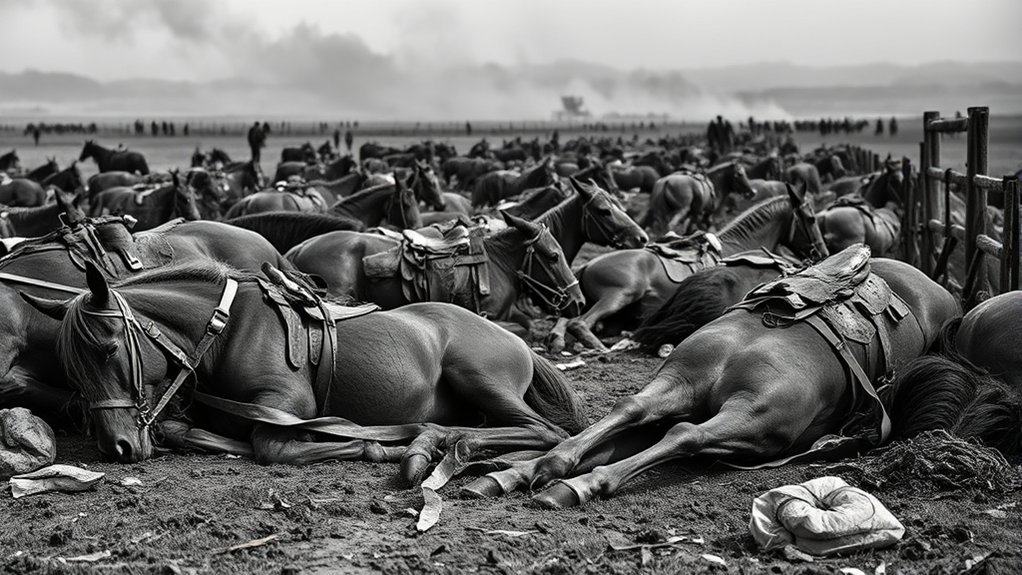
More than three million horses and mules served in the Civil War, playing essential roles in cavalry, artillery, and transportation. You should understand that about half of these animals, roughly 1.5 million, died due to wounds, disease, or exhaustion.
Over three million horses and mules served, with nearly half succumbing to wounds, disease, or exhaustion.
Horses were indispensable, with each artillery battery requiring around 120 horses and a cavalry regiment approximately 1,200.
When focusing on the Union cavalry, you’ll note that the army supplied horses through its quartermaster departments, contrasting with Confederate soldiers who often provided their own.
This distinction impacted the availability and condition of horses in both forces.
Why Horses Were Vital to Civil War Armies
You relied on horses to move troops, artillery, and supplies quickly across tough terrain. That’s what made them such an essential part of military transportation.
For instance, each artillery battery needed about 120 horses to work properly. That really shows how important they were for support roles.
Without fresh horses, cavalry units and generals just couldn’t keep up the fast pace needed to succeed on the battlefield.
Essential Military Transportation
Why did horses become indispensable to Civil War armies? You rely on horses to transport artillery, supplies, and troops efficiently across diverse terrains. A typical artillery battery needed about 120 horses, while cavalry regiments depended on roughly 1,200 horses each to perform reconnaissance, raids, and rapid maneuvers.
General officers required fresh mounts to move swiftly, often commanding hundreds of horses for their staff. Beyond combat, horses and mules pulled wagons carrying food, ammunition, and wounded soldiers, making animal power essential for logistics.
The Quartermaster Department’s management of millions of horses underscores their strategic significance. The sheer number of horses killed during the war reflects how crucial they were, especially in supporting the cavalry and maintaining army mobility under harsh conditions.
Cavalry and Artillery Support
Although infantry formed the backbone of Civil War armies, cavalry and artillery units relied heavily on horses to maintain battlefield effectiveness. Each cavalry regiment required around 1,200 cavalry horses to execute reconnaissance, charges, and rapid troop movements.
Similarly, artillery batteries depended on approximately 120 horses per six-gun unit to transport cannons, caissons, and limbers, ensuring artillery could reposition swiftly. Up to 100 men supported these artillery batteries, but horses were the key to moving heavy equipment across varied terrain.
When horses were lost due to wounds, disease, or exhaustion, both cavalry and artillery faced operational setbacks, reducing mobility and firepower.
Understanding the essential role cavalry horses and horses in artillery batteries played clarifies why their loss deeply affected Civil War military capabilities.
How Civil War Horses Were Used on Battlefields and in Logistics
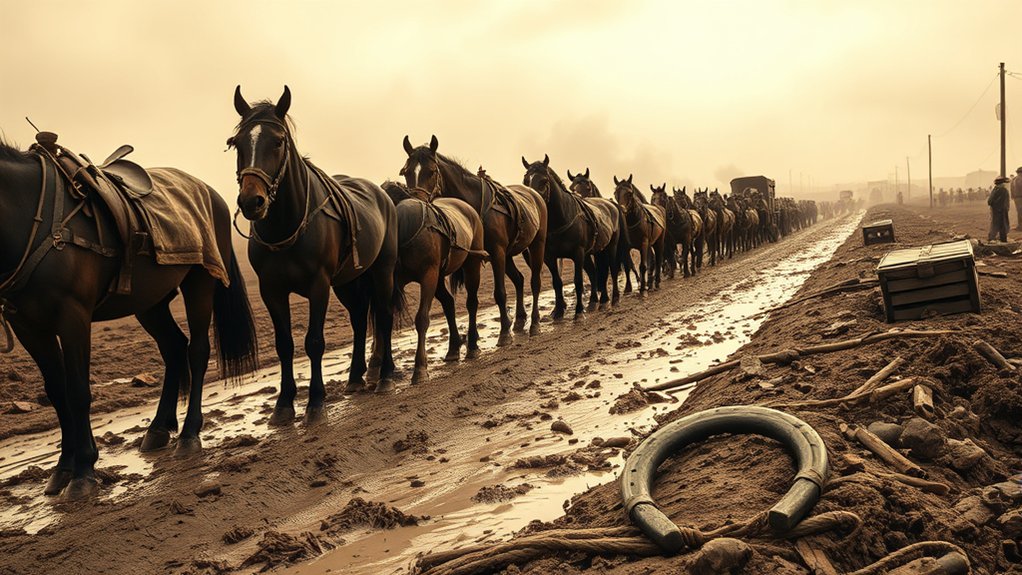
Because horses were integral to Civil War operations, they played essential roles both on battlefields and in logistics. You’d see horses moving artillery, with each six-gun battery needing around 120 horses to maneuver heavy cannons efficiently.
Horses were vital in the Civil War, moving artillery with about 120 horses per six-gun battery.
Cavalry regiments, including Confederate units, depended on roughly 1,200 horses for combat and reconnaissance, demonstrating their scale of use. These horses were trained to respond to specific commands and bugle calls, ensuring coordinated troop movements.
Beyond combat, horses transported supplies along supply routes, supporting army logistics. However, their heavy workload and frequent underfeeding made them vulnerable to exhaustion, wounds, and disease.
Understanding these roles highlights how horses were indispensable to military operations, shaping both battlefield tactics and logistical support throughout the war.
What Caused So Many Civil War Horse Deaths?
While Civil War horses were essential to military operations, their deaths were alarmingly frequent due to multiple factors. Horses died in large numbers not only from direct combat but also from conditions related to their demanding roles.
Overwork pushed many beyond their limits, while inadequate care worsened their vulnerability. You can pinpoint key causes behind the high mortality:
- Overwork during long campaigns drained horses physically, leading to collapse and death.
- Insufficient feeding caused starvation and weakened immune systems, increasing disease susceptibility.
- Exposure to harsh battlefield environments resulted in injuries and infections.
- Lack of medical treatment meant even minor wounds could be fatal.
Understanding these causes helps explain why so many horses died despite their crucial importance to the war effort.
How Many Civil War Horses Died From Battle Injuries?
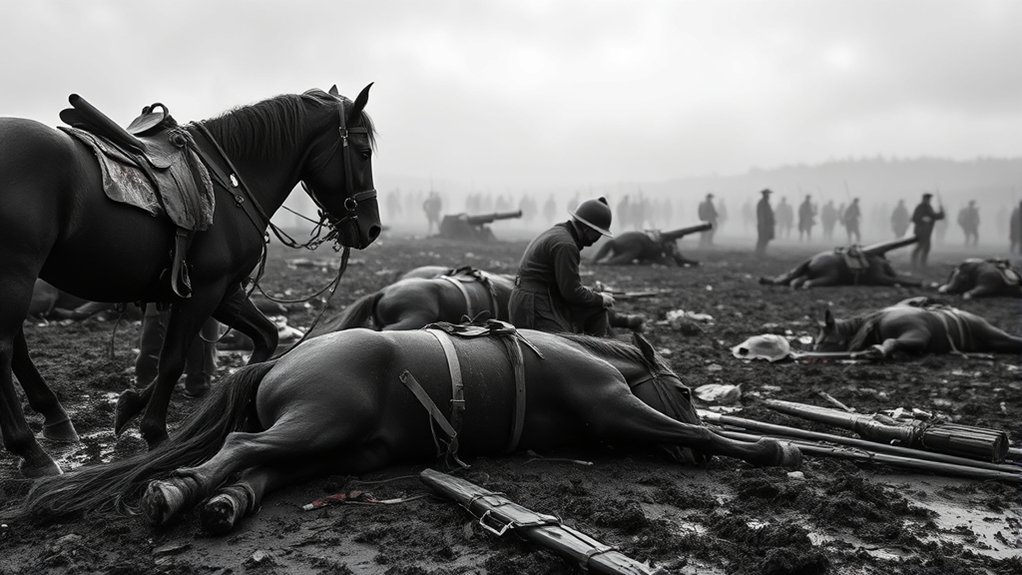
You should know that battle injuries caused the deaths of hundreds of horses in major Civil War battles. In fact, during just one battle, an artillery branch lost over 1,700 horses.
Many of these casualties were due to gunfire and shelling. Because of the sheer number of dead horses, armies often had to resort to mass disposal methods like burning or burying them.
When you look at these numbers, it really highlights how the loss of horses had a huge impact on military operations throughout the war.
Horse Battle Casualty Numbers
Although horses weren’t the primary combatants, their battle casualty numbers in the Civil War were staggering. You need to understand that horse casualties far surpassed many human losses, highlighting the war’s heavy toll on animals.
For instance, over 1,700 horses from a single service branch died in just one battle, mostly artillery horses.
Approximately 1.5 million horses and mules were killed or wounded throughout the Civil War.
Mass graves and burning were standard methods to dispose of these large numbers of dead horses.
Many horses died directly from battle wounds sustained during combat operations.
These figures clearly show the immense scale of Civil War horse casualties, emphasizing the critical role horses played and the severe risks they faced on the battlefield.
Causes Of Horse Deaths
Because horses were integral to battlefield operations, many suffered fatal injuries directly from combat. You’ll find that horse casualties mainly resulted from battle injuries such as gunshot wounds, shrapnel, and trauma.
For example, a single service branch lost about 1,700 horses in one battle alone, mostly artillery horses. The scale of horse deaths was so high that mass graves and large-scale disposal methods were necessary.
These facts underscore the brutal impact of war on horses.
| Cause of Death | Description |
|---|---|
| Gunshot Wounds | Penetrating injuries from bullets |
| Shrapnel | Injuries caused by exploding shells |
| Physical Trauma | Injuries from falls or collisions |
| Exhaustion | Result of extreme battlefield stress |
| Infection | Complications from untreated wounds |
Impact On Military Operations
The staggering number of horse deaths from battle injuries directly weakened military operations during the Civil War. You can see how the loss of horses on the battlefield severely limited mobility and logistical support.
For example, one artillery branch lost about 1,700 horses in a single battle, not counting cavalry or supply animals. This massive loss forced armies to adapt quickly under challenging circumstances.
Consider these critical impacts:
- Reduced artillery movement and slower repositioning
- Compromised supply lines due to fewer draft animals
- Increased burden on surviving horses leading to overwork
- Use of mass graves and disposal methods affecting battlefield sanitation
The Impact of Disease and Starvation on Horse Casualties
When you consider the challenges faced by Civil War horses, disease and starvation emerge as leading causes of death. Many horses died from illnesses like colds, infections, and malnutrition-related ailments due to poor conditions and inadequate care.
Feeding horses proved more difficult than feeding soldiers, resulting in insufficient daily rations. Over a two-month period, reports documented starvation of about ten thousand animals, highlighting the severity of wartime food shortages.
The harsh logistical environment compounded these issues, as horses endured exhaustion alongside disease and malnutrition. These factors combined to create widespread suffering and high mortality rates among horses.
Understanding the scale of death caused by disease and starvation reveals the critical vulnerabilities of horses during the Civil War beyond battlefield injuries.
How Armies Dealt With Losing Horses During the War
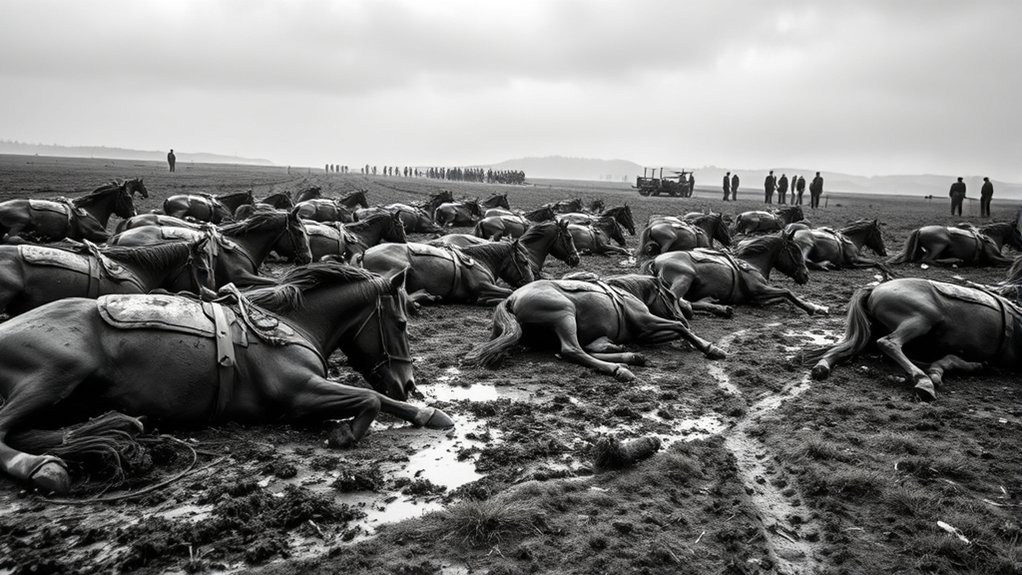
When you think about how armies dealt with dead horses, they often resorted to mass graves or burning the carcasses because there were just so many of them. Imagine the sheer scale of it all—it wasn’t something that could be handled quietly or easily.
Soldiers had to push or roll those heavy bodies into pits, or sometimes even set whole parts of the battlefield on fire to get rid of them.
It was an intense physical and emotional challenge.
You can really see how this grim task added to the logistical headaches of war, not to mention the psychological toll it took on those responsible for cleaning up after the fighting.
Burial Methods For Horses
Although armies faced immense logistical challenges during large battles, they developed grim but efficient methods to manage the vast number of horse casualties. Mass graves were commonly dug to facilitate rapid burials of hundreds of dead horses and mules. This helped minimize health risks and kept the battlefield clear.
When burials weren’t feasible, soldiers resorted to alternative methods, including dismembering and piling carcasses into heaps, setting piles of bodies on fire to reduce decomposition hazards, pushing or rolling carcasses into pits for containment, and burning entire battlefield sections along with the fallen animals.
These approaches were physically taxing and emotionally distressing for soldiers. The presence of bloated or mangled horse bodies was a stark reminder of the war’s brutality and the high animal toll. It highlighted the grim realities faced beyond just human casualties.
Battlefield Cleanup Challenges
Because armies faced overwhelming numbers of dead horses after battles, they’d to develop harsh and labor-intensive cleanup methods to manage the carcasses. Battlefield cleanup often involved burying hundreds of dead horses in mass graves or pits.
But when burial was impractical, soldiers dismembered and burned carcasses.
Entire sections of the battlefield were sometimes set on fire to dispose of dead horses, resulting in chaotic and destructive scenes. You’d have witnessed soldiers physically exhausted and emotionally disturbed as they rolled or pushed carcasses into graves amid ongoing combat.
Roads became littered with corpses, reflecting the toll of overwork, disease, and starvation.
Managing dead horses was a formidable and undesirable task. It frequently overwhelmed troops due to the sheer scale of animal casualties during the war.
How Dead Horses Were Disposed of During the War
Handling the vast number of dead horses during Civil War battles demanded practical and often harsh solutions. You’d encounter dead horses buried in mass graves or shallow trenches, a method used when burial was feasible.
However, when the scale was overwhelming, disposal methods shifted. You might see bodies dismembered or burned on pyres, sometimes with entire battlefield sections set aflame to clear carcasses quickly. Soldiers faced physical and emotional strain managing these grim tasks.
Common disposal methods included:
- Burial in mass graves or trenches
- Dismemberment and piling of carcasses
- Burning on pyres or entire battlefield sections
- Use of makeshift methods under exhausting conditions
These approaches reflected the brutal reality and logistical challenges of handling dead horses during the war.
What Memorials Honor Civil War Horses and Mules
When you visit the Virginia Museum of History & Culture in Richmond, you’ll find a memorial dedicated in 1997 that honors roughly 1.5 million horses and mules involved in the Civil War. This memorial specifically acknowledges animals killed, wounded, or dying from disease.
Across the country, other memorials and statues, like those in Middleburg, Fort Riley, Four Oaks, and Murfreesboro, serve as tangible relics of the Civil War. They emphasize the crucial roles these animals played.
| Location | Type of Memorial |
|---|---|
| Richmond, VA | Memorial for 1.5M animals |
| Middleburg, VA | Statues and plaques |
| Fort Riley, KS | Military commemorations |
These memorials reinforce the significant animal casualties and their contributions during the war.
Why We Still Remember Civil War Horses
Memorials across the country remind us of the staggering number of horses and mules involved in the Civil War. Many of these animals never survived the conflict.
You recognize Civil War horses as vital to military operations. They endured immense suffering and faced high mortality.
Memorials play a key role in preserving their legacy. They symbolize both the importance and sacrifice of these animals.
Memorials honor the vital role and profound sacrifices of horses and mules in the Civil War.
You can see this reflected in statues commemorating horses and riders, like Robert E. Lee on Traveller, monuments honoring the estimated 1.5 million animals killed, wounded, or diseased, personal accounts that highlight the emotional and physical toll on horses, and battlefield memorials that emphasize their role in logistics and combat.
Frequently Asked Questions
What Types of Horses Were Preferred by Civil War Armies?
You’ll find that Civil War armies preferred specific horse breeds based on their roles, guided by horse breeding practices and equipment standards. Cavalry units favored agile Morgans and Thoroughbreds for quick maneuvers.
Support units used larger draft horses to handle heavy equipment.
The Union’s Quartermaster Department guaranteed endurance and resilience in their selections, whereas the Confederates focused on hardy, adaptable local breeds.
This strategic breeding aligned with military equipment demands efficiently.
How Were Horses Trained for Military Service During the Civil War?
You train horses like forging steel through discipline and care. Military horses, selected via horse breeding for stamina and temperament, learned to heed bugle calls and commands amid chaos.
Equine nutrition played a key role, guaranteeing strength for grueling drills. Trainers used gradual exposure to battlefield sounds and positive reinforcement to build obedience.
This methodical preparation ensured horses could execute complex maneuvers reliably, embodying the resilience essential for military effectiveness.
Did Cavalry Horses Receive Special Care Compared to Other Military Horses?
Yes, cavalry horses received special care compared to other military horses. You’d find they benefited from selective horse breeding to guarantee strength and stamina.
Officers prioritized veterinary care, providing regular grooming, medical attention, and better nutrition to maintain peak condition. This care included special rations and improved shelter, which helped cavalry horses endure the demands of swift mobility.
Despite this, many still faced hardships like disease and overwork during campaigns.
Were Horses Used Differently by Union and Confederate Forces?
You might say Civil War horse usage was like comparing iPhones and flip phones in today’s terms. Union forces focused on battlefield logistics, using horses mainly for pulling wagons and artillery. They backed this up with standardized horse breeding programs.
Confederate troops, relying on self-supplied mounts, emphasized cavalry action. This resulted in varied horse quality.
This difference reflected each side’s resources and tactics, shaping how horses contributed strategically throughout the conflict.
How Did the Civil War Influence Future Military Use of Horses?
The Civil War pushed you to rethink horse breeding, emphasizing stronger, more resilient mounts suited for combat and transport. You’d notice how battlefield logistics became essential, prompting better care and coordination of horses to maintain mobility.
These lessons led to specialized cavalry units and improved training methods.
Ultimately, your military strategies evolved, relying on enhanced horse breeding and streamlined logistics to support more effective mounted warfare in future conflicts.
Conclusion
You’ve seen how many horses served, how crucial they were, and how many died from battle and disease. You’ve learned how armies managed losses and honored these animals.
Remember, horses carried supplies, pulled artillery, and fought alongside soldiers. They endured harsh conditions, just like the men.
Their sacrifice shaped logistics, battlefield outcomes, and history itself. By understanding their role, you grasp the full scope of the Civil War’s human and animal cost.