How to Identify Thoroughbred Horse Characteristics
You can identify a Thoroughbred by its refined head with a straight profile, expressive eyes, and a long, lean neck. Check for distinctive facial markings like stars or blazes, plus white socks on the legs.
Use lip tattoos featuring a birth-year letter and numeric ID, and verify with official databases. Microchips implanted near the nuchal ligament offer reliable ID.
Precise conformation traits and detailed photos help confirm identity. Exploring these methods further reveals how to guarantee accurate identification.
Recognizing Distinctive Physical Features of Thoroughbreds

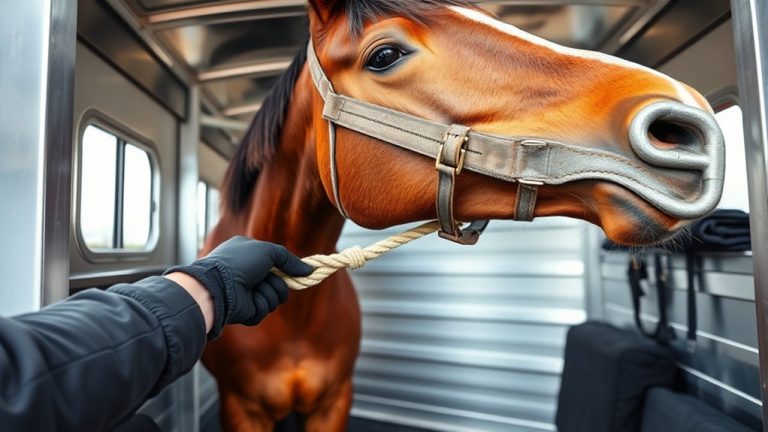
When you examine a Thoroughbred, you’ll notice its refined head with a straight profile, large expressive eyes, and widely spaced, prominent nostrils. These features enhance its sensory perception and airflow.
A Thoroughbred’s refined head features a straight profile, expressive eyes, and prominent nostrils for enhanced senses and airflow
The horse’s head is proportionate to a long, lean neck that supports agility.
Moving downward, the legs stand out with their length and pronounced tendons, aligned straight from front to back. This alignment optimizes stride efficiency and durability under high-speed conditions.
Balanced, well-formed hooves complement the legs, providing essential traction and shock absorption.
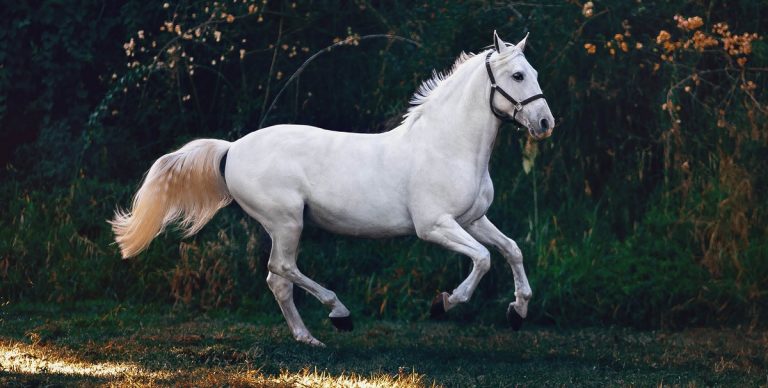
The overall conformation is lean and athletic, emphasizing speed and power rather than bulk. Recognizing these distinctive physical features helps you identify a Thoroughbred’s specialized anatomy designed for racing performance and endurance.
How to Use Lip Tattoos to Identify Your Thoroughbred
You’ll notice that a Thoroughbred’s lip tattoo starts with a letter indicating its birth year, followed by a unique registration number. This combination acts as the horse’s official racing ID.
To check this information, you can head over to The Jockey Club’s online “Research a Tattoo” tool. Just keep in mind, you’ll need clear images to get an accurate read.
If the tattoo happens to be smudged or faded, don’t worry—you might have to rely on other methods like DNA testing to confirm the horse’s identity.
Tattoo Composition Explained
Although lip tattoos may appear simple at first glance, they encode critical identification data through a specific combination of a letter and four or five numbers. The letter represents the Thoroughbred’s birth year according to the registry identification system, while the numbers provide a unique registration identifier.
To decode lip tattoos accurately, you must discern the exact letter and digits, often requiring photographic enhancement to clarify faded or smudged marks. This precise tattoo composition allows for definitive identification within official records.
Understanding this coding system is essential for verifying a horse’s identity, as the registry identification ties the tattoo to detailed information such as the horse’s sex and color.
Mastering lip tattoos ensures you can confidently authenticate any Thoroughbred’s official identity.
Researching Tattoo Information
Decoding a Thoroughbred’s lip tattoo is only the first step.
Accurately researching this information requires precise recording and verification.
Start by carefully noting the tattoo’s letter, which indicates the birth year, followed by the four or five-digit registration number.
To confirm identity, input these details into The Jockey Club’s online “Research a Tattoo” tool.
Confirm the lip tattoos are legible.
If faded or smudged, use photographic enhancement or compare with reference images for clarity.
In cases where tattoos are incomplete or illegible, you may need alternative identification methods, such as DNA testing or visual markings.
Properly documenting tattoo details is essential for verifying the horse’s registered name, age, and pedigree, guaranteeing accurate and reliable identification when researching tattoo information.
Overcoming Identification Challenges
How can you accurately identify a Thoroughbred when its lip tattoo is faded or partially obscured? Start by gently lifting the horse’s lip and using a flashlight or magnifying glass to enhance the visibility of the lip tattoos.
If the tattoo remains unclear, follow these steps:
- Photograph the tattoo clearly and use image editing software to clarify smudged or faint markings.
- Use the Jockey Club’s online “Research a Tattoo” tool to verify the horse’s identity by entering the letter and numbers from the tattoo.
- Combine lip tattoo analysis with other physical markings and microchip data to confirm the Thoroughbred’s identity when tattoos are illegible.
This multi-method approach ensures precise identification despite challenges with lip tattoos.
How Microchips Make Thoroughbred ID Easier
You’ll find that microchips, which meet ISO 11784/11785 standards and are implanted near the nuchal ligament, offer a reliable and permanent way to ID your horse.
Just use a compatible scanner, and you can instantly pull up the horse’s unique number tied to official records.
This technology really takes the hassle out of identification because it removes the risks that come with traditional methods like branding or lip tattoos, which can fade or get lost over time.
Microchip Implementation Standards
Although traditional identification methods remain in use, microchip implementation has revolutionized thoroughbred horse identification by providing a permanent, tamper-resistant solution. You’ll find that microchipping follows strict standards to guarantee reliability and consistency. Here’s what you need to know:
- Microchips must comply with ISO 11784/11785 standards, ensuring consistent data transmission during identification.
- The microchip, roughly rice-sized, is implanted on the left side of the horse’s neck near the nuchal ligament for ideal placement and minimal interference.
- Since 2017, all U.S.-born foals require microchipping, linking their unique chip number with registration details to enhance identification accuracy and trackability.
This standardized approach streamlines thoroughbred identification, making it more precise and tamper-proof than traditional methods.
Scanning and Data Retrieval
Where can you find the most efficient way to confirm a thoroughbred’s identity? Microchips implanted near the nuchal ligament on the left side of the horse’s neck provide a precise solution. These ISO 11784/11785-compliant devices store a unique identification number, which compatible scanners read instantly.
When you scan the microchip, data retrieval occurs seamlessly, presenting the horse’s ID without relying on visual markings that may be damaged or obscured. This permanent form of identification guarantees accuracy during races, sales, and health record verification.
The Jockey Club advises recording microchip numbers alongside physical features to create a complete identification profile.
Advantages Over Traditional Methods
Because microchips offer a permanent and tamper-proof form of identification, they surpass traditional methods like brands or tattoos in reliability and security. When you use microchips for identification, you benefit from:
- Instant Verification. Compatible readers scan microchips quickly, providing immediate and accurate identification without manual inspection errors.
- Durability and Consistency. Unlike faded tattoos or worn brands, microchips maintain clear identification that can’t be altered or removed.
- Centralized Digital Records. Microchip data integrates with international databases, which simplifies access to comprehensive identification histories across jurisdictions.
Reading and Comparing Thoroughbred White Markings and Facial Patterns
When identifying Thoroughbreds, you’ll find that white facial markings such as stars, stripes, and blazes serve as reliable, unique identifiers. These white markings vary in shape, size, and position, remaining consistent throughout the horse’s life. That makes them invaluable for precise comparison.
To enhance visibility, especially when markings are faint, wetting or clipping the facial area can reveal subtle details.
You should document these facial markings carefully, noting their exact contours and placement.
Furthermore, combining these observations with white sock markings on the legs improves identification accuracy.
Identify Key Conformation Traits in Thoroughbreds
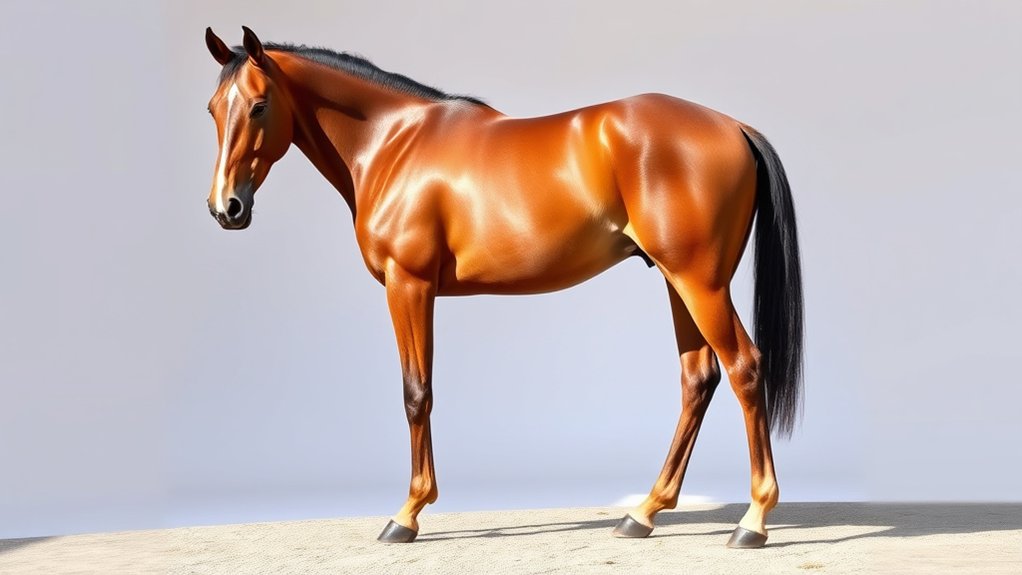
Although identifying white markings aids in recognition, evaluating key conformation traits is essential for understanding a Thoroughbred’s athletic potential. When appraising horse anatomy, focus on these critical features:
- Shoulder Angle and Neck Proportion: A short, well-sloped shoulder around 40 degrees enhances stride length and efficiency. The neck should be about 1.5 times the head’s length, ensuring balance and stability.
- Hindquarter Structure: The hips, stifle, and buttocks should form a nearly equilateral triangle, signifying strong propulsion and power critical for speed.
- Limb Alignment and Musculature: Straight, well-defined legs with matching pastern and hoof angles minimize injury risk.
Additionally, a deep heart girth, short back, and muscular hindquarters support stamina and durability.
Estimate Age and Condition to Identify Thoroughbreds
Understanding a Thoroughbred’s conformation provides insight into its athletic potential, but estimating age and evaluating condition offer extra layers of identification.
To estimate age accurately, examine the horse’s teeth: note the eruption sequence, wear patterns, and presence of “cups” in incisors.
Younger Thoroughbreds have smoother teeth with minimal wear. Older horses show angled, worn teeth and diminished cups.
Appraising condition involves evaluating muscle tone, body fat, and coat quality.
Younger horses typically display a sleek, uniform coat and firm musculature. Conversely, older horses may exhibit graying, dull coats, prominent withers, sunken eyes, and signs of joint wear.
These physical indicators, combined with dental examination, enable you to determine the horse’s age and overall fitness.
This is critical for identifying Thoroughbreds with precision.
How Photos Can Help You Match Your Thoroughbred to Registry Records

How can you guarantee your Thoroughbred’s identity aligns perfectly with registry records? You rely on detailed photographic evidence capturing the horse’s unique physical features. Clear, high-quality photos allow precise comparison against official documentation.
To optimize identification, follow these steps:
To optimize identification, capture detailed photos from multiple angles highlighting unique physical features.
- Capture multiple images from front, side, and rear angles, focusing on facial markings, scars, whorls, and white socks.
- Enhance brand visibility by wetting or clipping hair around the brand area to improve photographic clarity.
- Compare all captured physical features meticulously with registry records, verifying consistency with pedigree descriptions.
This methodical photographic approach ensures you accurately match your Thoroughbred to its registry records, confirming identity and preserving the integrity of its documented lineage.
Get Expert and Community Support for Thoroughbred Identification
You can really boost your Thoroughbred identification by looking into tattoo patterns and using DNA testing to confirm lineage with great accuracy. It’s a solid way to be sure about a horse’s background.
Also, getting involved with expert communities is super helpful. They offer a wealth of collective knowledge that can guide you in interpreting brands, microchips, and those unique markings that make each horse special.
Plus, when you share detailed images and data within these networks, you often discover subtle traits that make verification even more precise. It’s like having a whole team helping you out!
Tattoo Research Techniques
Although lip tattoos remain the primary identification method for Thoroughbreds, deciphering faded or partial markings requires specialized techniques. You’ll need to leverage both technology and community knowledge to confirm a horse’s tattoo and registration details accurately.
Here are three essential tattoo research techniques:
- Use photo editing software to enhance images of the tattoo, increasing contrast and clarity to reveal obscured characters.
- Access The Jockey Club’s online database to match visible tattoo elements with registered identification numbers and birth year codes.
- Engage with online forums and social media groups where experts and previous owners collaborate, sharing images and insights to verify ambiguous tattoos.
DNA Testing Benefits
When tattoo identification proves inconclusive due to faded markings or ambiguous codes, DNA testing offers a reliable alternative for verifying a Thoroughbred’s lineage. Since 2001, The Jockey Club has mandated DNA sampling of all foals to guarantee accurate identification.
You collect approximately 50 hairs with roots from the mane, then send them to a certified laboratory for genetic analysis.
DNA testing definitively confirms parentage and resolves disputes related to mistaken identity, theft, or pedigree inaccuracies.
By analyzing Thoroughbred bloodlines, this method provides incontrovertible proof of a horse’s heritage, safeguarding breeding integrity.
Employing DNA testing enhances your ability to authenticate Thoroughbred identity precisely, especially when traditional markers fail.
This scientific approach is indispensable for breeders and owners committed to maintaining accurate lineage records.
Community Identification Help
Since accurate identification of Thoroughbreds can be challenging due to faded markings or incomplete records, leveraging community identification help offers a practical solution. Engaging with online groups and social media platforms lets you gather expert input and collective knowledge, which is vital for precise identification.
To maximize community identification effectiveness:
- Post high-resolution images of the horse’s legs, head, and any visible brands or tattoos to provide clear reference points.
- Collaborate actively with experienced community members, including former trainers and breeders, who can interpret ambiguous markings.
- Use feedback from diverse community sources to cross-verify the horse’s pedigree or racing history.
This community-driven approach greatly enhances your ability to confirm Thoroughbred identity with detailed, expert-supported evidence.
Identifying Horses With Faded Tattoos or No Records
If you encounter a Thoroughbred with faded tattoos or no records, you’ll need to rely on alternative identification methods to verify its identity accurately. Digital enhancement tools like Photoshop can clarify faded tattoos. Physical markers such as scars, white hairs, or unique coat patterns offer additional identifiers.
When tattoos remain illegible, DNA testing through the Jockey Club provides definitive identification using hair samples. Microchipping also guarantees reliable verification by matching scanned chip numbers to registration data.
| Method | Application | Limitations |
|---|---|---|
| Digital Enhancement | Clarify faded tattoos | Requires software skill |
| Physical Markings | Identify unique traits | Subjective interpretation |
| DNA Testing | Confirm identity definitively | Requires laboratory analysis |
| Microchipping | Scan and verify registration | Chip may be missing |
Tips for Handling Thoroughbreds Without Complete Identification
Faded tattoos and incomplete records often leave you relying on alternative identification methods, but handling Thoroughbreds without complete identification requires additional care and technique. To manage this effectively, focus on enhancing visible markers and leveraging technology.
- Improve visibility of shoulder brands by clipping or wetting the area, then take clear photos of the horse’s legs and front-on head for detailed feature comparison.
- Examine the horse for microchips or alternative branding methods, providing a secondary layer of identification when markings are ambiguous.
- Carefully document unique physical characteristics such as white socks, facial markings, and estimate the horse’s age to aid distinction.
Using these precise steps enhances your ability to identify Thoroughbreds confidently despite incomplete records, ensuring better management and care of the horse.
Frequently Asked Questions
What Is the History Behind Thoroughbred Breed Registration?
You’ll find that the Thoroughbred breed registration began with formalizing breed origins through the General Stud Book in 1791. This registration process meticulously documented pedigrees, ensuring lineage accuracy.
It traced most paternal lines back to key stallions, especially Eclipse. By registering Thoroughbreds, breeders maintained breed purity and historical records, which helped standardize the breed’s traits and supported the integrity of racing bloodlines worldwide.
How Do Thoroughbred Bloodlines Affect Racing Performance?
Imagine you’re analyzing a colt descending from Eclipse’s sire line. Genetic markers in his DNA reveal traits linked to speed and stamina.
Through pedigree analysis, you identify ancestors excelling in middle-distance races, indicating potential versatility. This informs your training focus and race selection.
Thoroughbred bloodlines directly affect racing performance by passing on inherited physical and behavioral traits. This allows you to predict and enhance a horse’s competitive edge with precision.
What Are Common Health Issues Specific to Thoroughbreds?
You’ll often encounter genetic disorders in Thoroughbreds, particularly musculoskeletal weaknesses leading to joint microdamage and chronic fatigue.
Respiratory issues, like exercise-induced pulmonary hemorrhage (EIPH), frequently occur due to intense exertion.
Moreover, you should monitor for hoof-related problems and gastric ulcers caused by stress and rigorous training.
These health concerns demand precise management to maintain their high-performance capabilities and minimize injury risks during racing and training.
How Do Training Methods Differ for Thoroughbreds Versus Other Breeds?
Training Thoroughbreds is like tuning a finely crafted violin; you focus on precision and finesse. You use interval training and high-intensity workouts to build speed and endurance, adjusting gradually to protect their delicate tendons.
Their behavioral traits demand consistency and positive reinforcement rather than heavy aids. Unlike other breeds, your training techniques emphasize stride length, balance, and race-specific conditioning.
You tailor every session to optimize their athletic, sensitive nature for peak racing performance.
What Are the Legal Requirements for Owning a Thoroughbred Horse?
You must guarantee your Thoroughbred is registered with The Jockey Club, complete with a microchip or tattoo for identification if born after 2017. Maintain thorough documentation, including pedigree and health records, to comply with legal ownership requirements.
Proper horse grooming and meticulous stall management are vital for meeting racing authority standards, ensuring your horse remains healthy and compliant.
Regularly update all paperwork and adhere to breeding and sale regulations to protect breed integrity.
Conclusion
To truly track thoroughbred traits, trust thorough techniques: tactile tattoos, thorough photos, and tech tools like microchips. Tackling tricky traits, from faded marks to facial features, takes timely, targeted attention.
Thoroughbred identification thrives through thoroughness, tapping expert tips, testing conformation, and tracing patterns precisely. You’ll find firm footing in forensic features, fostering faster, finer findings.
So stay sharp, stay systematic, and secure your success in spotting superb, standout thoroughbreds swiftly and surely.