What Do Horses See at Night?
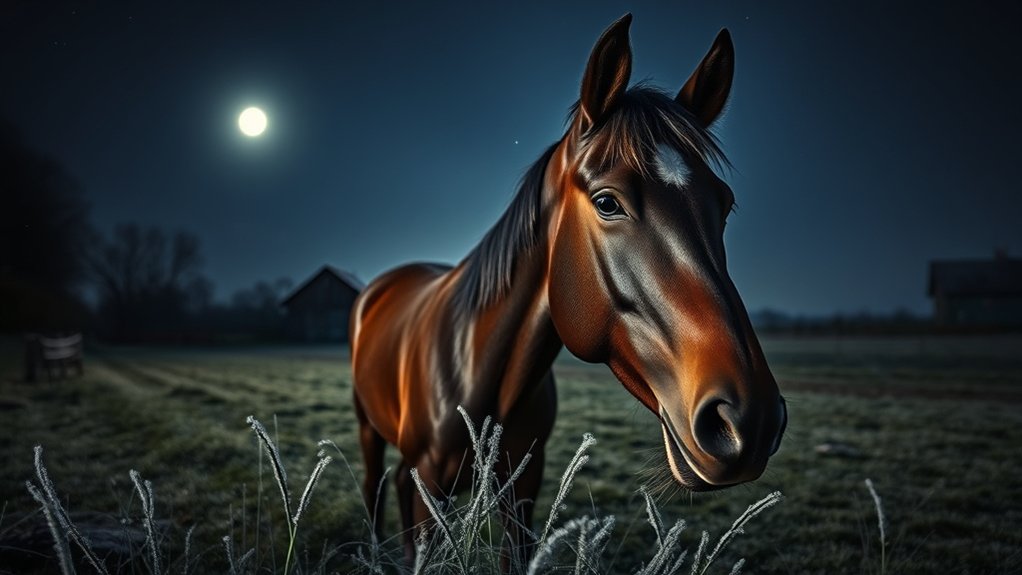
At night, your horse sees mostly shapes and movement rather than clear details or vibrant colors. Thanks to its tapetum lucidum, light reflects inside the eye to boost low-light vision, but this also causes some blurring and glare.
Horses detect blues and yellows better than reds or greens and rely on wide peripheral vision rather than sharp depth perception. Their eyes take up to 45 minutes to adjust to darkness, which can make navigation tricky initially.
Discover how these features affect your horse’s night vision and safety.
How Do Horses’ Eyes Differ From Human Eyes at Night?
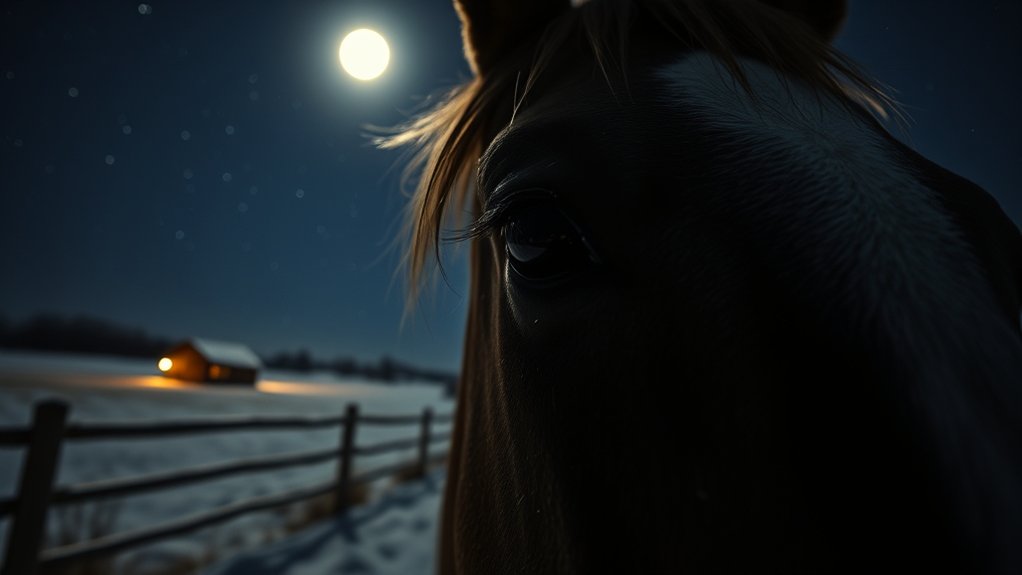
Although human eyes rely heavily on cones for color vision, horses’ eyes are equipped with a tapetum lucidum, a reflective layer behind the retina. This layer notably boosts their ability to see in low light by bouncing light back through the retina. This feature considerably enhances their night vision compared to humans.
Horses have a higher rods to cones ratio, favoring rods for detecting light intensity and motion in low light but limiting their color perception to mostly blue and yellow hues. Their large eyes provide an expanded visual range and strong binocular vision, which aids in depth perception and environmental awareness at night.
However, despite these adaptations, horses’ night vision lacks the clarity and detail found in daylight. Also, their eyes take longer to adjust when shifting from bright to dark conditions.
What Role Does the Tapetum Lucidum Play in Night Vision?
Because horses often navigate dim environments, the tapetum lucidum plays a *vital* role in enhancing their night vision. This reflective tissue, located behind the retina, boosts a horse’s eyes’ sensitivity by reflecting light that passes through the retina back into the eye.
The tapetum lucidum is essential for horses, reflecting light to enhance their night vision in dim environments.
By doing so, it amplifies the available light, improving vision in low light conditions.
Here’s how the tapetum lucidum contributes to night vision:
- Increases the sensitivity of photoreceptor cells, enabling better detection of movement and objects.
- Causes the characteristic glow of horse’s eyes when illuminated at night.
- Enhances vision by maximizing light use, though it may slightly blur images.
This mechanism allows horses to see more effectively in dim environments, *essential* for their survival.
How Clearly Can Horses See at Night?
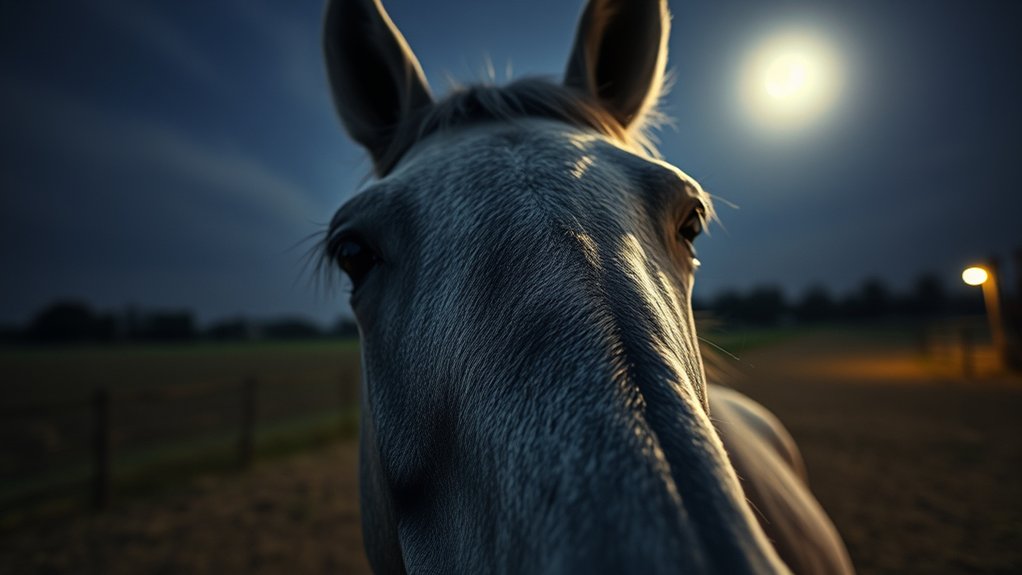
You won’t see as clearly at night as you do during the day because horses’ vision in low light is kind of like partial moonlight conditions. Their eyes actually take about 45 minutes to fully adjust to the dark.
This means they can’t pick up on sharp details or colors very well.
Even though their night vision helps them make out the shapes of things, horses mostly count on their other senses to get around safely when it’s dark.
Night Vision Limitations
When horses move from bright daylight into darkness, their vision takes up to 45 minutes to fully adjust. During this time, their ability to see clearly is markedly reduced. Their night vision, while better than humans in low light, still has notable limitations.
Thanks to the tapetum lucidum, horses can detect movement and shapes in dim environments. But their perception of detail suffers significantly.
Horses struggle to see fine details and colors at night, mostly perceiving shades of gray. The tapetum lucidum helps enhance sensitivity but also causes image blurring, which lowers clarity.
Their night vision resembles dim moonlight, enough to detect outlines but poor for sharpness.
Low Light Adaptation
How clearly can horses see in low light conditions? Horses rely on a high rod-to-cone ratio (20:1) and a tapetum lucidum to enhance night vision. These adaptations improve their vision in dim light but limit color perception and detail clarity.
Dark adaptation takes about 45 minutes, longer than in humans, before their eyes adjust fully. You’ll notice horses can detect dim edges after dark adaptation, though overall vision remains blurry compared to daylight.
| Feature | Description | Effect on Vision |
|---|---|---|
| Rod Cells | High ratio (20:1) | Enhanced low light sensitivity |
| Tapetum Lucidum | Reflective layer behind retina | Amplifies available light |
| Dark Adaptation | Takes ~45 minutes | Slow transition to night vision |
| Vision in Dim Light | Blurry, edge detection only | Reduced detail and color |
Why Do Horses Take Longer to Adjust Their Eyes to Darkness?
Although horses possess excellent night vision, they take nearly twice as long as humans, about 45 minutes, to fully adjust their eyes from bright to dark environments. This slower dark adaptation results from the larger size of their eyes, which requires more time for the retina to adapt to low light.
Furthermore, the tapetum lucidum, which reflects light back into the retina to enhance night vision, delays initial eye adjustment. When you move a horse quickly from bright to dark conditions, it experiences temporary visual impairment and may hesitate.
Key factors affecting their adjustment time include:
- Size of the eye and retina sensitivity
- Light reflection by the tapetum lucidum
- Age-related decline in light sensitivity
Understanding these helps explain why horses need more time for full dark adaptation.
Which Colors Do Horses See Best After Dark?
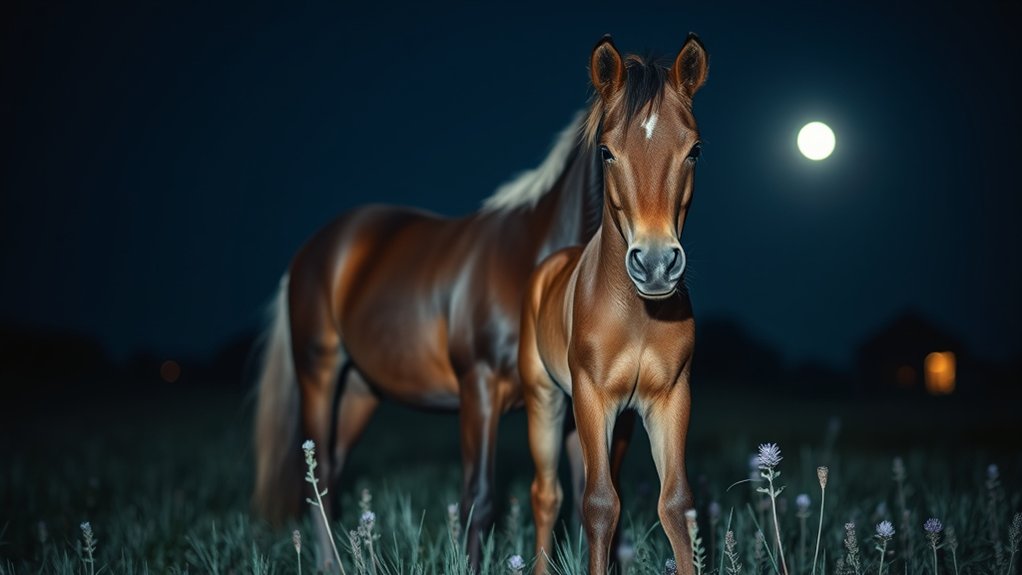
Because horses have dichromatic vision, their ability to perceive colors changes considerably after dark.
In low light, horses primarily see shades of blue and yellow, with yellow being the most clearly perceived color due to their cone cell sensitivity.
Colors like red and green lose definition, appearing as dull shades of gray or brown since horses’ cones don’t detect these hues well in dim environments.
This limited color perception means that during night vision, horses rely less on color cues and more on motion detection and contrast.
Understanding which colors horses see best after dark helps you interpret how they navigate their surroundings and respond to objects in low light conditions, where their color perception narrows to a simpler palette dominated by yellow and blue shades.
How Does Horses’ Wide Field of Vision Affect Their Night Vision?
When you observe a horse at night, its nearly 360-degree field of vision plays an essential role in detecting movement and potential threats from almost every direction. This wide field of vision, dominated by extensive peripheral vision, allows horses to monitor their environment effectively in low-light conditions.
However, the limited binocular zone restricts their ability to use depth perception at night.
The narrow binocular zone hampers horses’ depth perception during nighttime conditions.
Here’s how this affects their night vision:
- The large monocular visual fields enable early detection of movement or obstacles from the sides.
- Peripheral vision helps horses stay alert to threats without needing to move their heads.
- Despite these advantages, impaired depth perception in darkness limits precise distance judgment.
Thus, their wide field of vision enhances awareness but doesn’t fully compensate for depth perception challenges at night.
How Does Limited Depth Perception Affect Horses at Night?
You’ll notice horses have a tougher time with depth perception at night because their binocular vision only covers about 65 to 80 degrees. That limited range makes it harder for them to judge distances accurately when the light is low.
Because of this, they often hesitate or act more cautiously when moving through unfamiliar areas.
At night, horses rely a lot more on monocular cues—basically seeing with one eye at a time—which isn’t as effective for judging depth. This means they’re more likely to misjudge obstacles or run into safety hazards after dark.
Depth Perception Challenges
Although horses possess wide monocular vision, their limited binocular field, ranging from about 65 to 80 degrees, restricts their ability to judge depth accurately at night. This reduced binocular vision impairs depth perception in low-light conditions. It makes obstacle avoidance more challenging.
When you observe a horse shifting from bright to dark environments, you’ll notice temporary disorientation caused by compromised night vision. To compensate, horses rely heavily on their extensive monocular fields. They often move their heads to gather spatial information.
Key challenges include:
- Impaired depth perception increasing the risk of misjudging distances.
- Dependence on head movement to supplement limited binocular vision.
- Greater difficulty in avoiding obstacles due to low-light conditions.
Understanding these challenges highlights why horses may hesitate or stumble during nighttime activity.
Impact on Night Navigation
How exactly does limited depth perception impact a horse’s ability to navigate at night? Horses rely heavily on monocular vision because their binocular vision field is narrow. This means they get less accurate depth cues in low light.
This limitation affects their night vision by making it harder to judge distances and increasing the risk of missteps. When moving from light to darkness, their depth perception adapts slowly, which can cause hesitation.
Environmental adjustments like proper lighting help compensate for these challenges.
| Visual Aspect | Navigation Effect |
|---|---|
| Narrow binocular vision | Limited precise depth cues |
| Wide monocular vision | Broader field, less depth accuracy |
| Low light conditions | Reduced depth perception |
| Slow dark adaptation | Temporary navigation confusion |
Safety Risks and Responses
Since horses have limited depth perception at night, they often misjudge distances, which raises the risk of collisions with obstacles or other animals. Their reduced binocular vision in low light impairs their ability to accurately assess spatial relationships. This can cause hesitation or make them spook near unfamiliar objects.
Moving between lighting levels can further disrupt their vision capabilities, increasing safety risks.
To help you understand these challenges, consider:
- Horses may trip over uneven terrain due to poor depth cues.
- Sudden changes from well-lit to dark areas can confuse their spatial judgment.
- Inadequate lighting increases the chance of collisions with hidden obstacles.
Proper, gradual lighting adjustments reduce these risks, improving a horse’s night navigation and safety.
What Challenges Do Horses Face Moving From Bright to Dark Areas?
When horses move from bright to dark areas, their eyes take about 45 minutes to fully adjust due to the slow dilation of their pupils. During this adjustment, their vision in the dark is temporarily impaired, making it harder to detect obstacles or changes in terrain.
Sudden shifts in light can cause disorientation and hesitation as horses struggle to interpret their surroundings. The tapetum lucidum enhances night vision by reflecting light, but it can also create glare and blurring during rapid changes.
This visual challenge means that horses may appear hesitant or cautious when entering dimly lit environments. Understanding these limitations helps you manage horses safely during night or low-light conditions, minimizing risks linked to their slower visual adjustment from bright to dark areas.
How Does Age Affect a Horse’s Ability to See at Night?
Although horses generally have excellent night vision, their ability to see in low light declines as they age due to decreased retinal sensitivity and a reduction in functioning rod cells. You’ll notice that age-related changes affect their night vision and overall visual performance.
Specifically:
- Older horses take longer to adapt from bright to dark environments because their retinal sensitivity diminishes, slowing pupil size adjustment.
- Visual decline often includes cataracts or smaller pupils, further impairing their ability to detect objects in low light.
- These changes cause increased cautiousness in dim conditions, as their night vision no longer provides the same clarity.
Understanding these age-related changes helps you appreciate the challenges senior horses face orchestrating at night.
Safety Tips for Horses and Handlers in Low Light
Because horses rely heavily on their night vision to navigate safely, ensuring proper lighting and careful handling in low light conditions is essential for preventing accidents. Horses need gradual lighting shifts to avoid disorientation, as abrupt changes can startle them. Even with enhanced night vision, their depth perception suffers in low light, so well-lit paths and stalls are crucial for safety. When handling horses, move slowly and allow time for vision adjustment.
| Tip | Reason | Action |
|---|---|---|
| Gradual lighting changes | Prevent disorientation | Use dimmers or shaded lights |
| Illuminate walkways | Enhance vision in low light | Install low-level, even lighting |
| Avoid sudden movements | Reduce spooking and stress | Approach calmly, speak softly |
| Allow adjustment time | Improve night vision accuracy | Wait 30-45 minutes after dark |
Frequently Asked Questions
Can Horses Recognize Familiar People or Objects at Night?
You can’t rely on horse vision alone for recognizing familiar people or objects at night because their visual acuity drops with limited light.
Their eye structure enhances night adaptation and light sensitivity but slows color perception and detail recognition.
Instead, horses use movement, shape, and scent cues.
Do Horses Rely More on Hearing or Sight in Darkness?
Like a shadow steering twilight, you rely more on your hearing than sight in complete darkness.
Equine vision excels in low light thanks to your eye structure and nighttime adaptations, boosting darkness sensitivity and visual acuity.
However, your color perception dims as rods dominate over cones.
When visual cues falter, your acute hearing takes the lead, guiding you safely through the night’s obscurity with heightened awareness beyond what your eyes alone can achieve.
How Does Weather Affect a Horse’s Night Vision?
You’ll find that weather impacts a horse’s night vision by reducing light sensitivity and visual acuity. Their eye structure, including the tapetum lucidum, enhances night adaptation.
But fog, rain, or snow scatter light, lowering contrast and blurring color perception.
Moisture can cause glare, hindering their ability to detect obstacles. So, adverse weather diminishes how effectively horses see in darkness despite their specialized eyes designed for low-light conditions.
Are Some Horse Breeds Better at Seeing in the Dark?
You might think some horse breeds see better in the dark, but equine eye structure is pretty consistent across breeds, showing little visual acuity differences tied to breed.
Night vision evolution gave horses tapetum lucidum and high rod ratios, enhancing light sensitivity variations equally.
Color perception limits aren’t breed-dependent, and eye health considerations play a bigger role.
Can Horses See Stars or Moonlight Clearly at Night?
You won’t see horses perceiving star visibility clearly at night because their night vision adaptation favors detecting larger, moving objects over pinpoint lights.
Their moonlight vision lets them navigate dimly lit environments with enhanced darkness sensitivity, but they interpret moonlight as a bluish-gray glow rather than sharp illumination.
Thanks to their twilight perception and nocturnal behavior, horses efficiently move through low light, though stars and moonlight lack the clarity you might expect.
Conclusion
When night falls, your horse’s eyes transform into natural night-vision devices, thanks to the tapetum lucidum reflecting faint light. Though their vision sharpens in dim settings, their slower dark adaptation and limited depth perception can make shadows tricky puzzles.
Like a quiet guardian, understanding these nocturnal nuances helps you guide and protect your horse safely through darkness, making every evening ride a well-lit journey despite the night’s subtle challenges.