Does Riding a Horse Burn Calories?
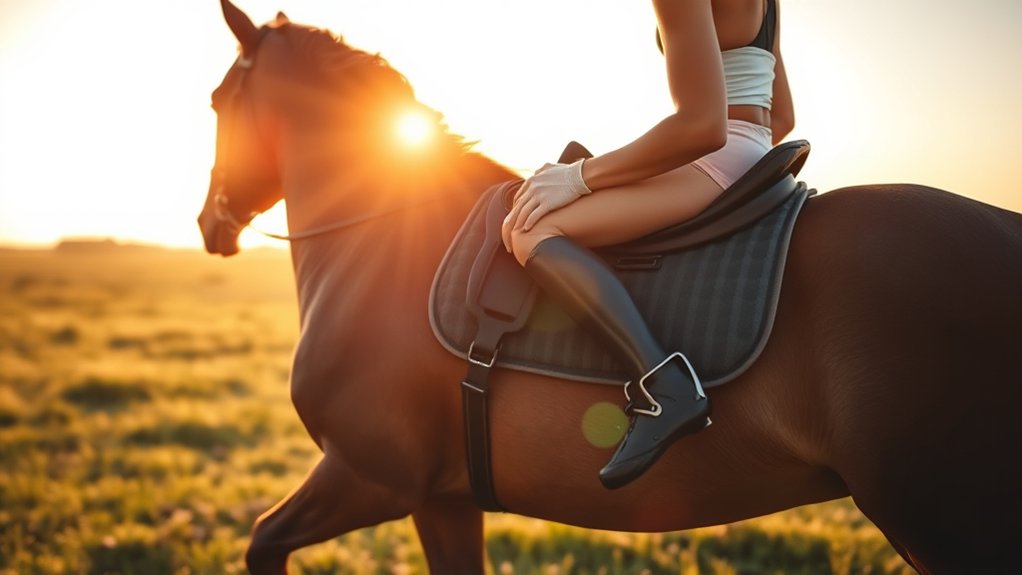
Yes, riding a horse burns calories by engaging multiple muscle groups and elevating your heart rate. Depending on your weight, riding intensity, and style, you can burn between 200 and 550 calories per hour.
Activities like trotting and jumping increase caloric expenditure, while barn chores and preparation also contribute markedly. This dynamic exercise improves cardiovascular fitness, muscle tone, and posture, making it a full-body workout.
Exploring these factors further reveals how you can optimize your calorie burn and fitness gains.
How Many Calories Does Horseback Riding Burn on Average?
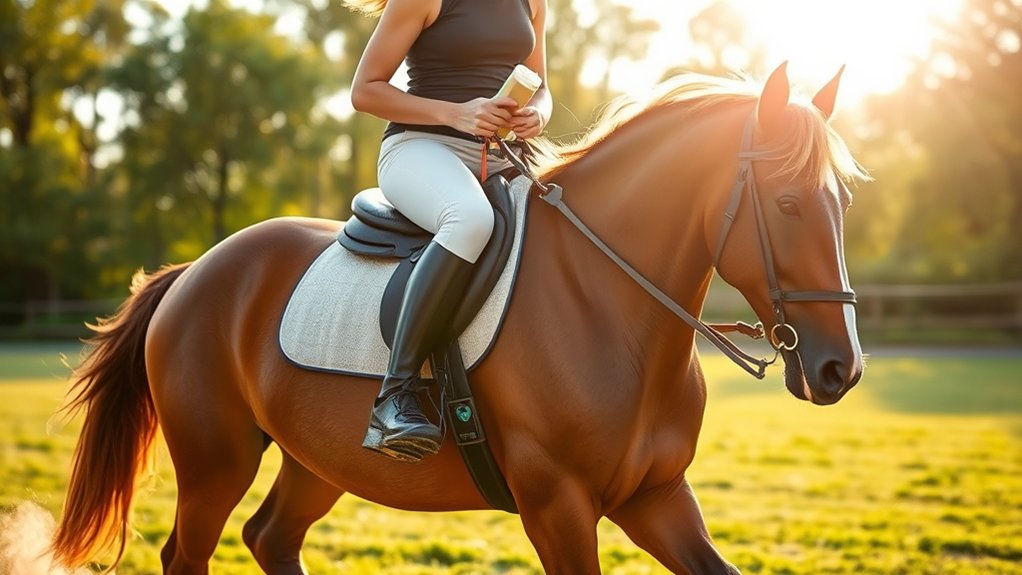
Horseback riding typically burns between 200 and 300 calories per hour, depending on factors like your weight, riding speed, and intensity.
Horseback riding burns 200 to 300 calories per hour, influenced by weight, speed, and intensity.
On average, engaging in basic horseback riding activities, such as walking the horse at a slow pace, will expend calories closer to the lower end of this range.
If you increase your activity level to trotting or jumping, you can burn considerably more calories, up to approximately 550 calories per hour.
It’s important to recognize that these figures represent general averages, as individual calorie expenditure varies.
Moreover, calorie burn occurs not only during active riding but also through preparatory tasks like grooming.
Understanding the average calories burned through horseback riding provides a foundation for evaluating its effectiveness as a physical activity.
Which Factors Affect Calories Burned Riding a Horse?
Although the number of calories you burn while riding varies widely, several key factors determine your overall energy expenditure. Your weight plays a significant role. Heavier riders typically burn more calories during identical riding sessions.
The intensity and gait of your ride, such as walking versus galloping, directly influence calories burned. More vigorous activities demand greater energy.
Duration also matters; longer rides naturally increase total calorie expenditure.
Furthermore, preparatory tasks like grooming and tacking up contribute to your overall calories burned before mounting.
Finally, your individual effort and body composition can cause variations in calorie burn, even during similar riding activities.
Understanding these factors helps you better estimate your energy output and tailor your riding regimen accordingly.
How Different Riding Styles Change Your Calorie Burn

When you choose different riding styles, your calorie burn changes considerably due to variations in intensity and muscle engagement.
For example, dressage riding burns about 450 calories per hour, emphasizing control and core muscles.
Jumping and faster gaits like canter or gallop burn up to 550 calories an hour because the vigorous, aerobic movements increase physical activity notably.
Trotting burns around 400 calories per hour, offering moderate intensity.
While a leisurely walk burns the least, approximately 250 calories per hour.
Thus, the amount of calories burned during horseback riding depends directly on how active your ride is.
Even though sitting still on a horse burns calories, a more intense horseback ride burns a lot of calories, maximizing the health benefits of horseback riding and improving overall fitness per hour.
How Preparation Adds to Your Total Calories Burned
Before you even get on your horse, grooming and saddling it work several muscle groups and get your heart rate up. This means you’re already burning calories even before the ride begins.
Depending on how long and how hard you work, these prep activities can burn over 100 calories.
Grooming And Saddling
Since grooming and saddling involve various physical tasks, you can substantially increase your total calorie burn even before mounting the horse. Brushing, tacking up, and adjusting the saddle engage muscles in your arms, shoulders, and back, contributing to energy expenditure.
These activities can burn roughly 50 to 100 calories per session, depending on intensity and duration. Moreover, moving around the barn, lifting equipment, and preparing the horse add to your physical activity.
The cumulative effect of these tasks becomes significant, especially when combined with the calories burned during riding.
Consequently, grooming and saddling are important components in the overall energy output of equestrian activity, enhancing total calorie expenditure beyond the ride itself.
Energy From Preparations
Grooming and saddling set the stage for a ride, but the energy you expend during all preparation activities considerably contributes to your total calorie burn. Preparation workouts, including dressing appropriately and warming up, can burn over 100 calories depending on intensity.
Tasks such as pulling ropes, lifting saddle equipment, and adjusting tack engage multiple muscle groups, increasing energy expenditure before mounting. Researchers estimate that preparation activities can account for nearly half of the total calories burned in a riding session.
Furthermore, physically demanding preparations like cleaning stalls or hauling equipment amplify this effect. By recognizing the substantial caloric cost of these activities, you can better appreciate how preparation workouts integrate into your overall energy output during a horse riding experience.
How Horseback Riding Builds Muscle and Core Strength
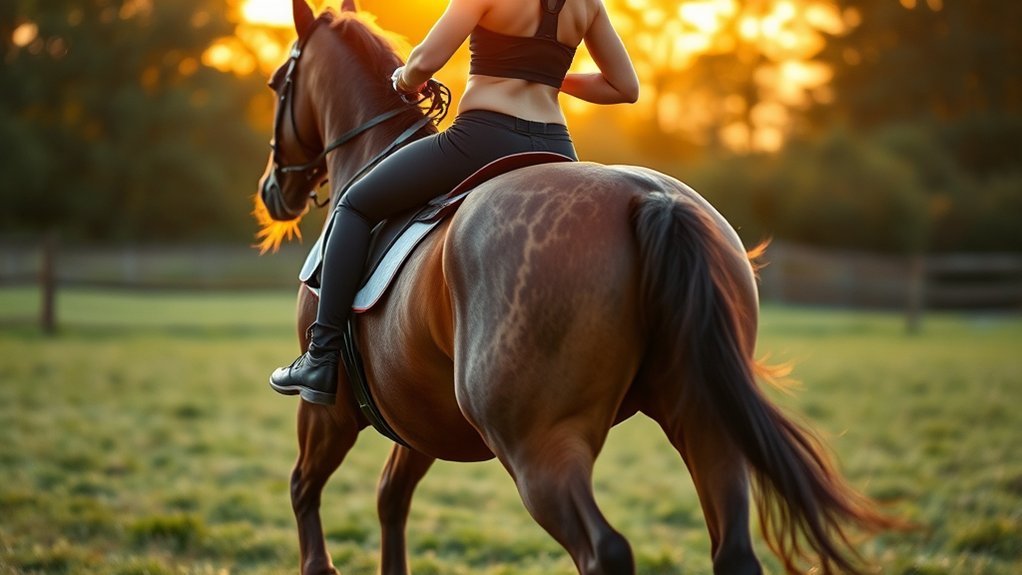
When you ride a horse, your core muscles are working nonstop to help you stay balanced and steady. This constant engagement really helps strengthen your abs and lower back.
Plus, you’re not just using your core — your upper body, legs, and hips get involved too, as you guide the horse and keep good posture.
Core Muscle Engagement
Although horseback riding may seem passive, it demands constant engagement of your core muscles to maintain balance and stability on a moving horse. This core engagement is essential for controlling posture and preventing falls during different gaits.
When you ride, you:
- Activate abdominal and lower back muscles to stabilize your torso.
- Flex and contract your core muscles continuously, sculpting and strengthening your midsection.
- Enhance neuromuscular coordination by balancing and adjusting to the horse’s movements.
Research indicates that consistent horseback riding improves core strength comparably to targeted core exercises.
By maintaining proper riding technique, you not only support the horse’s motion but also build muscular endurance and tone your core efficiently.
This precise, ongoing muscle activation makes horseback riding a valuable activity for core development.
Full-Body Muscle Activation
Building on the significant core engagement required in horseback riding, the activity also recruits multiple muscle groups across your body to maintain control and balance. This full-body muscle engagement involves your arms, legs, back, and stabilizer muscles. These muscles contract continuously to adapt to the horse’s movements.
Over time, this develops muscle toning, improves neuromuscular coordination, and strengthens your lower back and legs. It also enhances muscular endurance.
| Muscle Group | Primary Function | Effect of Riding |
|---|---|---|
| Core | Stability & balance | Enhances abdominal strength |
| Legs | Control & grip | Builds muscle endurance |
| Back | Postural support | Strengthens lower back |
| Arms | Reins control | Improves upper body strength |
| Stabilizers | Balance adjustment | Continuous contraction |
This extensive muscle engagement makes horseback riding an effective workout for muscular fitness.
Posture and Stability
Since horseback riding demands that you maintain an upright posture, your core muscles remain constantly engaged to keep you balanced on the saddle. This engagement promotes posture stability by activating key muscle groups through continuous micro-adjustments.
Specifically, horseback riding:
- Strengthens abdominal and lower back muscles as you compensate for the horse’s movements, enhancing core stability.
- Improves neuromuscular coordination, reinforcing proper posture habits both on and off the horse.
- Enhances overall muscle tone in postural muscles, reducing the risk of back pain through increased stability.
Scientific research supports that regular riding builds muscle and core strength by demanding precise control and balance.
Can Barn Chores Count as Horse-Related Exercise?
When you engage in barn chores like mucking out stalls or pushing a wheelbarrow full of manure, you activate multiple muscle groups and elevate your heart rate. This results in calorie burns comparable to high-intensity workouts such as CrossFit.
Barn chores demand significant energy expenditure. For example, lifting hay bales and pulling on ropes engage your upper body muscles, while continuous movement enhances endurance.
The combination of strength and functional movements inherent in these tasks leads to efficient calorie burning and muscle toning.
By regularly performing barn chores, you incorporate a form of exercise that stimulates both muscular and cardiovascular systems without requiring gym equipment.
How Horseback Riding Boosts Cardiovascular Fitness
When you ride a horse at a moderate pace, your heart rate goes up, giving you cardiovascular benefits similar to brisk walking or light jogging. It’s pretty interesting how just riding can get your heart pumping like that.
The intensity of your ride really matters too—trotting or cantering will boost your cardiovascular endurance even more. So, the harder you go, the better your heart gets at handling the workout.
Cardiovascular Benefits Explained
Although horseback riding may seem leisurely, it effectively elevates your heart rate and stimulates cardiovascular function. This activity parallels brisk walking or light jogging in its aerobic benefits. Understanding how this works can enhance your appreciation of horse nutrition, as both rider and horse require ideal energy management.
Here’s how horseback riding improves your cardiovascular fitness:
- Sustained moderate riding for 45 minutes burns about 200 calories, supporting heart and lung efficiency.
- The balance and continuous movement involved engage aerobic pathways, improving circulation and endurance.
- Regular sessions progressively boost cardiovascular capacity, reducing risks of heart-related conditions.
Riding Intensity Effects
Increasing the intensity of horseback riding, from walking to trotting or cantering, dramatically raises your calorie burn and cardiovascular workload. By elevating your riding pace, you engage more muscle groups continuously, which increases heart rate and aerobic capacity.
This intensified effort can burn up to 550 calories per hour, depending on your weight and activity level. Your riding technique also plays a vital role; maintaining proper posture and control optimizes muscle engagement and cardiovascular stimulation.
Scientific studies confirm that vigorous horseback riding delivers cardiovascular benefits comparable to other moderate-to-high intensity aerobic exercises.
Heart Health Improvement
How does horseback riding contribute to improving your heart health? Riding at a moderate pace elevates your heart rate, offering cardiovascular benefits comparable to brisk walking. Incorporating activities like trotting and cantering further intensifies this effect, enhancing heart efficiency and endurance.
Here’s how horseback riding boosts your cardiovascular fitness:
- Regular riding sessions improve blood circulation and strengthen your cardiovascular system, reducing heart disease risk.
- The physical effort of managing a horse, including maintaining balance and controlling movements, engages multiple muscle groups, improving overall heart function.
- Sustained riding positively influences lipid profiles and lowers blood pressure, contributing to better heart health.
While focusing on your horse’s diet guarantees peak performance, your cardiovascular fitness also benefits considerably from consistent horseback riding routines.
What Makes Horse Riding a Full-Body Workout
Because horseback riding requires you to engage multiple muscle groups simultaneously, it serves as a complete full-body workout. Your arms and hands control the reins, activating upper body muscles, while your legs maintain grip and balance.
Core and stabilizer muscles continuously engage to keep posture steady on the moving horse. Adjusting pace through different gaits like trotting or cantering demands increased muscular coordination and effort.
Furthermore, mounting, dismounting, and maneuvering the horse contribute to overall physical exertion. Understanding horse breeding enhances your ability to anticipate movement patterns, improving your muscular response and control.
This complex interaction between rider and horse creates a dynamic environment where your entire body works in synergy, making horseback riding an effective full-body exercise beyond simple calorie burning.
How Rider Weight and Ride Duration Influence Calories Burned
The physical demands of horseback riding vary considerably based on rider weight and ride duration, directly influencing calorie expenditure. Understanding these Weight Factors helps you estimate energy use more accurately.
Heavier riders burn more calories since calorie expenditure correlates directly with body weight. For example, a 200-pound rider burns roughly 300-400 calories per hour, compared to 200-300 calories for a 150-pound rider.
Calorie burn increases with rider weight—heavier riders expend more energy per hour horseback riding.
Ride duration substantially affects total calories burned. Doubling the ride time from one to two hours approximately doubles energy expenditure.
The intensity of the ride combined with Weight Factors further modifies calorie burn, especially during trotting or cantering.
How to Maximize Calorie Burn and Muscle Gain From Horseback Riding
Although horseback riding naturally burns calories, you can substantially increase its effectiveness by adjusting your riding intensity and incorporating targeted muscle engagement. Shift from walking to trotting or cantering to boost calorie burn, and maintain core engagement and proper posture to maximize muscle activation.
Supplement riding with barn chores for added resistance training. Don’t neglect horse nutrition; a well-fed horse supports your performance and safety. Below is a concise guide:
| Activity | Calorie Burn (cal/hr) | Muscle Focus |
|---|---|---|
| Trotting/Cantering | 300-400 | Core, legs, back |
| Jumping | Up to 550 | Core, legs, arms |
| Barn chores | 200-350 | Full body, strength |
Vary intensities and disciplines regularly to avoid plateaus and promote balanced muscle gain.
Frequently Asked Questions
What Type of Horse Is Best for Calorie-Burning Rides?
If you want to maximize calorie burn, choose a horse breed known for energy and agility, like Thoroughbreds or Arabians. These breeds demand more physical effort because of their spirited nature and high activity levels.
Riding larger breeds, such as warmbloods or draft crosses, also increases your exertion since controlling them requires strength.
Match the horse breed to your skill level to ensure an efficient, safe workout that challenges your body effectively.
Does Horseback Riding Help With Mental Health?
Absolutely, horseback riding dramatically boosts your emotional well-being! When you ride, your brain floods with endorphins, sharply reducing stress and anxiety.
You engage in mindful movement, which enhances relaxation and mental clarity.
Plus, bonding with your horse fosters companionship, strengthening your emotional resilience.
Scientific studies confirm that regular riding sessions decrease symptoms of mental health disorders, improve confidence, and promote overall emotional balance.
How Does Riding Frequency Affect Long-Term Fitness?
Your riding frequency directly influences long-term fitness by enhancing muscle endurance and cardiovascular health. Riding three to five times weekly strengthens core, leg, and back muscles, improving posture and strength.
Weather conditions can affect your ability to maintain this schedule, potentially disrupting consistency. But adapting to varying weather helps sustain habit formation and calorie expenditure, which speeds up weight management and fat loss.
Regular riding under diverse conditions optimizes sustained physical activity and fitness gains.
Are There Specific Diets Recommended for Riders?
You won’t find universal dietary guidelines specifically for riders, but maintaining a balanced diet rich in protein, healthy fats, and complex carbohydrates supports your energy and muscle recovery.
Proper hydration is essential to sustain stamina during riding.
To optimize performance, especially in competitive disciplines, you might follow sport-specific nutrition plans.
Consulting a sports nutritionist can help tailor your dietary guidelines to match your riding intensity and energy expenditure precisely.
Can Horseback Riding Improve Balance and Coordination?
Like a tightrope walker adjusting with every step, you improve balance and coordination through horseback riding. This activity demands continuous core engagement and neuromuscular control, refining your proprioception.
By adapting your posture and weight distribution, you develop stability essential for riding success.
Integrating equine nutrition knowledge supports both rider and horse performance, ensuring peak energy for these precise movements that enhance your overall physical control and coordination scientifically.
Conclusion
You might not realize it, but riding a horse can burn calories much like other moderate exercises. It coincidentally combines muscle building, core strengthening, and cardiovascular benefits all at once.
Your calorie burn depends on your weight, riding style, and ride duration. So optimizing these factors boosts your total expenditure. By preparing properly and engaging fully, you turn horseback riding into a precise, efficient full-body workout that consistently challenges your fitness and metabolism.