How Many Bales of Hay Per Horse?
You’ll need about two small square bales per horse every ten days, assuming each bale weighs 50-60 lbs and the horse consumes roughly 2% of its body weight in hay daily. Adjust amounts based on horse size, activity, and bale weight, adding 5-10% extra for waste.
For multiple horses or seasonal feeding, multiply accordingly and plan for proper storage to minimize loss. Understanding these factors helps you manage hay efficiently and cost-effectively.
How Much Hay Does One Horse Need Daily?
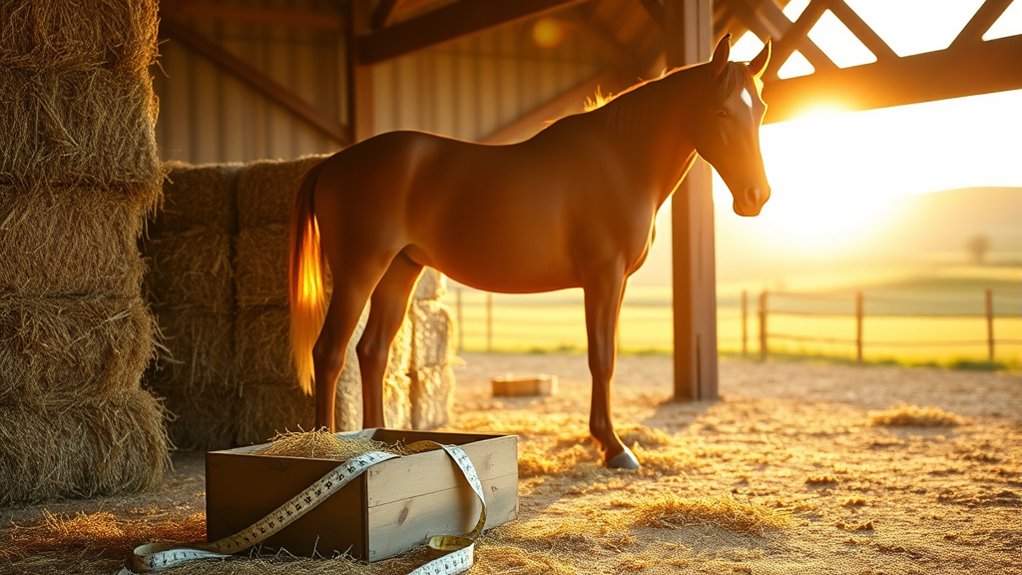
Although individual needs vary, a horse weighing around 1,100 pounds typically requires 12 to 14 pounds of hay daily, which is about 2% of its body weight. This amount guarantees adequate fiber intake essential for digestive health and energy maintenance.
In the wild, horses graze up to 16 hours daily, consuming forage steadily to meet nutritional demands. For domestic horses, hay serves as the primary forage substitute.
A standard 60-pound hay bale can supply approximately five days of feed for one horse at this intake level.
Keep in mind, factors such as age, activity level, and body condition influence the specific hay requirement, but 1.5% to 2.5% of body weight in hay is the typical range for most horses to maintain the best health.
How to Adjust Hay Amounts Based on Your Horse’s Weight
When you adjust hay amounts based on your horse’s weight, you guarantee they receive the right nutrition to maintain health and performance. Typically, horses require about 2% of their body weight in hay intake daily. However, adjusting hay amounts is essential.
Adjust hay amounts by your horse’s weight to ensure proper nutrition and optimal health.
Overweight horses need less than 2%, while lighter or growing horses may require up to 2.5%. To do this precisely, use accurate weight estimation methods like measuring heart girth and body length or employing a weight tape.
For example, a 1,000-pound horse generally needs 20-25 pounds of hay daily for maintenance. By tailoring hay intake according to weight, feeding goals, and activity level, you prevent overfeeding or underfeeding.
This supports ideal health and effective nutrition management.
How to Convert Daily Hay Intake Into Bales Per Horse
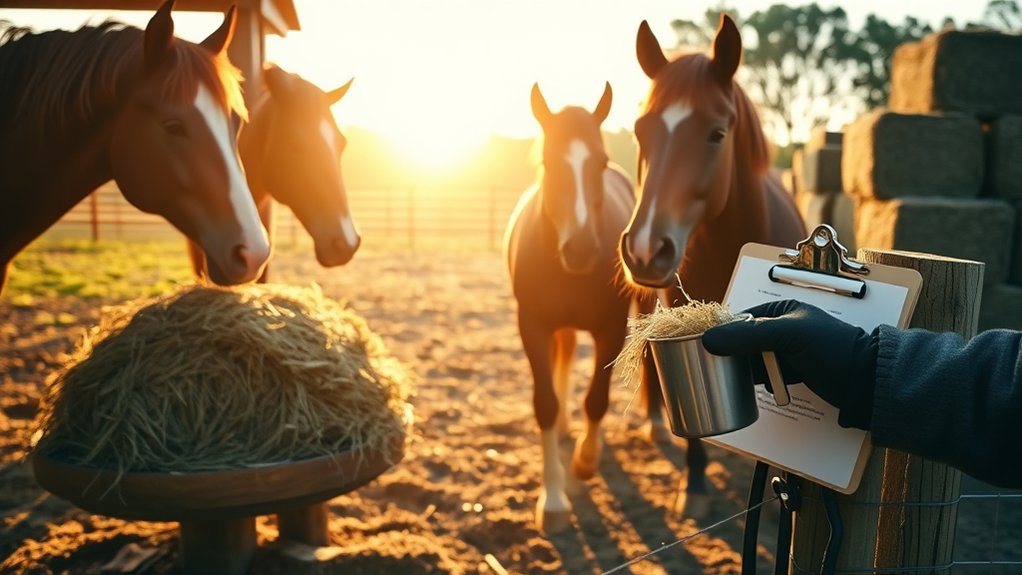
To figure out how many bales of hay your horse will need each day, first find out exactly how many pounds of hay your horse eats daily.
Once you have that number, check the weight of one bale.
Then, you can easily calculate how many bales you’ll need to cover your feeding period, usually a year.
This way, you get a reliable estimate of the total bales required based on how much your horse eats and the size of the bales.
Daily Hay Intake
Since an average adult horse weighing around 1,100 pounds consumes about 12 to 15 pounds of hay daily, you can estimate feed requirements by calculating 2% to 2.5% of the horse’s body weight.
Accurately evaluating daily hay intake is essential for efficient feeding plans.
To convert this into bales per horse, consider the typical weight of a hay bale and factor in hay waste, which can considerably affect total consumption.
Hay waste occurs during feeding and storage, so accounting for it ensures you don’t underestimate your supply needs.
By multiplying the daily hay intake by the number of feeding days and adjusting for expected hay waste, you can determine the total hay required.
This precise calculation helps prevent shortages and optimizes your hay inventory management.
Bale Weight Estimates
Although calculating daily hay intake provides a good starting point, converting that figure into the number of bales needed requires careful attention to bale weight variations. To perform an accurate hay calculation, you divide the total hay required in pounds by the bale weight.
For example, a 1,100-pound horse consuming 12 pounds daily needs 4,380 pounds annually. Dividing this by a 60-pound bale equals 73 bales per year.
Keep in mind bale weights vary widely: small square bales typically weigh 50 to 60 pounds, whereas round bales range from 900 to 1,200 pounds.
Using precise bale weight estimates in your hay calculation guarantees you procure the correct number of bales, preventing shortages or excess during feeding periods. Always verify bale weight for accurate planning.
Feeding Duration Calculation
When calculating how many bales of hay you’ll need for a specific feeding period, start by determining your horse’s daily hay intake as a percentage of its body weight, typically around 2%. Multiply this daily intake by the total feeding days to find the total hay required.
Adjust for hay waste by increasing the total by 5-10%. Finally, divide the adjusted total by the bale weight to estimate the number of bales necessary. This method guarantees precise feeding quantities while accounting for unavoidable loss.
| Step | Calculation Example |
|---|---|
| Body weight | 1,000 lbs |
| Daily intake (2%) | 20 lbs |
| Feeding duration | 100 days |
| Total hay (without waste) | 2,000 lbs |
| Adjusted total (10% waste) | 2,200 lbs |
Use this calculation to optimize hay feeding and minimize waste.
How to Figure Out Hay Needs for Several Horses
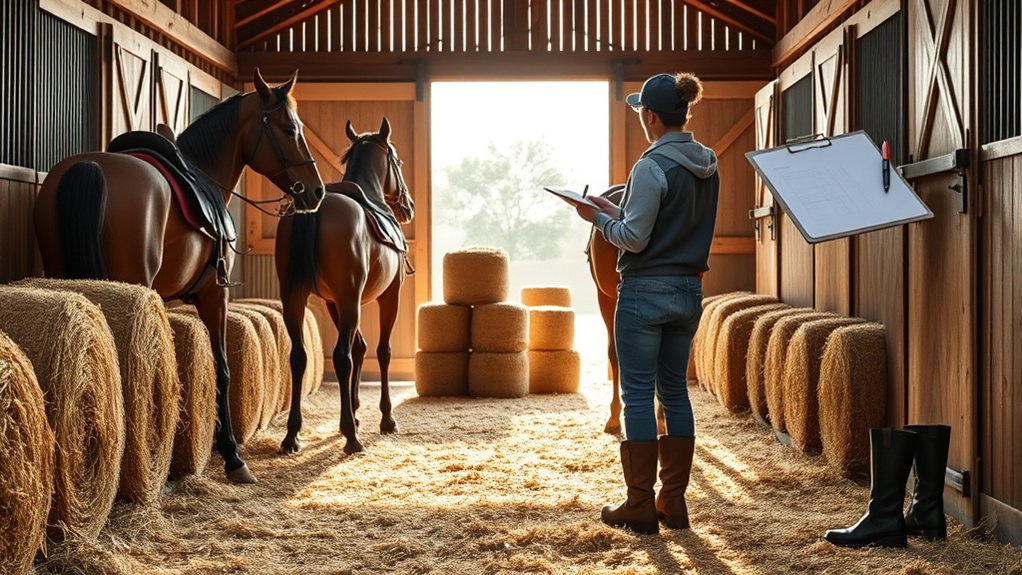
To accurately determine how much hay you’ll need for multiple horses, start by understanding that hay consumption scales directly with the number of animals.
Determining hay needs begins with knowing that consumption increases proportionally with each additional horse.
You can calculate how much hay is required by using a standard ratio. Typically, each horse consumes about 2 bales every ten days.
Multiply the number of horses by 2 to get the total bales needed per ten-day period.
Then, multiply that result by the total number of ten-day periods in your feeding schedule.
For example, 4 horses require 8 bales every ten days.
If you plan for 30 days, multiply 8 bales by 3 (three ten-day periods), totaling 24 bales.
Accurately calculating hay needs this way guarantees you provide an adequate supply for all horses without shortages or excess waste.
Planning Your Horse’s Winter Hay Supply Effectively
Since winter feeding demands increase, you’ll need to plan your horse’s hay supply carefully to guarantee consistent nutrition throughout the season.
A 1,000-pound horse requires about 20 pounds of hay daily, totaling roughly 2,668 pounds for 121 days when factoring in waste. To estimate bales, divide total hay needed by bale weight, typically 40 pounds per bale, covering two days.
Consider buying extra hay to prevent shortages.
Key planning points include:
- Calculate total hay needed based on horse weight and days
- Factor in 5-10% extra hay for waste and emergencies
- Know your bale weight to convert pounds to bales accurately
- Store hay properly to minimize spoilage
- Monitor consumption regularly and adjust supplies accordingly
This approach ensures your horse has sufficient hay bales for a consistent winter diet.
How Horse Hay Feeding Methods Affect Waste and Intake
You’ll notice there are big differences in hay waste depending on how you feed your horse. If you don’t use any feeders, waste can easily hit 13% or even more.
But when you use slow feeders or slat feeders, that waste drops a lot—sometimes down to just 1-5%.
On top of that, round-bale feeders that are managed well can also keep waste low. They don’t just reduce waste; they help control how much your horse eats, which makes feeding more efficient and can save you money in the long run.
Feeding Techniques Impact Waste
Although many horse owners overlook feeding methods, the way you present hay markedly affects both waste and intake. Effective feeding techniques can drastically reduce hay waste, optimizing your forage investment.
Using slow feeders or hay racks with small mesh controls how much hay your horse grabs, cutting waste by up to 80%.
Round-bale feeders that limit access reduce hay waste from 57% down to as low as 5-33%. Conversely, feeding hay in open areas without proper equipment often leads to over 13% waste, increasing costs.
- Slow feeders control intake, minimizing spillage
- Small mesh feeders limit large mouthfuls
- Round-bale feeders restrict access, reducing trampling
- Open-area feeding causes considerable hay waste
- Proper feeders can reduce hay waste to 1-5%
Implementing these feeding techniques notably lowers hay waste.
Intake Variations By Method
When you select a feeding method, it directly influences both how much hay your horse consumes and how much is wasted. Feeding methods like no feeders or slat feeders result in about 2.2-2.4% hay waste, with intake percentages matching that range.
Using feeders markedly reduces hay waste, especially for round bales, where waste drops from over 50% without feeders to 5-33% with restricted access feeders.
Small square bales fed in baskets or hayracks maintain low hay waste around 2.2-2.4%, with hay intake at roughly 2.2-2.4% of body weight.
Proper feeding methods ensure minimal hay waste and consistent intake near 2.3-2.4% of body weight, optimizing forage delivery and reducing resource loss.
Selecting appropriate feeders is vital for efficient hay management.
How Hay Storage and Waste Influence Total Hay Needed
Since hay waste can vary dramatically depending on storage conditions, you need to account for potential losses when calculating total hay requirements. Different storage methods directly impact hay waste, influencing how much hay you’ll actually need to supply your horses reliably.
Outdoor storage can lead to 5-35% waste due to environmental exposure, while indoor storage reduces waste by about two-thirds.
To minimize hay waste and optimize storage methods, consider:
- Using dry, covered, and well-ventilated areas
- Avoiding exposure to rain, snow, and humidity
- Regularly inspecting hay for spoilage
- Storing hay off the ground to prevent moisture absorption
- Choosing storage locations with minimal temperature fluctuations
Factoring in storage-induced hay waste guarantees you purchase adequate hay without costly shortages.
Choosing the Right Hay Bale Size for Your Horse
Accounting for hay storage and waste is only part of managing your horse’s feeding needs; selecting the right bale size plays a significant role in efficiency and cost-effectiveness. Small square bales, typically weighing 50-60 pounds, suit individual feeding and smaller operations well.
For example, a 60-pound small square bale feeds a 1,100-pound horse consuming 12 pounds daily for about five days, reducing hay waste through controlled portions.
Conversely, larger round bales, weighing 900-1,200 pounds, offer cost advantages and reduce labor but require specialized feeders and handling equipment to minimize hay waste.
Your choice should factor in your feeding system, storage capacity, and herd size. Using appropriate bale sizes tailored to your situation helps optimize feed utilization and limits unnecessary hay waste, ensuring effective and economical feeding management.
How to Estimate Hay Costs Based on Bales Per Horse
To estimate hay costs accurately, start by figuring out how many bales your horse will need each day based on its intake.
Then, think about how long you’ll be feeding that amount.
Once you have the total number of bales, multiply that by the price of each bale to get your overall cost.
It’s a good idea to update these numbers regularly.
That way, you can keep your hay budget on track and avoid running out or spending too much.
Calculating Bale Quantity
Calculating the number of hay bales needed per horse starts with determining their total hay consumption over the feeding period. You’ll multiply the horse’s daily intake by the number of feeding days to get total hay weight.
Then, divide that total by the weight of one bale to estimate the bales per horse. Don’t forget to factor in hay waste, which can considerably increase your required quantity.
Multiply daily intake (e.g., 20 lbs) by feeding days for total hay weight.
Divide total weight by bale weight (e.g., 40 lbs) for bales per horse.
Use known bale ratios (e.g., 2 bales for 4 horses per 10 days) to scale.
Add 5%-40% extra bales to cover hay waste.
Adjust calculations based on storage and feeding methods to refine estimates.
Cost Per Bale
Once you’ve determined how many bales a horse requires, you can estimate the total hay cost by multiplying that number by the price per bale. To do this precisely, factor in bale weight and hay waste, as both impact the total quantity needed.
Bulk purchases or larger bales often reduce the cost per bale, lowering your overall expenses. Here’s a quick reference:
| Bale Weight (lbs) | Price per Bale ($) | Adjusted Cost per Bale* ($) |
|---|---|---|
| 40 | 6 | 6.30 |
| 50 | 7 | 7.35 |
| 60 | 8 | 8.40 |
| 50 | 6.50 | 6.83 |
| 60 | 7.50 | 7.88 |
*Includes 5% hay waste adjustment. Use this to refine your cost per bale estimate.
Budgeting Hay Expenses
Although estimating hay expenses may seem complex at first, you can simplify the process by determining the total hay weight required per horse for the feeding period and dividing that by the bale weight.
For example, if each horse needs 2,668 pounds of hay over winter and each bale weighs 40 pounds, you’ll need about 67 bales per horse.
To budget accurately, consider these factors:
- Calculate total bales by multiplying per-horse bales by the number of horses.
- Include 5-10% extra bales to account for hay waste.
- Adjust for feeding small horses, which require less hay.
- Use current cost per bale to estimate total expenses.
- Monitor hay waste regularly to refine future budgets.
This approach guarantees you account for hay waste and feeding small horses while keeping costs precise.
How to Reduce Hay Waste and Stretch Your Hay Supply
When you implement effective feeding and storage practices, you can considerably reduce hay waste and extend your hay supply. Using hay feeders can cut waste from 13-57% to 1-33%. Storing hay indoors prevents 35-40% weather-related spoilage.
Regular hay quality checks help avoid overfeeding and unnecessary hay waste. Feeding smaller portions more frequently and using small square bales minimize trampling and scattering.
| Strategy | Impact on Hay Waste |
|---|---|
| Hay feeders/racks | Reduces waste to 1-33% |
| Indoor storage | Minimizes 35-40% spoilage |
| Hay quality analysis | Prevents overfeeding waste |
| Small square bales | Limits trampling/scattering |
| Controlled feeding times | Stretches supply, reduces waste |
Adopting these techniques helps you reduce hay waste and stretch your available hay efficiently.
Frequently Asked Questions
What Types of Hay Are Best for Different Horse Breeds?
You’ll find hay preferences vary by horse breed. For most breeds, high-quality grass hay like Timothy suits balanced fiber needs.
If your horse is prone to obesity, you’ll want low-calorie oat or wheat straw.
Performance breeds benefit from nutrient-rich alfalfa to meet protein demands, while draft breeds need mature, coarse hay for digestion.
Young horses require softer, digestible hay such as young Timothy or alfalfa to support growth effectively.
How Does Hay Quality Affect a Horse’s Nutrition?
You might think feeding moldy, nutrient-poor hay is a gourmet choice if you adore vet bills. Hay nutrient quality directly impacts your horse’s digestion, weight, and energy.
Low-quality hay means less digestible fiber and essential vitamins, forcing you to increase feeding frequency to meet dietary needs.
To keep your horse healthy and performing well, always select high-quality hay rich in nutrients and adjust feeding frequency based on hay’s nutritional content.
Can Horses Eat Hay Year-Round Without Grain Supplements?
Yes, you can feed horses hay year-round without grain supplements if the forage meets their fiber and nutrient needs. Proper hay storage is vital to preserve quality and prevent nutrient loss.
You’ll need to monitor nutritional supplements carefully to avoid deficiencies, especially minerals and vitamins not abundant in hay alone.
Make sure the hay provides around 2% of their body weight daily, adjusting for activity level to maintain excellent health and digestion.
What Are Signs a Horse Is Not Getting Enough Hay?
You’ll notice your horse showing signs like weight loss around ribs and hips, a dull coat, low energy, and a swollen abdomen if it’s not getting enough hay.
Manure becomes small, dry, and infrequent, indicating poor fiber intake.
Insufficient hay can also affect horse hydration, causing digestive issues.
Avoid hay mold risks, as mold can worsen health problems.
Watch for cribbing or stall walking, which are behavioral signs of hunger and inadequate forage.
How Does Weather Affect Hay Storage Requirements?
Weather directly impacts your hay storage requirements by influencing hay moisture levels and storage conditions. Increased rain or snow raises hay moisture, promoting spoilage and mold if not properly stored.
You’ll need to prioritize weatherproof storage to reduce exposure and prevent waste. Outdoor storage without cover can cause over 35% loss.
Adjust your storage methods seasonally to maintain ideal hay quality, ensuring stable feed and minimizing deterioration caused by fluctuating environmental moisture.
Conclusion
Now that you know exactly how much hay your horse needs daily and how to convert that into bales, you’re almost ready to plan perfectly. But here’s the twist: storage conditions and waste can drastically change your total hay requirements.
Don’t overlook these factors, or you could run short when it matters most. Master these details, and you’ll guarantee your horse stays well-fed, your hay lasts longer, and your costs stay under control, no surprises.