Why Do Horses Clack?
When your horse clacks its teeth, it’s using this sharp, rhythmic sound as a social signal to communicate emotions like calm, submission, or excitement. You’ll notice clacking often during grooming or anticipation of food, signaling contentment or mild stress.
It differs from slow chewing or licking and can also indicate discomfort, especially if paired with tense body language. Understanding these subtle cues helps you respond appropriately. And there’s more to discover about this intricate behavior.
Defining Clacking in Horse Behavior
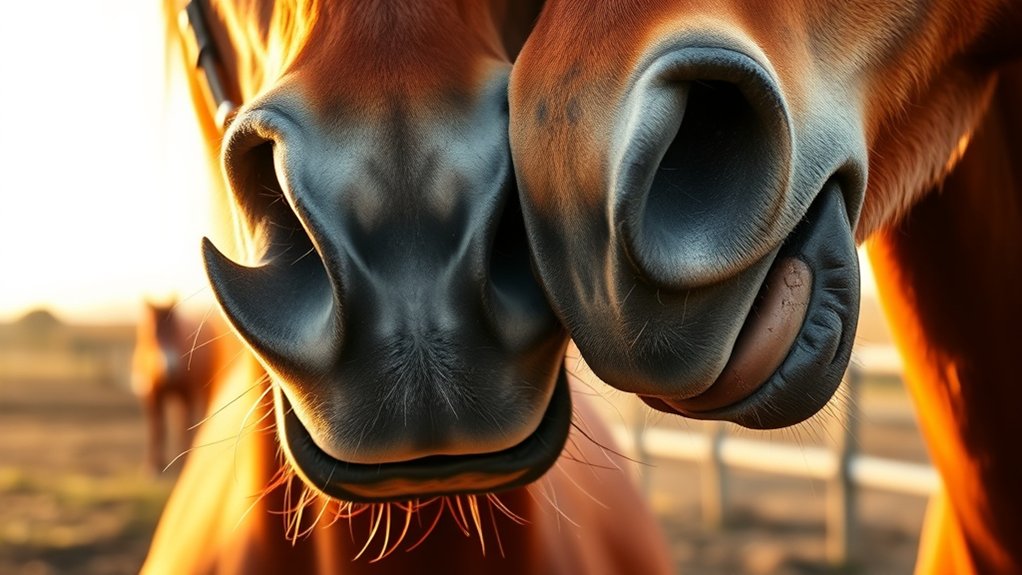
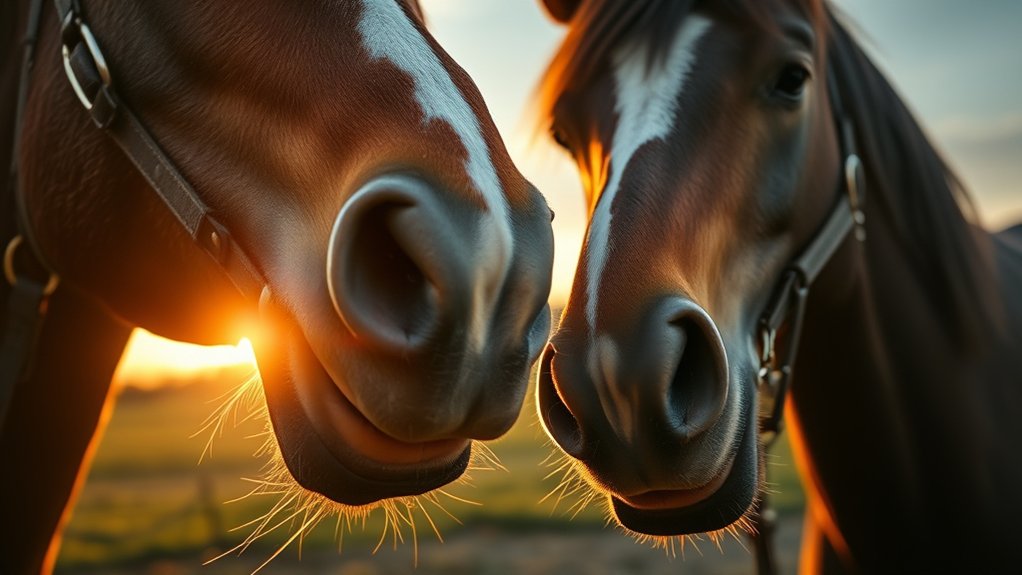
Although you might initially think clacking is just a random noise, it actually refers to specific sounds horses make by grinding their teeth or clicking their jaws. This clacking often occurs during relaxed states or social interactions.
Teeth grinding, also called bruxism, acts as a calming signal, indicating contentment or stress relief. You’ll notice horses clack their jaws as a form of social communication, using these sounds as social signals to establish bonds or show submission within their group.
Teeth grinding signals calm or stress relief, while jaw clacking fosters social bonds and submission among horses.
Recognizing clacking helps you interpret a horse’s emotional state accurately, distinguishing between relaxation, anxiety, or social intent.
Understanding this behavior scientifically allows you to better respond to your horse’s needs and enhance your interactions.
When and Why Do Horses Clack Their Teeth?
You’ll notice horses clack their teeth in all sorts of situations. Sometimes it happens during social interactions, other times when they’re just relaxing.
It’s pretty interesting because this behavior changes as they get older. That shift reflects how their communication and comfort needs evolve over time.
Social Signaling Functions
When horses clack their teeth, they’re often sending important social signals within the herd. Teeth clacking acts as a form of social signaling that communicates submission, reassurance, or respect among herd members.
You’ll notice horses clacking during social bonding activities like grooming or close contact, reinforcing positive relationships. This behavior also serves as a calming gesture, helping horses signal non-aggression and reduce tension in herd dynamics.
When you observe a horse clack its teeth, it’s typically relaxed or content, using this instinctive sound to convey comfort or social status. Understanding teeth clacking helps you interpret subtle herd interactions and recognize how horses maintain social harmony through these vocalizations.
Age-Related Behavior Changes
As horses age, changes in their teeth and overall health can cause them to clack their teeth more frequently. In older horses, dental issues like worn or uneven teeth often lead to increased clacking as they try to relieve discomfort.
You may also notice behavioral changes such as clacking when the horse is bored or frustrated, especially if mental stimulation is limited. These signs can indicate underlying health problems like dental infections, which are more common in senior horses.
| Factor | Explanation |
|---|---|
| Dental Issues | Worn/uneven teeth cause discomfort |
| Behavioral Changes | Boredom or frustration triggers clacking |
| Health Problems | Infections or oral pain increase clacking |
| Age | Natural wear leads to more frequent clacking |
Contexts of Mouth Clacking
Beyond age-related factors influencing teeth clacking, understanding the specific situations that trigger this behavior sheds light on its purpose. You’ll notice horses often clack their mouth when excited, anticipating food, or alert to something interesting.
This clacking acts as a social signal, conveying submission or reassurance within the herd. During play or social interactions, it serves as a non-verbal communication tool, helping horses establish boundaries or express intentions.
However, clacking can also indicate stress or discomfort, especially when linked to dental pain or oral irritation.
While more common in young horses, adults clack their teeth depending on individual temperament and context.
Observing these patterns helps you interpret whether the clacking signals positive social engagement or underlying stress.
How Clacking Differs From Other Mouth Movements
When you watch a horse clacking, you’ll notice it’s a quick, rhythmic tapping of the teeth. It’s not like slower movements such as chewing or licking.
This distinct pattern actually serves as a signal, often showing excitement or alertness rather than just ordinary mouth activity.
Knowing these traits makes it easier to tell clacking apart from other mouth behaviors and helps you understand what the horse is trying to communicate.
Unique Mouth Movement Traits
Although horses exhibit various mouth movements, clacking stands out due to its distinct, sharp sound produced by rapid, controlled movements of the jaw or tongue.
Unlike licking or chewing, clacking creates a rhythmic or spontaneous noise, making it a unique form of communication.
This behavior is sound-based rather than tactile, differentiating it clearly from nibbling or mouthing.
When you observe clacking, you’re witnessing a precise motor pattern linked to excitement or alertness, highlighting a specialized communication trait.
Feel the urgency in the sharp clacks during anticipation.
Sense the horse’s alertness through rhythmic mouth sounds.
Appreciate how clacking conveys excitement without touch.
Notice the subtle control in jaw and tongue movements.
Clacking truly enriches the spectrum of equine mouth movements.
Distinguishing Clacking Signals
Since clacking produces a distinct clicking sound through precise jaw or tongue movements, you can easily differentiate it from other mouth behaviors like licking or chewing.
Clacking involves deliberate, rhythmic clicks that serve as clear social signals among horses, unlike the more automatic or functional actions of chewing or licking.
When you observe a horse clacking, you’re witnessing a non-verbal cue often used to convey respect, submission, or reassurance within herd behavior.
This audible signal contrasts sharply with silent mouth movements, making it easier to identify in social contexts.
Recognizing clacking helps you understand how horses communicate subtle messages during interactions, highlighting its role as a purposeful behavior rather than a random or feeding-related mouth movement.
How Clacking Reveals Stress, Excitement, or Calm
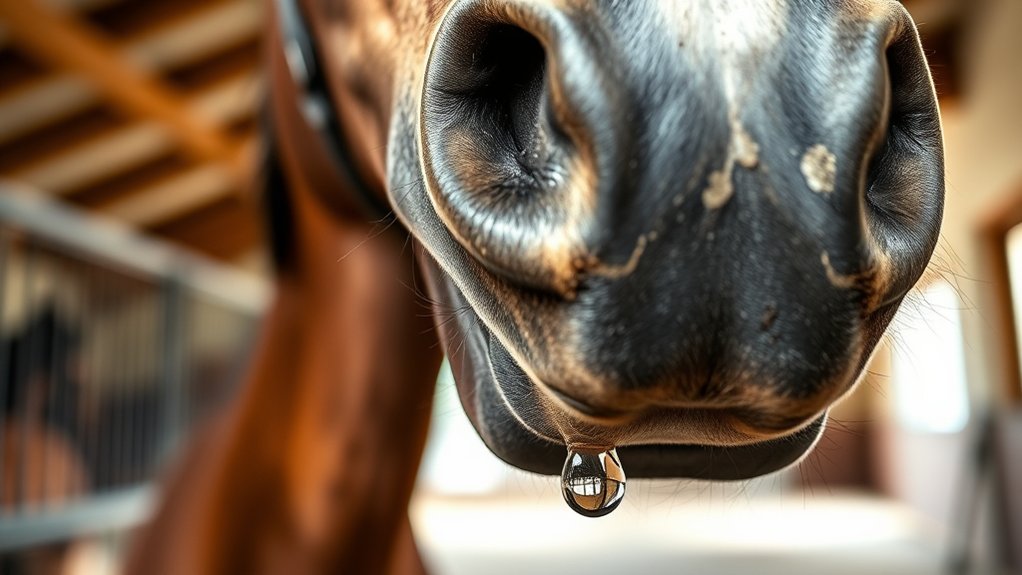
Because horses use clacking as a form of communication, you can learn a lot about their emotional state by paying attention to this behavior. Clacking often signals stress or discomfort, as horses may clack their teeth to self-soothe.
Horses use clacking to communicate emotions, often indicating stress or self-soothing behavior.
In contrast, clacking can also express excitement or anticipation, especially during play or active moments.
Calm horses rarely clack, instead showing relaxed behaviors like soft eyes and loose posture.
By observing clacking frequency and intensity alongside body language, you can better interpret whether a horse feels stressed, excited, or calm.
- Rapid clacking may indicate rising stress or agitation
- Gentle, infrequent clacking can signal mild excitement
- Absence of clacking often accompanies calm, relaxed states
- Changes in clacking patterns help you assess emotional shifts accurately
What Clacking Means in Horse Social Interactions
When horses engage in social interactions, clacking serves as a subtle yet important form of communication. You’ll notice horses clack their jaws or grind teeth to signal contentment or reassurance during bonding or grooming. This behavior also helps diffuse tension or indicate submission within a herd.
The intensity and frequency of clacking vary with the horse’s emotional state and social context, providing you with clues about their mood and intentions.
| Clacking Meaning | Social Context |
|---|---|
| Contentment | Grooming sessions |
| Reassurance | Close social bonds |
| Submission | Hierarchy signals |
| Tension diffusion | Herd interactions |
| Mild excitement | Playful encounters |
Understanding these signals enhances your insight into horse communication.
How Young Horses Use Clacking to Communicate
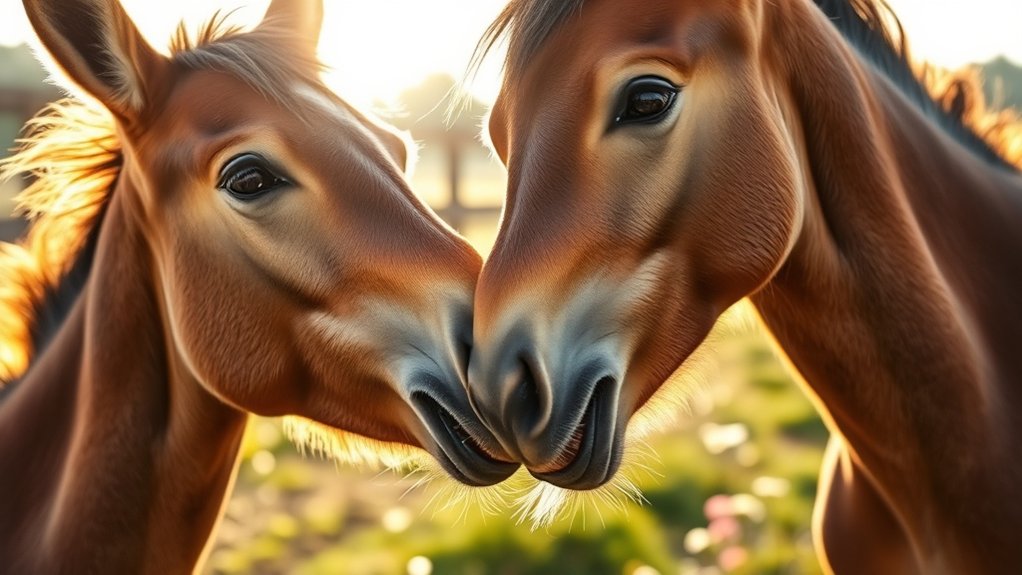
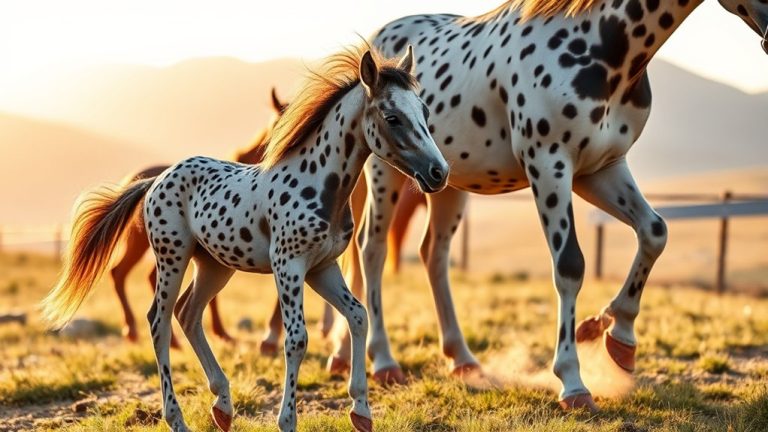
You’ll often notice young horses producing a distinct clacking sound by clicking their teeth together, which plays a crucial role in their early social communication. This behavior acts as a gentle, reassuring signal during interactions, helping a young horse navigate social bonding within the herd.
Clacking often emerges during play or when a foal shows submission or respect, reinforcing positive social connections. It also mimics maternal behaviors, offering comfort and strengthening communication with other horses.
Clacking during play or submission deepens bonds, mirrors maternal care, and enhances communication among young horses.
A young horse’s clacking invites trust and acceptance. This soft sound reduces tension during new encounters. It fosters emotional bonds critical for herd cohesion. You witness a silent language of respect and reassurance.
Through clacking, young horses develop essential social skills vital for their survival and well-being.
Can Clacking Indicate Stress or Discomfort?
You might notice horses clacking their teeth or jaw when they’re feeling stressed or uncomfortable. This is especially true if their body language looks tense.
These little mouth movements can actually be a sign of anxiety, pain, or even dental problems that need checking out. So, it’s a good idea to pay close attention to the situation and other behaviors.
That way, you can tell the difference between normal clacking and signs that your horse might be in distress.
Signs Of Stress
Although clacking may sometimes seem like a benign or curious behavior, it can signal stress or discomfort in horses, especially if paired with other indicators such as pinned ears or tail swishing.
When you notice clacking alongside these signs, it often means the horse is experiencing anxiety, pain, or feeling threatened.
Persistent clacking can be a clear warning that your horse feels overwhelmed or uneasy. Sometimes, clacking acts as a self-soothing mechanism during unfamiliar or stressful situations.
To accurately interpret clacking, you should observe the context and accompanying behaviors.
Look out for these signs of stress:
- Pinned ears signaling agitation
- Rapid tail swishing indicating irritation
- Tense body posture showing discomfort
- Repetitive clacking as a coping behavior
Recognizing these helps you address your horse’s needs promptly.
Mouth Movements And Discomfort
When horses clack their teeth or jaws, it often signals underlying stress or discomfort that you shouldn’t ignore. These mouth movements can indicate gastrointestinal issues, dental problems, or oral irritation, all of which cause discomfort.
You might notice increased teeth clacking when a horse feels anxious in new environments or stressful situations. Moreover, tension from improper handling or ill-fitting equipment can lead to persistent clacking.
Observing these behaviors helps you identify when a horse is uneasy or frustrated. If teeth clacking becomes frequent or ongoing, it’s vital to monitor the horse closely and seek veterinary evaluation.
Addressing the root cause of discomfort ensures the horse’s well-being and prevents further health complications linked to oral or systemic issues.
When Clacking May Be Misleading or Misinterpreted
Because horses often produce clacking sounds by rapidly clicking their teeth together as a response to stress, discomfort, or agitation, this behavior can easily be misread as aggression or stubbornness. You might misinterpret clacking as a dominant gesture, while it actually signals anxiety or pain. Without understanding the context, you risk misreading this behavior, which could lead to inappropriate reactions.
Horses’ teeth clacking often signals anxiety or pain, not aggression or dominance.
Consider these points to avoid misinterpretation:
- Clacking may signal discomfort, not defiance.
- It often accompanies nervousness or pain, not playfulness.
- Observers unfamiliar with this behavior might mistake it for a challenge.
- Body language and environment provide essential context to interpret clacking correctly.
Recognizing stress-related clacking helps you respond with empathy rather than misunderstanding.
How to Respond Safely to Clacking
If you notice a horse clacking, stay calm and avoid sudden movements to prevent escalating its behavior or causing fear.
Clacking can indicate curiosity, reassurance, or mild agitation, so you should respond safely by maintaining a relaxed posture and using gentle verbal cues or body language.
If clacking signals discomfort or warning, give the horse space and assess potential stressors or health concerns.
Understanding these nuances in horse behavior helps you respond appropriately and safely.
How to Interpret Clacking With Other Horse Signals
Although clacking alone provides valuable insight into a horse’s emotional state, you need to interpret it alongside other signals like ear position, body posture, and mouth movements to accurately gauge the horse’s intentions.
Clacking is a subtle social signal often paired with behaviors such as licking or nibbling, indicating reassurance or submission rather than aggression.
By observing a horse’s body language and accompanying social signals, you can distinguish between calm contentment and potential discomfort.
For example, relaxed ears and soft eye expressions combined with clacking suggest trust and bonding.
Ears pinned back with clacking may signal irritation, not submission.
Neck stretching with clacking often indicates curiosity or engagement.
Mouth mouthing combined with clacking can reflect calming or respect.
Eye winking paired with clacking may show relaxed social interaction.
Understanding these patterns sharpens your interpretation of horse communication.
Frequently Asked Questions
Can Clacking Cause Dental Problems in Horses?
Yes, clacking can contribute to dental problems in horses. When your horse clacks its teeth frequently, it often indicates oral discomfort, which can worsen if ignored.
This repetitive action may cause uneven dental wear and make jaw alignment issues worse. Over time, the abnormal pressure and movement can damage teeth or gums.
You should monitor clacking closely and consult an equine dentist to prevent serious dental complications.
Do Different Horse Breeds Clack Differently?
Like a symphony with varied instruments, different horse breeds clack differently due to breed-specific behaviors and vocalization patterns.
You’ll notice draft horses produce deeper, forceful clacks because of stronger jaw muscles, while Arabians clack more frequently, reflecting their social nature.
These variations stem from evolutionary adaptations shaped by environment and temperament.
Understanding these subtle differences helps you appreciate how each breed communicates uniquely through clacking.
Is Clacking More Common in Domesticated or Wild Horses?
You’ll find clacking is more common in domesticated horse behavior than in wild horse communication. Domesticated horses often use clacking as a social or submissive signal within managed herds. This is influenced by selective breeding and human interaction.
In contrast, wild horses rely on a wider range of natural horse sounds and body language to communicate in open environments. This makes clacking less prominent or necessary for their social interactions.
Can Clacking Be Trained or Modified by Handlers?
Sure, you can totally train a horse to stop clacking, just like convincing a cat to fetch.
In reality, effective training techniques and behavioral modification rely heavily on your rider influence.
By applying consistent cues and positive reinforcement, you shape your horse’s responses, gradually reducing clacking.
Patience is essential because this behavior often serves social or calming purposes.
Understanding triggers helps you tailor your approach for successful modification without causing stress.
Does Clacking Occur During Feeding or Only Social Situations?
You’ll notice horses’ vocalizations like clacking occur in both feeding behaviors and social interactions, but they’re more common and deliberate during social contexts.
When feeding, clacking can happen, especially if a horse is excited or anticipating food, but it’s less frequent and less expressive.
In social settings, clacking serves as a clearer communication cue, helping horses establish hierarchy or bond, making it primarily a social rather than feeding behavior.
Conclusion
When you notice a horse clacking, think of it as its way of “speaking” through subtle signals. Clacking isn’t just noise. It reveals emotions like stress, excitement, or calmness, and plays a crucial role in social interactions.
However, don’t jump to conclusions; context matters. By observing clacking alongside other behaviors, you’ll decode what your horse truly communicates. This helps you respond safely and appropriately to its needs.